Edvard Munch
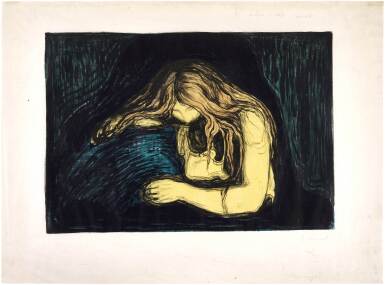
Vampire II (Schiefler 34; Woll 41)
Lot Closed
March 15, 03:44 PM GMT
Estimate
120,000 - 180,000 GBP
Lot Details
Description
Edvard Munch
1863 - 1944
Vampire II (Schiefler 34; Woll 41)
Lithograph printed in black and orange over woodcut printed in green, blue and ochre, 1895-1902, signed in pencil, Woll's variation six (of ten), on tissue-thin Japan paper, framed
image: 381 by 554mm 15 by 21¾in
sheet: 545 by 734mm 21½ by 28⅞in
This astounding composition was originally titled Love and Pain and depicts the entrancing embrace of a man and woman, encircled by a cascade of blush orange hair that wraps and tangles its way across the couple. In response to Munch’s oil on canvas portrayal of the Vampire in 1894, Polish author Stanisław Przybyszewski construes his own mythic interpretation by proclaiming he perceives:
‘A broken man, and the face of a biting vampire on his neck…There is something terribly calm and passionless in this picture; an immeasurable, fatal quality of resignation. The man there rolls and rolls into abysmal depths, without will, powerless…Yet he cannot rid himself of the vampire, cannot rid himself of the pain, and the woman will always sit there, biting forever with a thousand adders’ tongues, with a thousand poison fangs.’ [1]
Such divergent explanations of the composition easily capture the duality of Vampire, motioning the viewer through such conflicting themes – of lust and angst, power and pleasure – that emanate from Munch’s famous image.
Munch is noted for his experimentation and innovation when creating new impressions. According to Schiefler, the first multi-coloured prints were made at the turn of the century and saw Munch able to emphasize key components of his subjects such as the darkness of the vampire’s shadow or her light auburn hair.[2] Through a combination of both lithographic and woodcut processes, each impression holds a unique and exquisite importance. This impression is printed on tissue-thin Japan, which enhances a gothic brightness to the image and differs from other examples of this subject. The richness of this inking champions the crucial features of the scene, allowing the tumultuous embrace to truly express the tragic musings of love and pain.
[1] Stanislaw Przybyszewski (ed.), Das Werk des Edvard Munch. Vier Beiträge von Stanislaw Przybyszewski, Dr. Franz Servaes, Willy Pastor, Julius Meier-Graefe, Berlin 1894, pp. 19f.
[2] Edited by Klaus Albrecht Schröder and Antonia Hoerschelmann. Edvard Munch: Theme and Variation. Albertine, Hatje Cantz Publishers. 2003. Page 194.
You May Also Like