Property restituted to the Heirs of Ernst and Agathe Saulmann
Workshop of Defendente Ferrari
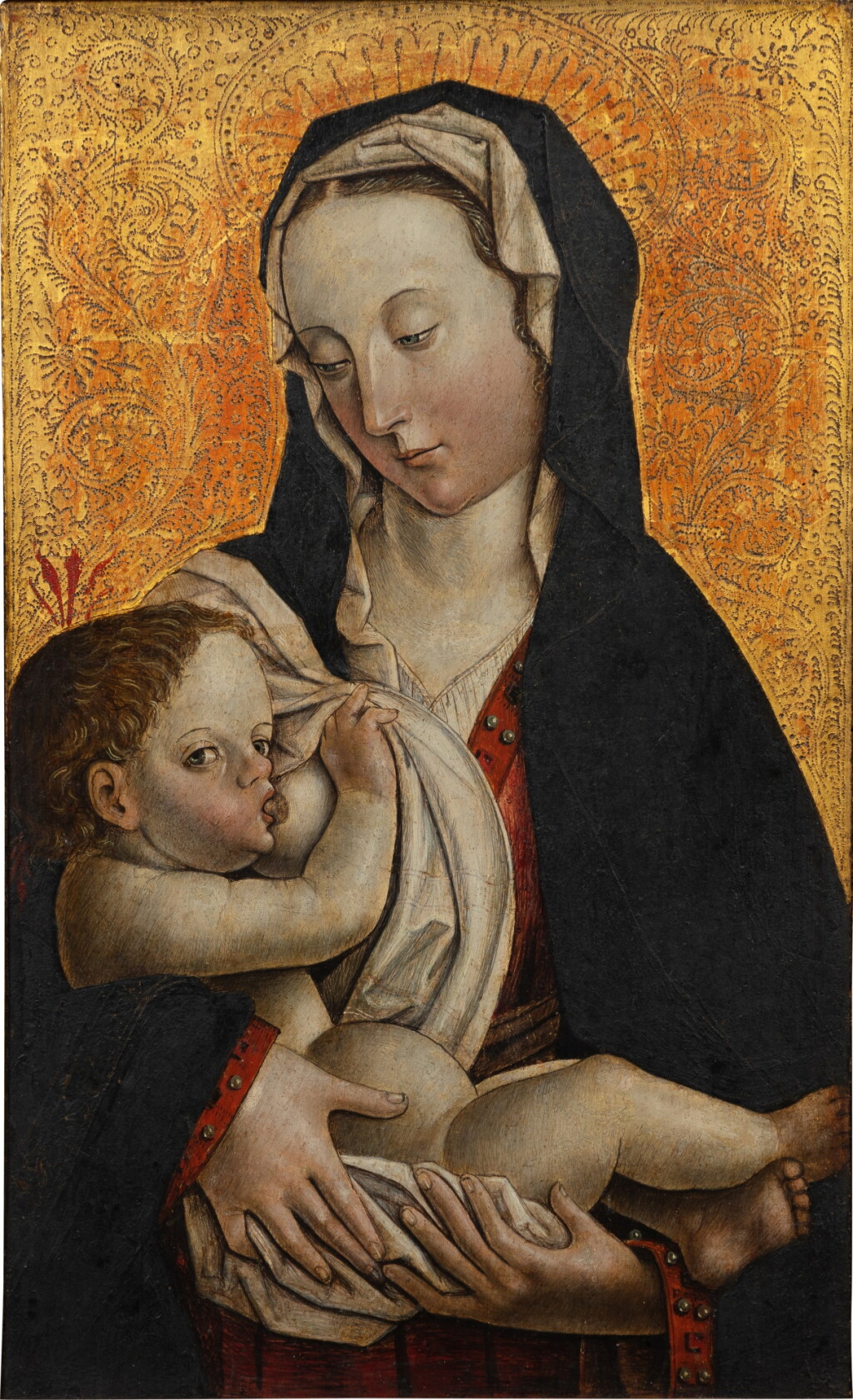
The Virgin suckling the infant Christ
Auction Closed
July 6, 10:53 AM GMT
Estimate
35,000 - 50,000 GBP
Lot Details
Description
Property restituted to the Heirs of Ernst and Agathe Saulmann
Workshop of Defendente Ferrari
active in Piedmont 1510–1535
The Virgin suckling the infant Christ
tempera on panel, gold ground
unframed: 47.8 x 29 cm.; 18⅞ x 11⅜ in.
framed: 55.6 x 34.8 cm.; 21⅞ x 13¾ in.
Heinrich Freiherr von Tucher (1853–1925), Vienna, by 1908;
His posthumous sale, Berlin, Cassirer and Helbing, 8 December 1925, lot 64 (as Paduan School, 15th century), for 5,000 Reichsmark;
Where acquired by Agathe (1898–1951) and Ernst Saulmann (1881–1946), Erlenhof, Baden-Württemberg, Florence and possibly Nice, until 1932 and most likely until at least October 1938 (recorded in a photograph in the Kunsthistorisches Institut, Florence, no. 50549);
With Walter Bornheim (1888–1971), Paris and Munich, by 1941;
From whom acquired by Oscar Robert Henschel (1899–1982), in 1941;
By whom gifted to Hermann Göring (1893–1946), Berlin (inv. no. RM1165), on 12 January 1942;
Deposited by the owner in Berchtesgaden (inv. no. 2105);
Transferred to the Central Collecting Point, Munich (inv. no. 7155), on 6 August 1945;
Repatriated to the French state on 25 September 1947;
Transferred to the Musée du Louvre, Paris (inv. no. MNR 253), by the Office des Biens et Intérêts Privés in 1950; then to the Château de Compiègne, Compiègne in July 1950; and finally to the Musée De Picardie, Amiens, in 1953 until 2023;
Restituted to the heirs of Ernst and Agathe Saulmann on 18 April 2023.
Compiègne, Château de Compiègne, Œuvres d'art récupérées en Allemagne, July 1950 – 21 May 1953.
F. Wickhoff, 'Die Sammlung Tucher', in Münchner Jahrbuch der bildenden Kunst, 1908, I, pp. 23–25, reproduced fig. 8 (as Defendente Ferrari);
'Versteigerung der Sammlung Tucher', in Kunst und Künstler, 1926, 24, 5, p. 199 (as Paduan School);
B.Berenson, Italian Pictures of the Renaissance. Central Italian and North Italian Schools, London 1968, vol. I , p. 106 (as studio of Defendente Ferrari);
O. Pujmanová (T. Gottheinerová transl.), 'Italian Primitives in Czechoslovak Collections', in The Burlington Magazine, August 1977, 893, p. 547 n. 43 (as a copy after the version in the Museo Civico d'Arte Antica, Turin);
M. Natale, Peintures Italiennes du XIVe au XVIIIe siècle, Geneva 1979, p. 147 n. 8 (as Paduan School / copy after the version in the Museo Civico d'Arte Antica, Turin);
A. Brejon de Lavergnée and D. Thiébaut, Catalogue sommaire illustré des peintures du Musée du Louvre, II: Italie, Espagne, Allemagne, Grande-Bretagne et divers, Paris 1981, vol. II, p. 303, no. M.N.R. 253 (as Paduan 15th century);
P. Matthieu, Couleurs d'Italie, couleurs du Nord: Peintures étrangères des musées d'Amiens, Paris 2001, p. 258, reproduced in colour (as after Defendente Ferrari, dated circa 1530);
C. Lesné and A. Roquebert, Catalogue des peintures MNR, Paris 2004, p. 616, no. MNR 253, reproduced (as Paduan 15th century / Defendente Ferrari);
N.H. Yeide, Beyond the Dreams of Avarice: The Hermann Goering Collection, Dallas 2009, pp. 169 and 380, no. A1179, reproduced (as Paduan 15th century / Defendente Ferrari);
J.-M. Dreyfus, Le Catalogue Goering, Paris 2015, pp. 510–11, no. RM1165/F643, reproduced (as Paduan master, first half of the 15th century);
M. Dulou, Évoquer les restitutions des œuvres d'art spoliées durant la Seconde Guerre mondiale: un discours tardif des expositions en France en faveur des ayants droit, MA thesis, Université Bordeaux-Montaigne, Bordeaux 2018.
Throughout its history, this well preserved Madonna Lactans has mainly been associated with the Piedmontese Renaissance painter Defendente Ferrari. Born in Chivasso, near Turin, he trained with Giovanni Martino Spanzotti (1455 or 1456–1526/28) developing a highly individual style marked by northern European late Gothic influences. A prolific painter, he ran a large and successful workshop, from which this painting is likely to have originated. Imbued with the painter's sophisticated refinement, its composition closely relates to a painting by the artist of nearly identical dimensions in the Museo Civico d'Arte Antica, Turin.1 Moreover, this subject was adopted and developed by the artist in a variety of iterations, attesting to its widespread success amongst patrons.2
When this work was sold nearly a century ago, the attribution 'Paduan School, 15th century' was proposed by historian Otto von Falke, with the support of Wilhelm von Bode. Since then, it has recurred sporadically in various publications without ever being substantiated. Stemming perhaps from a generic resemblance to Carlo Crivelli (c.1430–1495), this attribution does not hold up to scrutiny and has been superseded.
The Tucher Collection
While early history of this work remain to be discovered, it is first recorded in the collection of the Bavarian ambassador in Italy, Heinrich Freiherr von Tucher (1853–1925). The bulk of his collection, including this panel, was sold after his death in 1925 and included items ranging from Renaissance furniture, oriental carpets, textiles and an impressive collection of early Italian pictures and sculptures. These would have decorated his residence, first in the apartments assigned to the Bavarian legation in Palazzo Borghese, Rome, then in the Palais Mollard-Clar, Vienna and later in the Tucher Castle, Nuremberg. Following its sale in 1925, this panel entered the collection of Agathe (1898–1951) and Ernst Saulmann (1881–1946).
1 Inv. no. 227; tempera on board; 45 x 32 cm.; reproduced in L. Mallé, I Dipinti del Museo d'Arte Antica, Turin 1963, p. 66, reproduced plate 43.
2 For a discussion about the different versions of the The Virgin suckling the infant Christ see Pujmanová 1977, pp. 544–47.
You May Also Like