Attributed to Hyacinthe Rigaud
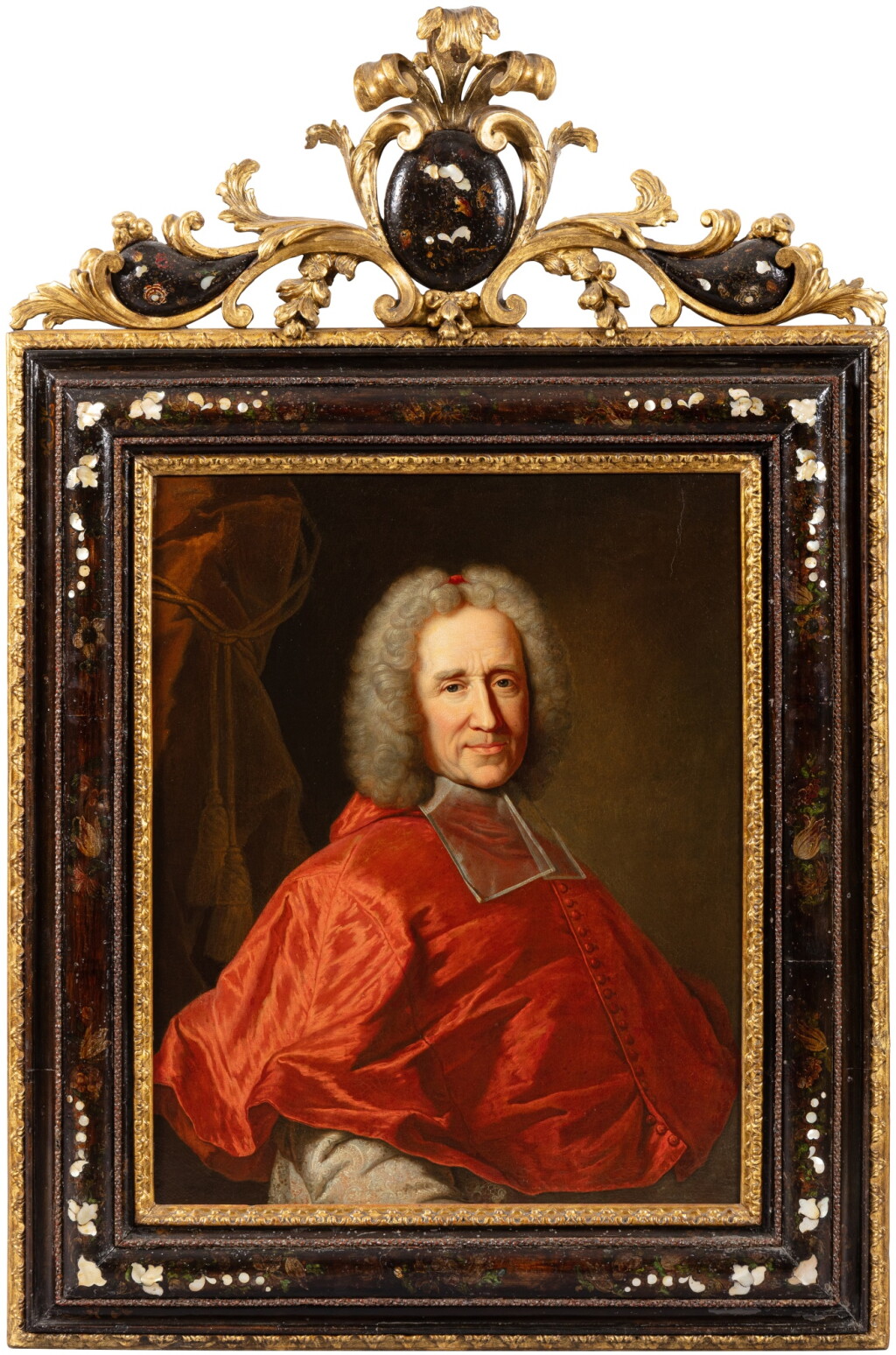
Portrait of Cardinal Guillaume Dubois, Archbishop of Cambrai and Secretary of State for Foreign Affairs
Estimate
12,000 - 18,000 EUR
Lot Details
Description
Attributed to Hyacinthe Rigaud
Perpignan 1659 - 1743 Paris
Portrait of Cardinal Guillaume Dubois, Archbishop of Cambrai and Secretary of State for Foreign Affairs
Oil on canvas
81,1 x 64,8 cm ; 31⅞ by 25½ in.
Anonymous sale, Hampel, Munich, 14 December 2011, lot 297;
Where acquired.
S. Perreau, Hyacinthe Rigaud: catalogue concis de l'œuvre, 2013, cat. no. P. 1309-2 (as Follower of Rigaud);
A. James-Sarazin, Hyacinthe Rigaud 1659-1743. Catalogue raisonné, Dijon 2016, vol. II, p. 474, under cat. no. P. 1390 (as a replica, possibly corresponding to one of the replicas recorded in the account books).
Born in Brive-la-Gaillarde in 1656, Guillaume Dubois became tutor to the Duke of Chartres, the future Regent, with whom he remained closely associated. A cardinal, he also held the positions of Councillor of State, Minister of Foreign Affairs and, ultimately, Chief Minister.
In the original portrait, now in the Cleveland Museum of Art (oil on canvas, 146.7 x 113.7 cm, inv. 1967.17), the cardinal is depicted at his desk, surrounded by legal and biblical works. Dated 1723, the painting is recorded in the artist’s account books alongside two replicas, one commissioned by the sitter’s nephew, Jean-Baptiste Dubois, canon of Saint-Honoré, and the other by Lukas Schaub, an English politician at the French court. Ariane James-Sarazin, in her catalogue raisonné of the artist’s work (op. cit., p. 474), suggests that our replica may perhaps be identified with one of these two versions, its composition being more tightly focused on the ecclesiastic’s serious yet smiling face.
You May Also Like