Property from the Theiline Scheumann Collection
Jacob Isaacksz. van Ruisdael
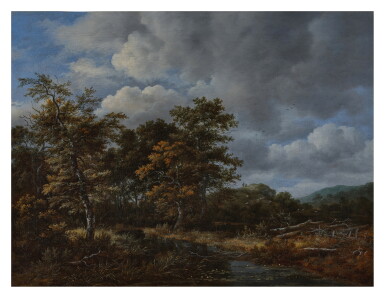
A wooded landscape with a stream and a group of trees
Auction Closed
July 5, 07:17 PM GMT
Estimate
300,000 - 500,000 GBP
Lot Details
Description
Property from the Theiline Scheumann Collection
Jacob Isaacksz. van Ruisdael
Haarlem 1628/9–1682 Amsterdam
A wooded landscape with a stream and a group of trees
signed lower right: JvRuisdael (JvR in compendium)
oil on canvas
43.5 x 56.5 cm.; 17⅛ x 22¼ in.
Martin Bromberg (1850–1915), Hamburg, by 1913;
With L. Douglas, London (possibly Robert Langton Douglas (1864–1951)), by 1926;
Otto von Held, Berlin;
His sale, Berlin, Paul Cassirer, 5 December 1929, lot 44;
With Jacques Goudstikker, Amsterdam, and Galerie Sanct Lucas, Vienna, acquired at the above sale in half shares (Jacques Goudstikker, stock no. 2441, as 'Boschlandschap');*
With Galerie Sanct Lucas, Vienna (full ownership from June 1941);
From whom acquired by Otto Naumann, Ltd., New York, 1992;
From whom acquired by Theiline Scheumann.
*Please note that Jacques Goudstikker’s share of this painting was restituted to his heir in 2023.
Brussels, Exposition Universelle et Internationale, 24 May – 13 October 1935, no. 764;
Amsterdam, Amsterdams Historisch Museum, 4th C.I.N.O.A. Exhibition, 27 March – 31 May 1970, no. 48.
J. Rosenberg, Jacob van Ruisdael, Berlin 1928, p. 93, no. 337a;
S. Slive, Jacob van Ruisdael: A Complete Catalogue of His Paintings, Drawings, and Etchings, New Haven and London 2001, p. 279, no. 358, reproduced (as datable to the first half of the 1650s).
Jacob van Ruisdael is generally considered the greatest Dutch landscape painter of the seventeenth century and was without question the most versatile. His remarkably varied œuvre included winter scenes, waterfalls, cityscapes, dunes, panoramas and coastal marines. From early in his career Ruisdael had consistently explored the compositional possibilities of forests and the watery margins of woodland, and during the 1650s this subject seems to have acquired an increasing importance for him. In this late summer scene, which Seymour Slive dates to early in this important decade, the great birches and oak trees, the foliage of which has just begun to turn a russet brown, stand in quiet contrast to dramatic masses of moving cloud behind them. Their forms are reflected in the still waters of the marshy stream which runs at their feet. As always with Ruisdael, human activity is discreetly present, denoted here by the diminutive figures of two shepherds, who are silhouetted on top of the low hills where their flock grazes in the right distance. Broken tree trunks lie scattered close to the edge of the stream.
Although Ruisdael frequently explored the dramatic nature and noble character of forests (and even individual trees) at this date, such as in his well-known canvas of The edge of a forest with a grainfield from the middle of the decade, now at Worcester College in Oxford,1 in other works such as this he seems to have concentrated upon a more peaceful, almost meditative contemplation of nature. Other works in this vein which probably date from this same period or a little later, are The edge of a wood near a cornfield in an American private collection, probably from the later 1650s, and the Woodland ford of around 1660 in the Krannert Museum at the University of Illinois, in both of which a massed woodland structure is similarly balanced by a more open vista to the right.2
1 Slive 2001, p. 299, no. 394, reproduced in colour.
2 Slive 2001, pp. 322–23, nos 431 and 432, both reproduced.
You May Also Like