Property from a Private Collection
Jan van de Capelle
A calm sea
Auction Closed
July 5, 07:17 PM GMT
Estimate
800,000 - 1,200,000 GBP
Lot Details
Description
Property from a Private Collection
Jan van de Capelle
Amsterdam 1626–1679
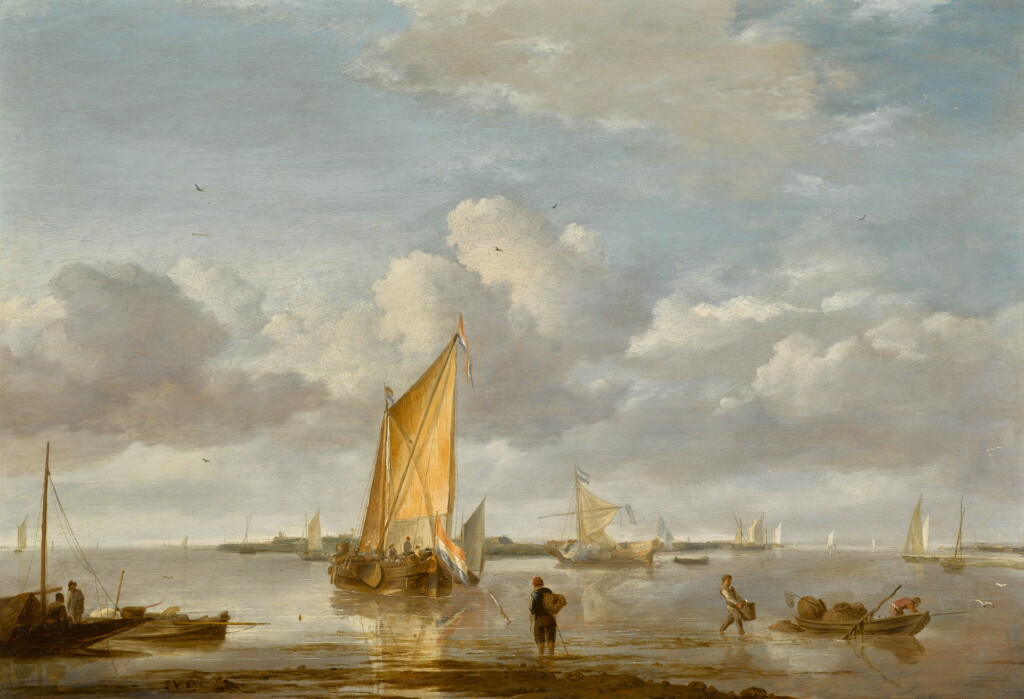
A calm sea
signed with monogram lower left: IVC
oil on oak panel
45.5 x 65.6 cm.; 17¾ x 25¾ in.
His sale, London, Christie's, 6 July 1923, lot 50, where bought back by the owner;
His daughter, Ida (1879–1961), who married Prince Natale Teodato Labia, Wynberg, Cape Town, South Africa;
Their son Count Natale Labia (1924–2016), Wynberg, Cape Town, South Africa;
By whom sold ('The Robinson Collection'), London, Sotheby's, 6 December 1989, lot 102, for £770,000;
Anonymous sale ('The Property of a Gentleman'), London, Sotheby's, 9 July 1998, lot 8;
Private collection, Europe;
Whence sold, London, Sotheby’s, 5 December 2018, lot 15 (for £2,050,000), where acquired by the present collector.
Cape Town, National Gallery of South Africa, The Joseph Robinson Collection, 1959, no. 30;
Zurich, Kunsthaus, Sammlung Sir Joseph Robinson 1840–1929, 1962, no. 21;
Cape Town, National Gallery of South Africa, 1962–77, on loan;
Birmingham, Museum and Art Gallery, 1977–81, on loan;
London, Wildenstein, Twenty Masterpieces from the Natale Labia Collection, 1978, no. 4
Cardiff, National Museum of Wales, 1981–88, on loan;
Boston, Museum of Fine Arts, 1988–89, on loan.
M. Russell, Jan van de Cappelle 1624/6–1679, Leigh-on-Sea 1975, p. 89, no. 6, reproduced pl. 90.
This magisterial evocation of a sunny and nearly windless day in Dutch inshore waters is a superb example of the type of subject that made Jan van de Capelle one of the most important marine painters of the seventeenth century. It is painted with a particular brightness and clarity and sense of atmosphere, capturing the view from the water’s edge of coastal shallows near the Dutch coast. In the foreground fishermen are unloading a small boat, while just beyond them in the centre of the composition we see a smalschip with its sails unfurled but barely filling. Further out is a States Yacht firing a salute, with a low fortified island beyond. The scene depicted is likely to be imaginary but is typical of the sheltered waters of the Zuider Zee or among the islands of Zeeland.
It has often been supposed that works by Van de Capelle on panels such as this tend to date from before 1650, while his works on canvas were mostly painted after this date.1 While there are exceptions to this view, a dating to the late 1640s or around 1650 for the present panel can be supported on compositional grounds. At this date Van de Capelle tended to concentrate his vessels in the centre of the composition, leaving open vistas to either side, as is clearly the case here. In this his style diverges from that of the painter who most influenced his early work, Simon de Vlieger (1610–1653), who, as Russell noted ‘…in similar compositions prefers to leave the central portion of the picture empty’.2 Nevertheless around 1650 and a little later Van de Capelle increasingly began to experiment with his palette, seeking to refine his atmospheric effects by slowly moving away from the cooler silver grey tones and influence of de Vlieger in the 1640s towards a warmer golden tonality and broader and more painterly brushwork. Other very comparable coastal scenes from this same period which can be directly compared to the ex-Robinson painting include the Ships in a calm in the Los Angeles County Museum of Art, Edward William Carter Collection, which is thought to date from the early 1650s,3 and the River view with boats of 1651 in the Kunsthaus in Zurich.4 All these paintings are distinguished by what Wolfgang Stechow described as Cappelle’s ‘luminous tonality’, and reflect his emphasis at this date on simpler and less crowded compositions, quieter skies and elements of the shore in the foreground.5 In the present picture, as always with Capelle, it is the sky – which here takes up at least three-quarters of the composition – which remains the keynote that underpins the painting’s tranquil and light-filled mood. It is perfectly complemented here by his remarkable ability to convey the effects of the reflections of the colours and details of the ships in the rippling waters of the shallows and beyond.
Remarkable as it may seem, there is no evidence to suggest that Jan van de Capelle ever received any formal training as a painter. Van de Cappelle was born into a wealthy family and was sufficiently affluent not to have to paint for a living, and indeed he referred to his painting as a liefhebberij or hobby. In a quatrain written for the Album Amicorum of the humanist Jacob Heyblocq in 1654, his fellow painter Gerbrand van den Eeckhout (1621–1674) praised ‘…the art of Johannes van de Cappelle, learned by himself for his own pleasure’. Though he was not certainly his pupil, his early works were clearly influenced by the marines of Simon de Vlieger (1601–1653), who maintained a residence in Amsterdam, and whose work he copied. Cappelle's admiration for his work may be gauged by the fact that he later owned nine paintings and no less than 1,300 drawings by him in his own highly distinguished collection.6
Note on Provenance
The first recorded owner of this painting, the South African magnate Sir Joseph Robinson Bt (1840–1929) was born in the Eastern Cape. A self-made man, he made his fortune in diamond and gold-mining. A contemporary of another great Randlord collector, Alfred Beit, he had settled in London by the mid-1890s, taking out a lease in 1894 on Dudley House on Park Lane, with its magnificent eighty-foot long picture gallery. With the help of his advisors, the dealers Sir George Donaldson (1845–1925) and Charles Davis (1849–1914), he set about amassing a highly important collection of around 170 Old Master and British paintings, many purchased during the period 1894–99. These included superlative Italian works, notably the Tornabuoni–Albizzi spalliera panels of the Departure of the Argonauts and the Argonauts in Colchis bought from the Ashburnham Collection, and Giambattista Tiepolo’s superb Madonna of the Rosary. From the same source came his fine late Murillo of The Vision of Saint Francis Paola. Dutch and Flemish paintings formed the core of the collection and included Van Dyck’s Portrait of Elizabeth, Lady Herbert, and those of Jacob de Witte and his wife Maria; a fine Family group by Gonzales Cocques; outstanding genre scenes by Eglon Hendrick van der Neer and Jacob Ochtervelt; and a Portrait of a gentleman by Frans Hals. Major British paintings included works by Gainsborough, Constable’s oil sketch for The opening of Waterloo Bridge, now in Anglesey Abbey, and Turner’s Falls of the Clyde, now in the Lady Lever Art Gallery, Port Sunlight. After 1900 the pace of Robinson’s collecting slowed, but fine French eighteenth-century works were bought for the reception rooms at Dudley House. Created a Baronet in 1908, Robinson returned to South Africa in 1910, where he spent the duration of the First World War, while the contents of Dudley House were put into storage. From these a selection of 116 works was put up for sale at Christie’s in July 1923. However, Robinson, who was by then nearly eighty, was struck on the eve of the auction by an apparent attack of vendor’s remorse. Too late to be able to withdraw the pictures, he placed instead prohibitive reserves on the collection succeeding in retaining all but twelve works. In 1958, eighty-four works, including the present painting, were exhibited at the Royal Academy in London and the following year at the National Gallery of South Africa in Cape Town. It is not known, however, when and from what source the present Van de Cappelle was acquired.
1 See, for instance, Russell 1975 pp. 20–21.
2 Russell 1975, p. 28.
3 Exhibited, Los Angeles, County Museum of Art, Mirror of Nature. Dutch Paintings from the collection of Mr. and Mrs. Edward William Carter, 1992–93, no. 7.
4 Russell 1975, p. 64, no. 21, reproduced pl. 10.
5 W. Stechow, Dutch landscape painting of the seventeenth century, London 1966, pp. 106–7.
6 At his death Van de Cappelle owned some two hundred paintings and approximately six thousand drawings, including works by Rembrandt, Hendrick Avercamp, Jan Porcellis and Hercules Seghers.
You May Also Like