Master L. Cz.
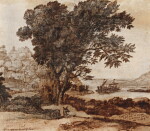
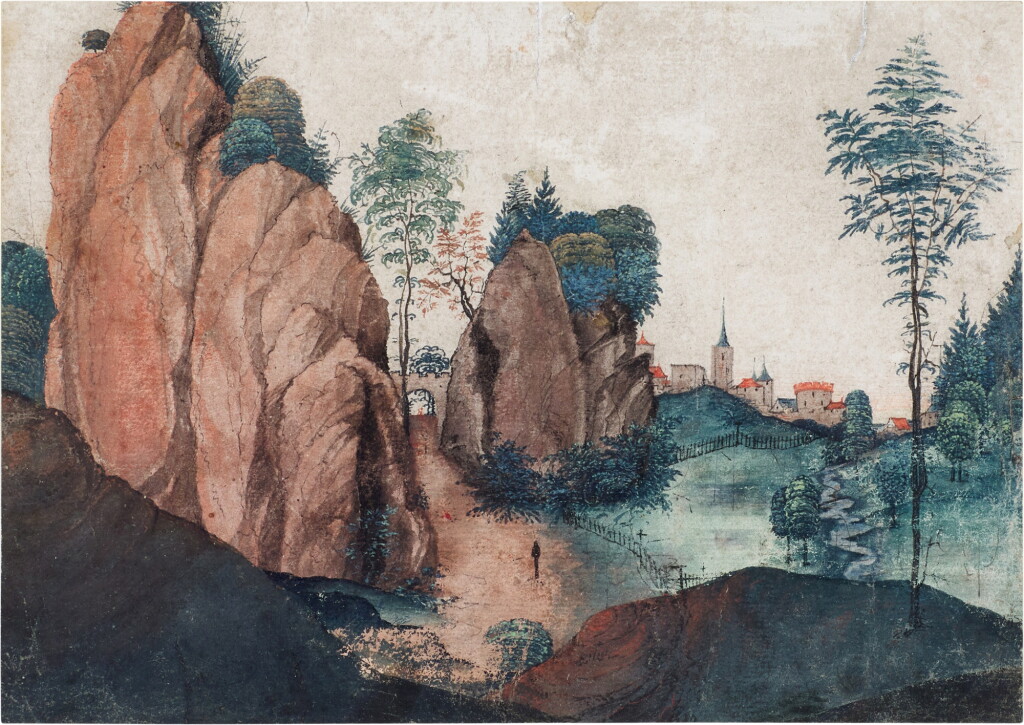
Road through a rugged landscape, a town behind
Auction Closed
January 25, 04:44 PM GMT
Estimate
60,000 - 80,000 USD
Lot Details
Description
Attributed to Master L. Cz.
Active circa 1480 - 1505
Road through a rugged landscape, a town behind
Watercolor and gouache
143 by 204 mm; 5 ⅝ by 8 in.
This poetic depiction of a lone traveller on a road leading between towering rocks, towards a distant town, seems to be an extremely rare example of a fully fledged German landscape watercolor contemporaneous with, or perhaps even predating, Dürer's pioneering works of that type, which he began to make in around 1494. Though these watercolors were unprecedented in their scale and naturalism, Dürer was none the less clearly looking to some extent at earlier German traditions in their creation: as Andrew Robison noted in the catalogue to the 2013 Washington exhibition of Dürer drawings from the Albertina, the woodcut townscapes made by Wolgemut and his workshop for the Nuremberg Chronicles, published in 1493, were frequently extensively hand-colored.1
Dr. Christof Metzger of the Albertina, Vienna, who has examined this drawing in the original, has kindly pointed out that the closest parallels to the landscape seen here, with its distinctive forms of buildings and trees, are to be found in the rare prints of the enigmatic Franconian printmaker known as the master L.Cz. (active circa 1480-1505). Only twelve engravings by his hand are extant, but their virtuosity establishes him as a talented artist whose work marks a stylistic transition between that of Martin Schongauer and Albrecht Dürer. Though the artist's real identity remains uncertain, he is most frequently thought to have been a Bamberg artist named Lorenz Katzheimer. His last two prints, The Entry into Jerusalem and The Temptation of Christ, executed around 1500, are both highly ambitious in scale and invention, and reveal a draughtsman and printmaker of considerable imagination and technical ability.
With the exception of the great group of landscape watercolors by Dürer, many of them now housed in the Albertina, extremely few works of this type have survived from the end of the 15th century, and the emergence of this previously unknown sheet is of some significance.
1. A. Robison and K.A. Schröder, Albrecht Dürer. Master Drawings, Watercolors, and Prints from the Albertina, exh. cat., Washington, D.C., National Gallery of Art, 2013, p.20
You May Also Like