
Jan Lievens
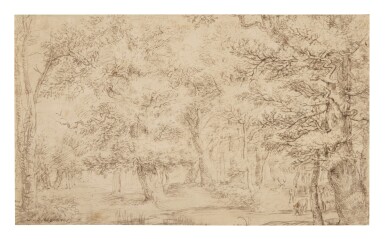
Densely wooded landscape with deer by a pond
Auction Closed
January 25, 04:44 PM GMT
Estimate
12,000 - 18,000 USD
Lot Details
Description
Jan Lievens
Leiden 1607 - 1674 Amsterdam
Densely wooded landscape with deer by a pond
Pen and brown ink;
bears old attribution in brown ink, lower left: J. Lievens
and a further old attribution in pencil, verso: J. Lievens
215 by 361 mm; 8½ by 14¼ in.
Private Collection, Connecticut;
with Kende Galleries, Inc., New York, by 1951;
Curtis O. Baer (1898-1976), New Rochelle and Atlanta (L.3366)
G. Rubinstein, in Jan Lievens. A Dutch Master Rediscovered, exh. cat., Washington/Milwaukee/Amsterdam 2008-9, p. 298, n.1 under cat. 139
Lievens was one of the most accomplished Dutch landscape draughtsmen of the 17th century. Though his early career was entwined with that of Rembrandt, the landscape drawings that he produced following his return to Amsterdam in 1644 have no obvious stylistic connection with those of his illustrious contemporary, despite the fact that the two artists were once again working side by side in the same city.
The landscape drawings of Lievens’ maturity, made between the mid 1640s and the end of his life, are hard to date with any precision, but several relatively coherent thematic and stylistic groupings can nonetheless be associated with different periods of his career. One of these, to which the present drawing belongs, consists of extremely densely worked, rather impenetrable wooded landscapes in which the artist’s characteristic combinations of hatchings and looping strokes almost take on a life of their own. Occasionally, as here, animals or shadowy figures of hunters emerge from the trees, but it is always the trees themselves, and the way they are drawn, that is the actual subject. There is also generally a slightly ominous mood. Though the deer that appear in this drawing and a few others, such as the fine sheet in Washington1, are shown at rest, one somehow feels that at any moment the peace may be shattered by a shot from the undergrowth, and the emergence of one of the hunters who appear in several other such compositions.
It seems reasonable to consider these late works, dating from the years around 1660.
1. Washington, National Gallery of Art, inv. 1978.19.5; exh. cat., op. cit., Washington et al., 2008-9, no. 139
You May Also Like


