
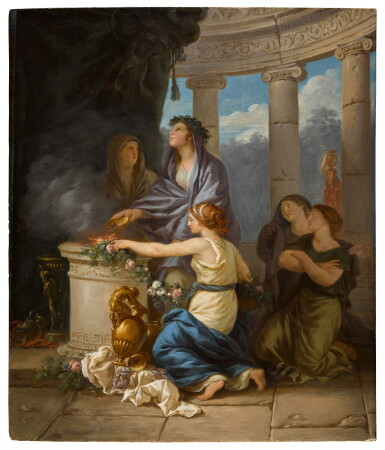
Jean-Jacques Lagrenée
Vestals making a sacrifice in the interior of a temple
Auction Closed
January 27, 09:38 PM GMT
Estimate
20,000 - 30,000 USD
Lot Details
Description
Jean-Jacques Lagrenée
Paris 1739 - 1821
Vestals making a sacrifice in the interior of a temple
signed on the step lower left: Lagrenee
oil on panel
panel: 16¼ by 13¾ in.; 41.3 by 34.9 cm.
framed: 22¼ by 18½ in.; 56.5 by 47 cm.
Her sale, London, Christies,11 June 1928, lot 28 (as Angelica Kauffman);
Private Collection, Switzerland.
M. Sandoz, "Jean-Jacques Lagrenée, peintre d’histoire (1739-1821)", in Bulletin de la Société de l’Histoire de l’art français, Paris 1962, pp. 121-132;
M. Sandoz, Les Lagrenée, II. Jean-Jacques Lagrenée (le jeune), 1739-1821, Tours 1988, pp. 204-205, cat. no. 76.
This recently rediscovered signed painting by Jean-Jacques Lagrenée was first exhibited at the Salon du Louvre in 1777 and was thought lost ever since.1 However, comparison with Gabriel de Saint Aubin's sketch in his copy of the Salon exhibition catalogue (fig. 1), and the given dimensions, there can be little doubt that this is the painting exhibited in 1777 by Lagrenée. The date of the exhibition furthermore provides a terminus ad quem for its execution.
Jean-Jacques Lagrenée was a pupil of his elder brother Louis-Jean-François (1725-1805), also a painter. He won second prize in the Prix de Rome in 1760 and was granted permission to stay at the Académie de France à Rome between 1763 and 1768. Having settled in Paris, Jean-Jacques was approved (agrée) by the Académie Royale in 1769 and received as a full member six years later in 1775, becoming adjoint à professeur in 1776 and professeur in 1781.
Jean-Jacques was an accomplished decorative painter, executing ceilings in the Galerie d'Apollon in the Louvre, and also receiving numerous religious commissions, such as the cycle for the royal chapel at Fontainebleau. He later experimented with painting on glass and porcelain, assuming the position of artistic director of the Manufacture de Sèvres from 1785 to 1800. Lagrenée's easel paintings are almost exclusively history pictures and, like his elder brother and Jean-Marie Vien, he was particularly attracted to subjects of ancient history. His style perfectly conforms to the French neoclassical aesthetic of the last quarter of the 18th century and this painting is no exception: the figures are shown in dramatic poses, their theatrical gestures carried out with measured restraint; and the classical architecture, with its elegant classical proportions, frames the scene perfectly, rather like a backdrop in a stage set.
1. In 1988, in his catalogue raisonné, Marc Sandoz writes about this painting: ‘Après le Salon le tableau ne paraît plus mentionné, et sa trace se perd. […] Localisat. : non connue’ [: following the Salon the panel doesn’t seem to be mentioned and the trail goes cold […] Location: Unknown]. He also highlights that ‘la critique contemporaine ne semble pas mentionner le tableau.’ [contemporary criticism doesn’t seem to mention the panel]. In his first study on Lagrenée in 1962, Sandoz mentions this reputedly lost work.
You May Also Like


