
Property from a Private Collection
Bernardo Bellotto
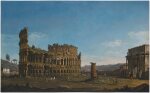
Rome, a view of the Colosseum and the Arch of Constantine
Auction Closed
May 25, 07:43 PM GMT
Estimate
700,000 - 900,000 USD
Lot Details
Description
Property from a Private Collection
Bernardo Bellotto
Venice 1722 - 1780 Warsaw
Rome, a view of the Colosseum and the Arch of Constantine
oil on canvas
canvas: 24 by 38 ⅝ in.; 61.0 by 98.1 cm.
framed: 33 ⅞ by 48 ⅜ in.; 86.0 by 124.1 cm.
Private collection, New England;
R. Birkedal, Seekonk, Massachusetts;
T. Gilbert Brouillette (1906-1970), Falmouth, Massachusetts;
Mme. Alicia Corchenuk de Buenfil, Mexico City;
With Steven Juvenis and Firestone & Parson, Massachusetts, by 1989;
Anonymous sale ("Property of a Gentleman"), London, Sotheby's, 4 July 1990, lot 19 (as Canaletto);
Where acquired by a private collector;
Anonymous sale ("Property of a European Collector"), London, Christie's, 7 July 2004, lot 98 (as Bellotto);
Private collection, by 2008
With Galleria Cesare Lampronti, London, by 2009 (as Bellotto);
Acquired privately from Hampel, Munich, by the present collector, 2019.
Milan, Palazzo della Torre, Le Meraviglie di Venezia, Dipiniti del '700 in collezioni private, 14 March - 27 July 2008, no. 92;
Foligno, Palazzo Trinci, Giuseppe Piermarini, tra barocco e neoclassico, Roma, Napoli, Caserta, Foligno, 5 June - 2 October 2010, no. B2.22;
Munich, Alte Pinakothek, Canaletto, Bernardo Bellotto Paints Europea, 17 October 2014 - 15 January 2015, no. 21.
W.G. Constable, Canaletto, Giovanni Antonio Canal, 1697-1768, J.G. Links (ed.), Oxford 1989, vol. I, cat. no. 388*, illustrated pl. 206; vol. II, pp. 393-394, cat. no. 388* (as Canaletto);
J.G. Links, A Supplement to W.G. Constable's Canaletto, Giovanni Antonio Canal, 1697-1768, London 1998, p. 38, cat. no. 388* (as Canaletto);
C. Beddington, in Bernardo Bellotto and the Capitals of Europe, exhibition catalogue, E.P. Bowron (ed.), New Haven and London 2001, p. 114 note 7, under cat. no. 26 (as Bellotto)
B.A. Kowalczyk, in Bernardo Bellotto and the Capitals of Europe, exhibition catalogue, E.P. Bowron (ed.), New Haven and London 2001, pp. 136-138, under cat. no. 35, reproduced p. 136 (as attributed to Bellotto);
D. Succi, in Le Meraviglie di Venezia, Dipinti del '700 in collezioni private, exhibition catalogue, D. Succi and A. Delneri (eds.), Venice 2008, pp. 264-265, cat. no. 92, reproduced in color (as Bellotto);
C. Lollobrigada, in Giuseppe Piermarini, tra barocco e neoclassico, Roma, Napoli, Caserta, Foligno, exhibition catalogue, M. Fagiolo and M. Tabarrini (eds.), Perugia 2010, pp. 300-301, cat. no. B2.22;
T. Wagner, in Canaletto, Bernardo Bellotto Paints Europe, exhibition catalogue, A. Schumacher (ed.), Munich 2014, p. 192, cat. no. 192, reproduced in color (as Bellotto).
Bellotto produced this depiction of Rome's most quintessential monuments in the early 1740s. Like many of the painter's early works, the present painting was previously (and erroneously) attributed to his uncle, Canaletto. Thanks to the scholarship of Charles Beddington and Bozena Anna Kowalczyk, this distinct body of work has since been correctly reattributed to Bellotto. Part of the confusion stems from the many similarities between the painting and a drawing by Canaletto (London, British Museum, inv. no. 1858,0625.235), which likewise depicts the Colosseum from a western vantage point.1 Both this painting, rendered with greater perspectival breadth, and the graphic prototype, one of an important series produced by Canaletto during his 1719-1720 stay in the Eternal City, include certain salient details: the cypress trees at the composition's left, the three crosses rising from the ruins of the Colosseum (attesting to its use as a Christian cult), and the horse-drawn cart in the foreground. However, the crisply rendered architectural details and precisely drawn figures, aspects of the work heightened by the cool late afternoon light cast by the setting sun, are characteristic of Bellotto.
1 On Bellotto's use of drawings executed by Canaletto during the latter's tenure in Rome in the 1720s, see C. Beddington, in Canaletto prima maniera, exhibition catalogue, A. Bettagno and B.A. Kowalczyk (ed.), Venice 2001, pp. 54-56, under cat. nos. 28-29.
You May Also Like


