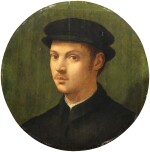

Florentine School circa 1540 | Ecole florentine vers 1540
Portrait of a Boy in Black | Portrait de jeune homme
Auction Closed
March 23, 03:25 PM GMT
Estimate
15,000 - 25,000 EUR
Lot Details
Description
Florentine School circa 1540
Portrait of a Boy in Black
Oil on panel, a tondo
D. 49 cm; 19¼ in.
____________________________________________
Ecole florentine vers 1540
Portrait de jeune homme
Huile sur panneau, tondo
D. 49 cm ; 19¼ in.
Lady Battersea Collection, London;
Her sale, Christie's, London, 15 March 1935, lot 48 (as by Sebastiano del Piombo);
With D. Katz, Dieren;
With Gimbels, New York, 1945 (as by Francesco Salviati);
Auction in Paris around 1952 (as by Francesco Salviati);
Where acquired by Julius H. Weitzner, New York City;
Acquired from the above by the present owner, in 1957.
____________________________________________
Collection Lady Battersea, Londres ;
Sa vente, Christie's, Londres, 15 mars 1935, lot 48 (comme Sebastiano del Piombo) ;
Galerie D. Katz, Dieren ;
Galerie Gimbels, New York, 1945 (comme de Francesco Salviati) ;
Vente aux enchères à Paris vers 1952 (comme de Francesco Salviati) ;
Où acquis par Julius H. Weitzner, New York City ;
Où acquis par l'actuel propriétaire en 1957.
Eindhoven, Stedelijk van Abbe-museum, 16de en 17de Eeuwsche Hollandsche, Vlaamsche en Italiaansche Schilderijen uit de collectie fer Fa. D. Katz te Dieren, 1936-37, no. 94 (as by Francesco Salviati).
____________________________________________
Eindhoven, Stedelijk van Abbe-museum, 16de en 17de Eeuwsche Hollandsche, Vlaamsche en Italiaansche Schilderijen uit de collectie fer Fa. D. Katz te Dieren, 1936-37, n° 94 (comme Francesco Salviati).
Art News, 1 January 1945 (repr. as by Francesco Salviati);
Den Ville Natur: Sveitsisk og Norsk romantikk, cat. exh., Tromsø 2007, p. 11, ill. 2.
____________________________________________
Art News, 1er janvier 1945 (repr. comme de Francesco Salviati) ;
Den Ville Natur: Sveitsisk og Norsk romantikk, cat. exp., Tromsø, 2007, p. 11, ill. 2.
Throughout Italy, the years between 1535 and 1540 were marked by a thriving artistic and cultural scene: Michelangelo completed his frescoes in the Sistine Chapel in Rome, while Vasari and Salviati went to Venice and Bologna after absorbing Florentine Mannerism. Artists from northern Europe also arrived, merging Flemish traditions with the Italian manner.
This portrait bears witness to these diverse influences: the young man’s pose and his austere clothing are close to the Flemish manner, while the thin outline around his face and the light accentuating the shadows around his nose and eyes speak more of an Italian Mannerist influence.
These same characteristics can be found notably in the Portrait of a young man by Francesco Salviati, now in the Museo Poldi Pezzoli in Milan (inv. 557), which is particularly close to the present work, leading Bernard Berenson, Sir Philip Hendy, Philippe Costamagna and Charles Sterling to attribute our painting to the master when it was put up for auction in 1935. While today this attribution cannot be so clear-cut, its date is certainly about 1535–1540.
The provenance of the portrait is also noteworthy, since it was included in the sale of Lady Battersea’s collection in 1935. It is very likely that it had been acquired by her father, Sir Anthony de Rothschild, a collector of Florentine portraits, some of which now hang on the walls of important museums, as in the case of the Portrait of a man in black holding a glove owned by the National Trust at Ascott (inv. 1535119). Our portrait could equally have been acquired by Lady Battersea’s husband, Cyril Flower, who was granted the title Lord Battersea in 1882 and whose Italian masterpieces brought renown to his residence.
____________________________________________
Les années 1535-1540 voient une foisonnante vie artistique et culturelle dans toute l’Italie : Michel-Ange réalise les fresques de la chapelle Sixtine à Rome, tandis que Vasari et Salviati se rendent à Venise et à Bologne après s’être imprégnés du maniérisme florentin. Les artistes du Nord de l’Europe affluent eux aussi, mêlant les traditions flamandes à la manière italienne.
Notre portrait témoigne de ces diverses influences : de par son attitude et son habit austère, le jeune homme se rapproche de la manière flamande, tandis que le fin cerne qui entoure son visage et la lumière accentuant les ombres du nez et des yeux traduisent plutôt l’influence maniériste italienne.
Ces mêmes caractéristiques se retrouvent notamment dans le Portrait de jeune homme de Francesco Salviati, aujourd’hui conservé au musée Poldi Pezzoli à Milan (inv. 557), particulièrement proche de notre tableau et ayant pu conduire Bernard Berenson, Sir Philip Hendy, Philippe Costamagna et Charles Sterling à l’attribuer au maître dès son passage en vente publique en 1935. Si aujourd’hui cette attribution ne peut plus être aussi définitive, sa datation quant à elle reste bien autour de 1535-1540.
La provenance de ce portrait mérite elle aussi d’être soulignée, puisqu’il se trouvait dans la vente de la collection de Lady Battersea en 1935. Il est fort probable qu’il ait été acquis par son père, Sir Anthony de Rothschild, collectionneur de portraits florentins dont certains ornent aujourd’hui les murs d’importants musées, comme c’est le cas par exemple du Portrait d’homme en noir portant un gant aujourd’hui conservé au National Trust à Ascott (inv. 1535119). Notre portrait aurait également pu être acquis par l’époux de Lady Battersea, Cyril Flower, qui obtint le titre de Lord Battersea en 1882 et dont les chefs-d’œuvre italiens faisaient la renommée de sa demeure.
You May Also Like


