Georg Hinz
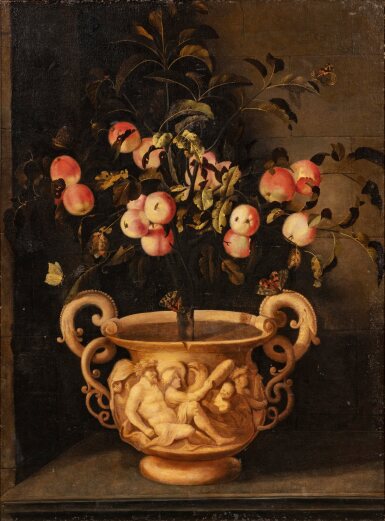
Apple tree in a terracotta pot | Pommier dans un vase en terre-cuite
Auction Closed
March 23, 03:25 PM GMT
Estimate
20,000 - 30,000 EUR
Lot Details
Description
Georg Hinz
Altenau 1630 - 1688 Hamburg
Apple tree in a terracotta pot
Oil on canvas laid down on panel
123,7 x 92,3 cm; 48¾ by 36⅜ in.
We are grateful to Dr. Fred G. Meijer, who endorsed the authentication of this painting based on photographs.
____________________________________________
Georg Hinz
Altenau 1630 - 1688 Hambourg
Pommier dans un vase en terre-cuite
Huile sur toile contrecollée sur panneau
123,7 x 92,3 cm ; 48¾ by 36⅜ in.
Nous remercions Dr. Fred G. Meijer d'avoir confirmé l'authenticité de cette œuvre, d'après photographies.
Georg Augustin Her zu Stubenberg, auff Würmberg, Regensbrug, in 1675;
Anonymous sale, Christie's, London, 29 March 1968, lot 15 (as by Ottmar Elliger the Elder);
The Arcade Gallery, London (as by Ottmar Elliger the Elder);
Where acquired by Absjorn Lunde in 1968.
____________________________________________
Georg Augustin Her zu Stubenberg, auff Würmberg, Regensbrug, en 1675 ;
Vente anonyme, Christie's, Londres, 29 mars 1968, lot 15 (comme Ottmar Elliger l'Ancien) ;
The Arcade Gallery, Londres (comme Ottmar Elliger l'Ancien) ;
Où acquis par Absjorn Lunde en 1968.
Nuremberg, German Nationalmuseum, Aufgang der Neuzeit, Deutsche Kunst, July-October 1952;
Münster and Baden-Baden, Stilleben in Europa, 1979-80, cat. no. 210, p. 398-399 and 561 (as by Tomas de Yepes).
J. von Sandrart, Teutsche Academie der Edlen Bau-, Bild-and Mahlerey- Kunste, Nüremberg 1675, p. 314;
K. Bastian, Georg Hinz und sein Stillebenwerk, Hamburg 1984, no. WV 51, pl. 51;
C. Sterling, 'Four Flower Pots in a Niche', in European Painting, 16th-18th Century in the Menil Collection, 1987.
____________________________________________
J. von Sandrart, Teutsche Academie der Edlen Bau-, Bild-and Mahlerey- Kunste, Nüremberg, 1675, p. 314 ;
K. Bastian, Georg Hinz und sein Stillebenwerk, Hambourg, 1984, n° WV 51, pl. 51 ;
C. Sterling, 'Four Flower Pots in a Niche', dans European Painting, 16th-18th Century in the Menil Collection, 1987.
While little is known about the life of Georg Hinz (sometimes spelt Hainz, Heintz or Hintz), his art has become better known since Karin Bastian wrote her 1984 doctoral thesis (Hamburg, 1984). It was Bastian who reattributed this imposing still life to this painter, born in northern Germany, whose works bear witness to the influence of classical Dutch still lifes, as well as to that of his predecessor Georg Flegel.
The painting was at first assigned to his compatriot Ottmar Elliger, and later – because of its deliberately frontal and hieratic, almost archaic composition – to the Spanish painter Tomas Yepes. But this ambitious composition is certainly the work of Hinz. The painting was in fact mentioned by Sandrart, in his Teutsche Akademie (1679, p. 314), as being – in 1675 – in the collection of Georg Augustin zu Stubenberg auf Warenberg in Regensburg: ‘Ein Apfelbaum in einem antichischen Geshirr von Heinz’.
This reference helps to date the canvas by providing a terminus ante quem. Karin Bastian also alludes, with good reason, to the influence of some of Jean Lepautre’s engravings, especially his series of decorated vases inspired by the designs of Claude Ballin, whose symmetry is sometimes comparable and whose motifs deriving from the antique, in relief on the vases’ bellies, are particularly close to Hinz’s vase. In fact, Hinz seems here to have directly borrowed two motifs of friezes featuring Tritons which were also engraved by Lepautre.
____________________________________________
Si l’on connaît peu de choses sur la vie de Georg Hinz (parfois épelé Hainz, Heintz ou Hintz), son art est mieux connu depuis la rédaction, en 1984 de la thèse de doctorat de Karin Bastian (Hambourg, 1984). C’est à elle que l’on doit la réattribution de cette imposante nature morte à ce peintre né dans le nord de l’Allemagne, et dont les œuvres témoignent de l’influence des natures mortes classiques hollandais, mais également de son prédécesseur Georg Flegel.
Le tableau fut tout d’abord donné à son compatriote Ottmar Elliger, puis, du fait de sa composition volontairement frontale et hiératique, presque archaïque, au peintre espagnol Tomas Yepes. C’est pourtant bien à Hinz qu’il faut rendre cette composition ambitieuse. Le tableau est en effet mentionné par Sandrart, dans sa Teutsche Akademie (éd. 1679, p. 314), comme faisant partie, en 1675, de la collection de Georg Augustin zu Stubenberg auf Warenberg à Ratisbonne : « Ein Apfelbaum in einem antichischen Geshirr von Heinz ».
Cette mention aide par ailleurs à dater la toile en donnant un terminus ante quem. Karin Bastian évoque également à juste titre l’influence quasi certaine des gravures de Jean Lepautre, en particulier sa série de vases ornementés inspirés de ceux exécutés par Claude Ballin, qui offrent une symétrie parfois comparable, et dont les motifs inspirés de l’antique, en reliefs sur les panses des vases, sont particulièrement proches de celui du vase de Hinz. Ce dernier semble ici avoir par ailleurs directement emprunté deux motifs de frises représentant des Tritons également gravés par Lepautre…
You May Also Like