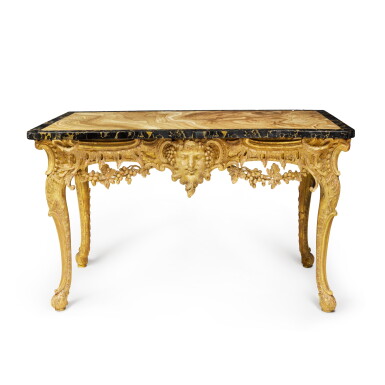
A George II Giltwood Console Table, Circa 1750, with a 19th Century Albastro Fiorito and Portor Marble Top
Auction Closed
January 31, 05:43 PM GMT
Estimate
50,000 - 80,000 USD
Lot Details
Description
A George II Giltwood Console Table, Circa 1750, with a 19th Century Albastro Fiorito and Portor Marble Top
height 33 in.; width 58 in.; depth 31 in.
84 cm; 147 cm; 79 cm
Edward I. Farmer (1872-1942), New York
The Farmer Collection, Parke-Bernet Galleries, New York 16-19 April 1947, Lot 835
Freeman's Philadelphia, 4 May 2010, lot 82
Elaborately carved pier or console tables, described by Thomas Chippendale as 'frames for marble slabs', developed in the second quarter of the 18th century and were suitable vehicles for exhibiting the fashionable rococo style in drawing rooms, entrance halls or in some cases dining rooms, the likely setting of the present table with its vine and grape festoons and Bacchic mask. The composition of the frieze relates to a design for a console that appears in plate 176 of the third edition of Chippendale's Gentleman and Cabinet Maker's Director (1762) [fig. 1], and a similar arrangement of a Bacchus mask flanked by vine swags appears on a giltwood pier table sold Sotheby's New York, 21 October 2005, lot 14, and a pair of giltwood consoles in the manner of Thomas Johnson formerly in the Viscounts Hambledon collection, sold Christie's London 4 July 2013, lot 38.
Further tables with comparable Bacchus mask and vine friezes include a giltwood pair with winged lion supports designed by John Vardy for the Great Dining Room of Spencer House, London in 1758 (one in situ), and a carved mahogany games table supplied by William Linnell in 1740 to Richard Hoare of Nine Elms, London, now at Stourhead House, Wiltshire (illustrated in Helena Hayward and Pat Kirkham, William and John Linnell, London 1980, Vol. II p. 136 figs. 269, 270).
Edward I. Farmer was a British dealer in Chinese art established in New York by 1913, with a gallery at 16 East 56th Street retailing porcelain lamps and jade and ivory objects mounted in silver and silver gilt. He also traded in and collected antique English furniture.
You May Also Like