Bartolomeo Cavaceppi
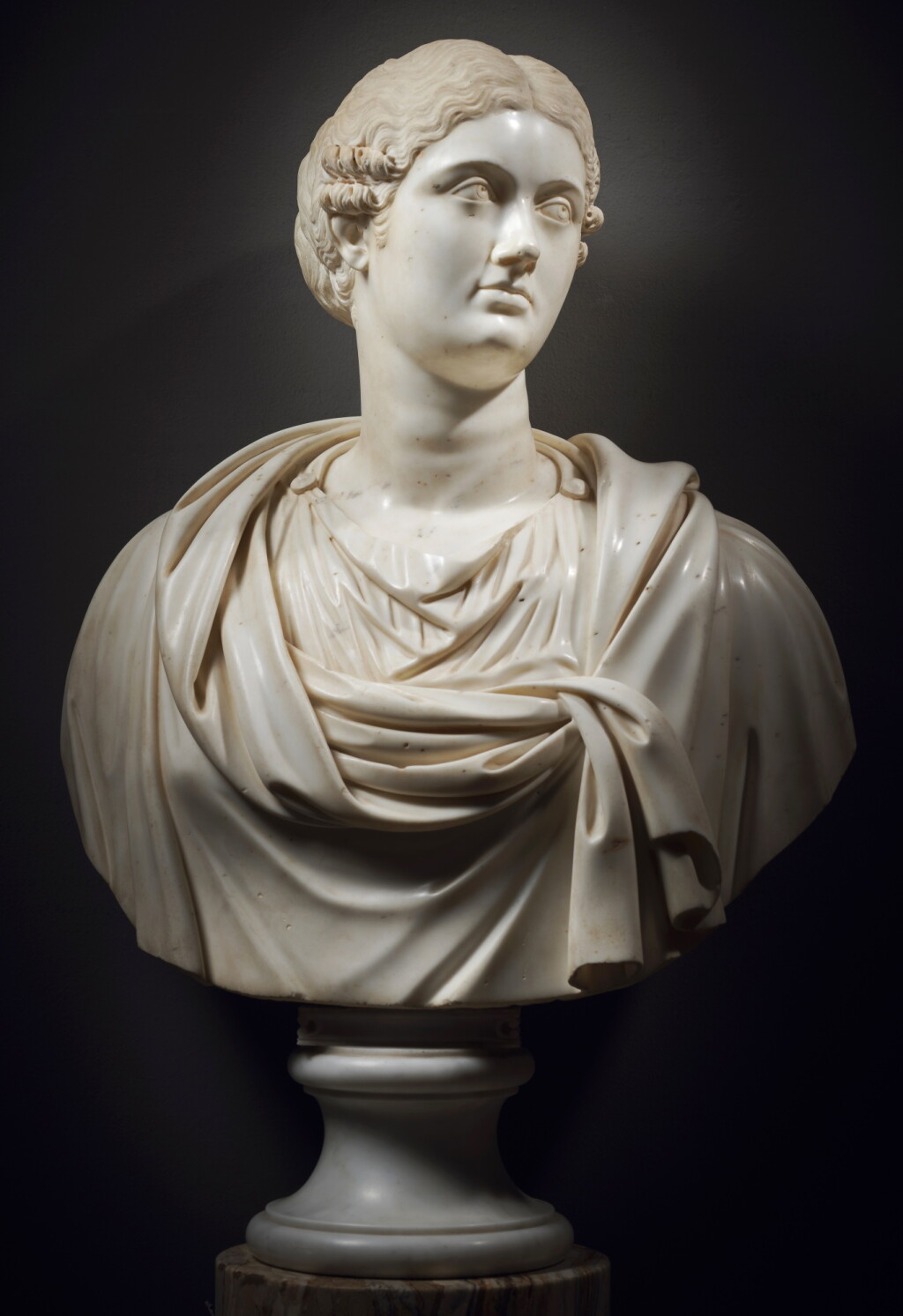
Bust of a Woman
Auction Closed
March 22, 07:15 PM GMT
Estimate
30,000 - 50,000 EUR
Lot Details
Description
Bartolomeo Cavaceppi
Rome 1716 - 1799
Bust of a Woman
marble, on a white marble socle
signed: B.CAV.F.ROMA
bust: 74cm., 29⅛in.
socle: 20cm., 7⅞in.
Naples, La Basilica di Santa Maria Maggiore alla Pietrasanta, I tesori nascosti. Caravaggio, Tino di Camaino e Gemito, 2016-2017
M. Barberini, in V. Sgarbi (ed.), I tesori nascosti, Naples, 2016, p. 238
A less known facet in the career of Bartolomeo Cavaceppi, the celebrated restorer and copyist of classical antiquities, is his activity as a portrait sculptor. Bearing the artist’s signature, the present marble depicting a woman in the guise of a Roman empress has been added to Cavaceppi’s limited but accomplished corpus of portrait busts (see Barberini, op. cit.).
Dressed in an all’antica chiton and a densely folded cloak, the woman is characterised by a pronounced nose, a full mouth, and carefully delineated eyes with a decisive gaze. While her wavy chignon recalls ancient prototypes, the 18th-century corkscrew curls framing her face contribute to the impression of a contemporary and individualised, commissioned portrait.
For his portrayal Cavaceppi drew primarily on the iconography of the Roman empresses Faustina the Elder, wife of Antoninus Pius (183-161 AD), and Faustina the Younger, wife of Marcus Aurelius (161-180 AD). Ancient portraits of the latter compare particularly well in the arrangement of the drapery. Widely copied in antiquity, representations of both empresses were known to Cavaceppi, who in fact restored as well as reproduced their likenesses. A pair of busts by Cavaceppi of the two Faustinas, after Roman originals in the Capitoline Museums, are housed in the Anhalt-Dessau collection at Schloss Wörlitz.
The present bust can be dated to circa 1770, following Cavaceppi’s tour of Germany with Johann Joachim Winckelmann. During this journey Cavaceppi and Winckelmann visited the country’s most important artistic centres and courts, including those of Anhalt-Dessau and Braunschweig, resulting in several members of the German aristocracy sitting for the sculptor’s portraits. The sculptor’s busts of Duke Karl I of Braunschweig and King Frederick II of Prussia, now respectively in Braunschweig and Potsdam, compare in their monumental conception and treatment of the hair and facial features, with prominently incised eyes. The terracotta portrait of Luise von Anhalt-Dessau in Castle Wörlitz, which Cavaceppi modelled in 1768, provides a parallel for the present bust’s marriage of all’antica modes with a sensuous, almost Baroque naturalism, which enlivens its sitter’s humanity.
RELATED LITERATURE
U. Schlegel, 'Bildnisbüsten des Bartolomeo Cavaceppi', in Scritti di Storia dell’Arte in onore di Federico Zeri, Milan, 1984, pp. 831-839; T. Weiss (ed.), Von der Schönheit weissen Marmors. Zum 200. Todestag Bartolomeo Cavaceppis, Mainz, 1999
This lot has an artistic export license. Please refer to the specialist department for further information about export procedures and shipping costs.
You May Also Like