Dutch Masterpieces from the Theiline Scheumann Collection
Willem van de Velde the Younger
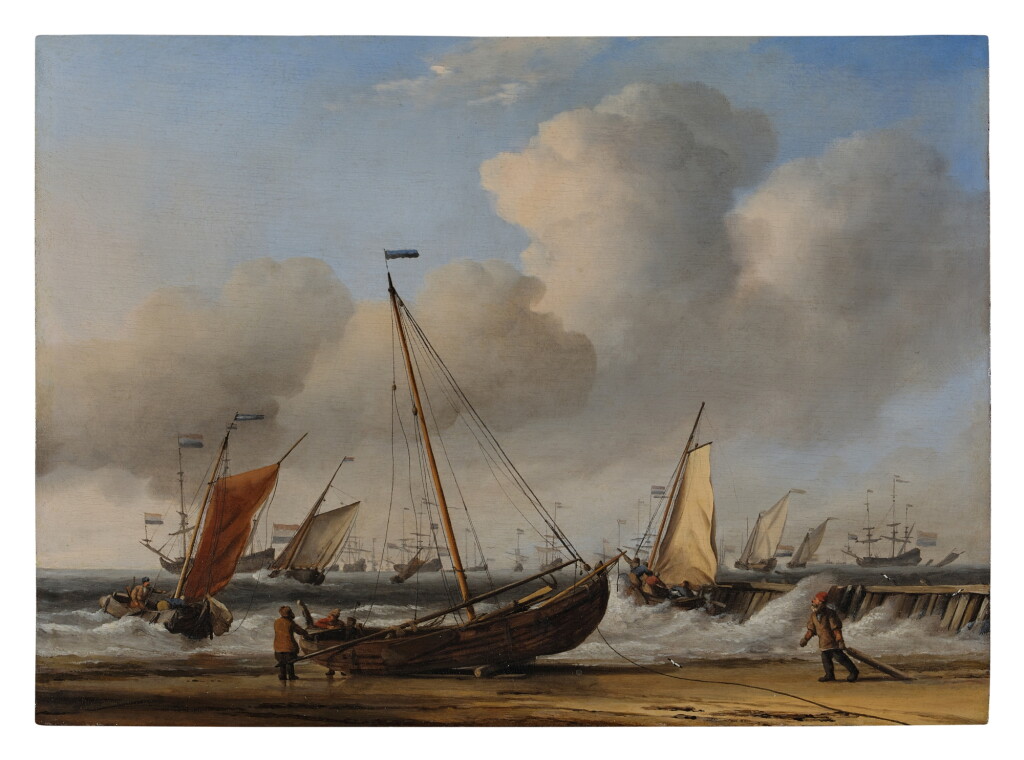
A fishing pink hauled up on the beach and other vessels under sail in a fresh breeze off the Dutch coast
Auction Closed
January 26, 04:01 PM GMT
Estimate
800,000 - 1,200,000 USD
Lot Details
Description
Dutch Masterpieces from the Theiline Scheumann Collection
Willem van de Velde the Younger
Leiden 1633 - 1707 London
A fishing pink hauled up on the beach and other vessels under sail in a fresh breeze off the Dutch coast
signed with initials on a piece of wood lower left: W.V.V.
oil on panel
panel: 9⅜ by 12⅞ in.; 49.2 by 32.7 cm.
framed: 15 by 18¾ in.; 38.1 by 47.6 cm.
By whom sold, London, Christie's, 31 January 1947, lot 24;
There acquired by Horace Ayerst Buttery (1902-1962), London;
By whom given to Thomas Agnew & Sons, London (stock no. 12146);
From whom acquired by R.E. Brandt;
Hon. Mrs. Ursula Mary Parshall (née Bathurst) (1900-1975);
By whom gifted to her brother, Benjamin Ludlow Bathurst (1899-1979), 2nd Viscount Bledisloe Q.C.;
By whom sold ("The Property of the Viscount Bledisloe, Q.C."), London, Christie's, 28 November 1975, lot 22;
There acquired by E. Speelman for 24,000 gns;
With Galerie G. Berlin, by June 1977;
With Richard Green, London, by March 1979;
With David Carritt Ltd., London, March 1988;
With Otto Naumann, Ltd., New York;
From whom acquired, 1997.
C. Hofstede de Groot, A Catalogue Raisonné of the Works of the Most Eminent Dutch Painters of the Seventeenth Century, vol. VII, London 1923, p. 102, cat. no. 396;
M.S. Robinson, Van de Velde: A Catalogue of the Paintings of the Elder and the Younger Willem van de Velde, Greenwich 1990, vol. II, pp. 871-872, cat. no. 48, reproduced.
This beautiful, signed painting by Willem van de Velde the Younger is datable to circa 1672. Displayed across the panel's small surface is the artist’s acute and intuitive mastery of observation, visible in the curves and details of the small vessel in the foreground, the crisp and clear light that enlivens the atmosphere, and the seemingly perceptible fresh breeze coming in from the left. Born into a family of artists, Willem van de Velde the Younger is renowned as one of the leading Dutch marine artists of the second half of the seventeenth century, a reputation established by capturing the views off the coast of Holland with remarkable accuracy, vigor, and finesse, all characteristics that define the present painting.
The scene is set beneath a swath of cumulous clouds that cast a soft shadow across the vast sea beyond. A pink, or a small ship with a narrow stern, anchors the foreground of the composition. Seen from its starboard side, it has been hauled onto the beach by a rope and a wooden roller, and its sprit (a spar for a mast of a sail that runs diagonally from lower to upper corner) rests on the starboard gunwale (the upper edge of the side of a boat). As two men rest their hands on the stern of the boat, another walks toward the bow dragging a roller in the sand behind him. Beyond this figure in the right foreground, a small vessel with figures attempts to free itself from being driven against the wooden groyne (jetty) that runs perpendicular to shore. In the left foreground another vessel approaches the coast, while a wijdship, or Dutch transport vessel, can be seen just beyond sailing out to sea. A fleet of ships, largely at anchor and broadly visible from their port sides, animates the distant view, providing a pleasing balance to the foreground's blustery seas.
In his catalogue entry for this painting, M.S. Robinson praised Van de Velde’s expert and unmistakable rendering of the details of the vessels, as well as their accurate perspectives and relative sizes to one another. That the one yacht in distant right seems to be painted on a higher level of water than the others led Robinson to suggest there may have been a small amount of assistance by another hand. A possible candidate could be Ludolf Bakhuizen, who sometimes collaborated with Van de Velde the Younger during this period.
You May Also Like