Provenant de Giuseppe Ve prince Rospigliosi / From the collections of Giuseppe, 5th Prince Rospigliosi
An Italian silver and silver-gilt cruet, Giuseppe Valadier, Rome, circa 1808 | Huilier en argent et vermeil par Giuseppe Valadier, Rome, vers 1808
Lot Closed
November 17, 02:01 PM GMT
Estimate
15,000 - 25,000 EUR
Lot Details
Description
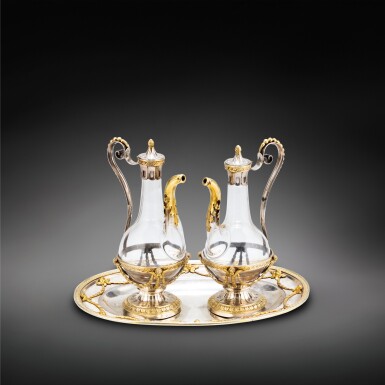
An Italian silver and silver-gilt cruet, Giuseppe Valadier, Rome, circa 1808
the oval tray, with rim moulded with a Greek frieze, the matted border, engraved with twelve cherubs linked by garlands of leaves engraved under the rim Giuseppe Rospigliosi 1808, the cruets resting on a fluted pedestal with rims moulded with water leaves, the frame decorated with four cherubs linked by garlands of laurel leaves, the handle moulded with pearls, the spout topped with acanthus leaves, pine cone-shaped finial
tray length 10 3/8in. ; tray weight 14¾in.
tray length 26.4 cm ; tray weight 418 g
--------------------------------------------------------------------------
Huilier ou service de burettes et leur plateau en argent et vermeil par Giuseppe Valadier, Rome, vers 1808
le plateau ovale à bord mouluré d'une frise de grecques, le marli amati, agraphé de douze chérubins reliés par des guirlandes de feuilles, gravé sous le bord Giuseppe Rospigliosi 1808, les burettes reposant sur un piédouche cannelé à bord mouluré de feuilles d'eau, la monture ornée de quatre chérubins reliés par des guirlandes de feuilles de laurier, l'anse moulurée de perles, le bec verseur coiffé de feuilles d'acanthe, la prise du couvercle en pomme de pin
Long. du plateau 26,4 cm ; poids du plateau 418 g
This beautiful pair of ewers has probably been ordered by Prince Rospigliosi for his private chapel or possibly for his table use.
Giuseppe Valadier, Luigi's son, was born in 1762. He bacame in the same time silversmith and architect and he left many souvenirs in the City of Rome. During a few years after his father's death in 1785, he went on using his father maker's mark. He sold his workshop in 1817 to Pietro Paolo Spagna and died in 1839.
Giuseppe Rospigliosi (1755 - 1833), V Prince of Rospigliosi, was a prominent Italian nobleman. Known for his influence and wealth, he was a patron of the arts and culture, supporting various artists and intellectuals of his era. His palace, the Palazzo Rospigliosi in Rome, became a hub for cultural gatherings and events, attracting renowned figures of the time.
You May Also Like