
Louis-Léopold Boilly
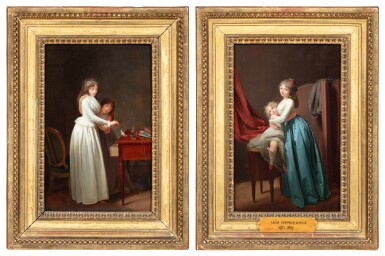
(I) Two sisters playing with a bird; (II) A young mother holding her child | (I) Deux sœurs jouant avec un oiseau ; (II) Jeune mère serrant dans ses bras son enfant
Auction Closed
December 13, 07:26 PM GMT
Estimate
50,000 - 70,000 EUR
Lot Details
Description
Louis Léopold Boilly
1761 - 1845
(I) Two sisters playing with a bird
(II) A young mother holding her child
A pair, both oil on panel
(I) 29,7 x 19,3 cm ; 11¾ by 7⅝ in. ; (II) 29,8 x 19,4 cm ; 11¾ by 7⅝ in.
(2)
____________________________________________
Louis Léopold Boilly
1761 - 1845
(I) Deux sœurs jouant avec un oiseau
(II) Jeune mère serrant dans ses bras son enfant
Huile sur panneau, une paire
(I) 29,7 x 19,3 cm ; 11¾ by 7⅝ in. ; (II) 29,8 x 19,4 cm ; 11¾ by 7⅝ in.
(2)
Collection Adrien Girardon (1789-1855) and his wife Pauline, née Bellier de Presles (1798-1824)
Collection Pierre-Gustave Girardon (1821-1887)
Collection Louis Girardon
Collection Alain Girardon
By descent, domaine des Husseaux
Anonymous sale, Beaussant-Lefèvre, Paris, 20 June 2008, lots 48 and 49
With Galerie Saint-Honoré Art Consulting, Paris
Where acquired by Monsieur Hubert Guerrand-Hermès, March 2011
____________________________________________
Collection Adrien Girardon (1789-1855) et son épouse Pauline, née Bellier de Presles (1798-1824)
Collection Pierre-Gustave Girardon (1821-1887)
Collection Louis Girardon
Collection Alain Girardon
Par descendance, domaine des Husseaux
Vente anonyme, Beaussant-Lefèvre, Paris, 20 juin 2008, lots 48 et 49
Galerie Saint-Honoré Art Consulting, Paris
Où acquis par Monsieur Hubert Guerrand-Hermès, mars 2011
P. Marmottan, Le Peintre Louis Boilly (1761-1845), Paris 1913, p. 250 (titled Deux sœurs jouant avec un oiseau)
E. Bréton and P. Zuber, Boilly. Le peintre de la société parisienne de Louis XVI à Louis-Philippe, Paris 2019, vol. II, p. 539, nos. 314 P and 315 P
____________________________________________
P. Marmottan, Le Peintre Louis Boilly (1761-1845), Paris, 1913, p. 250 (sous le titre Deux sœurs jouant avec un oiseau)
E. Bréton et P. Zuber, Boilly. Le peintre de la société parisienne de Louis XVI à Louis-Philippe, Paris, 2019, vol. II, p. 539, n° 314 P et 315 P
A soft gentleness emanates from these two pendant compositions, each illustrating a moment in ordinary life: in the first, two young women – sometimes described as a mother and daughter, sometimes as two sisters – are feeding a bird. In the second, a young mother tenderly hugs her child.
Dated by Etienne Bréton and Pascal Zuber to 1795-1796, these ambiguous scenes, which caused Boilly some problems during the Terror, brought the artist success with his Parisian clients. The subject of a young woman feeding a bird often conceals a risqué allusion, but as a pendant to the tender scene of a mother and child, it is more likely to be an ode to motherhood: half a century earlier, Boucher had used the same motif to highlight the maternal qualities of Alexandrine Lenormand d’Etiolles, daughter of Madame de Pompadour, in a work that is now in the Châteaux de Versailles et de Trianon (inv. V2019.29).
Boilly departs from traditional compositions by dramatically illuminating the protagonists in his intimate scenes, a pretext for a subtle and skilful play of light. With his fine, precise brushstroke, Boilly specialized in the rendering of featherlight draperies and the depiction of fabrics with moiré reflections, to the extent that the rustling of silk skirts is almost audible.
Boilly settled in Paris in 1785 and exhibited at the Salon de Paris from 1793 onwards, showing portraits and trompe-l’œil paintings as well as scenes of ordinary life which brought him fame and many commissions. His long career began under the Ancien Régime, but it was after the Revolution and during the Empire that it reached its peak.
Although the early history of these paintings is not precisely known, they very swiftly appeared in the collection of Adrien François Girardon (1789-1855), son of a wealthy lawyer to the Parlement. When he died, his widow preserved them faithfully at their residence in Drôme; the works were then carefully handed down from generation to generation, remaining in the same family until the very beginning of the twenty-first century.
____________________________________________
Une grande douceur se dégage de ces deux compositions formant pendants, décrivant chacune un instant de la vie quotidienne : dans le premier, deux jeunes femmes tantôt décrites comme une mère et sa fille, tantôt décrites comme deux sœurs, donnent la becquée à un oiseau. Dans le second, une jeune mère serre tendrement son enfant dans ses bras.
Datées par Etienne Bréton et Pascal Zuber de 1795-1796, ces scènes à double lecture, qui ont valu quelques ennuis à Boilly sous la Terreur, font alors déjà le succès du peintre auprès de sa clientèle parisienne. Le sujet de la jeune femme donnant la becquée à un oiseau permet en effet bien souvent de dissimuler une allusion grivoise ; en pendant ici avec une tendre scène d’une mère avec son enfant, il est plus probablement une ode à la maternité ; un demi-siècle auparavant, Boucher avait ainsi utilisé ce même motif et mis en valeur les qualités maternelles d’Alexandrine Lenormand d’Etiolles, fille de Madame de Pompadour dans un œuvre aujourd’hui conservée aux châteaux de Versailles et de Trianon (inv. V2019.29).
Boilly se détache des compositions traditionnelles en éclairant les protagonistes de ses scènes intimes d’une lumière théâtrale, prétexte à un subtil jeu de lumière maîtrisé par le peintre. D’un pinceau fin et précis, Boilly se fait une spécialité du rendu des drapés aériens et de la représentation des étoffes aux reflets moirés, rendant presque perceptible le bruissement des jupes de soie…
Installé dès 1785 à Paris, Boilly expose au Salon de Paris à partir de 1793 des portraits, des trompe-l’œil mais aussi des scènes de vie quotidienne qui lui valent sa renommée et de nombreuses commandes. Commencée sous l’Ancien Régime, c’est en effet après la Révolution puis sous l’Empire que la longue carrière de l’artiste connaît son apogée.
Si l’on ne connaît pas exactement le parcours de ces tableaux depuis leur création, on les retrouve très rapidement dans la collection d’Adrien François Girardon (1789-1855), fils d’un riche avocat au Parlement. A sa mort, son épouse les conserve précieusement dans leur propriété drômoise ; les œuvres seront ensuite précieusement transmises de générations en générations, restant dans la même famille jusqu’au tout début du XXIe siècle.
You May Also Like


