Louise Bourgeois
Untitled
Auction Closed
June 21, 04:43 PM GMT
Estimate
60,000 - 80,000 EUR
Lot Details
Description
Louise Bourgeois
1911 - 2010
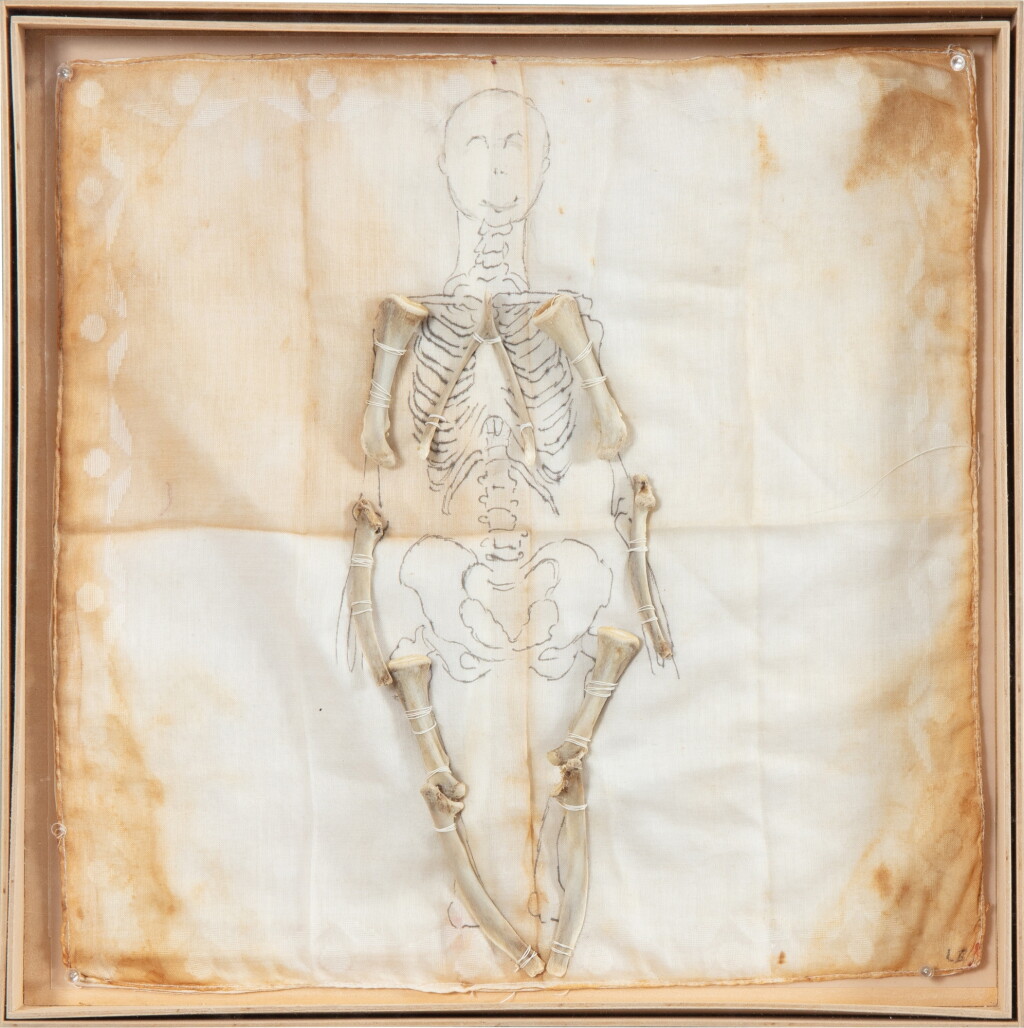
Sans Titre
signé des initiales
os de poulet et stylo sur tissu dans une boite en bois
33 x 33 cm ; 13 x 13 in.
Exécuté en 1996.
---------------------------------------------------------------------------
Louise Bourgeois
1911 - 2010
Untitled
signed with the initials
chicken bone and pen on fabric in a wooden box
33 x 33 cm ; 13 x 13 in.
Executed in 1996.
Galerie Pièce Unique, Paris
Galerie Alain le Gaillard, Paris
Collection Hélène Leloup, Paris (acquis auprès du précédent en septembre 2004)
---------------------------------------------------------------------------
Galerie Pièce Unique, Paris
Galerie Alain le Gaillard, Paris
Collection Hélène Leloup, Paris (acquired from the above in September 2004)
Bordeaux, CAPC Musée d'art contemporain; Belem, Centro Cultural; Malmö, Konsthall; London, Serpentine Gallery, Louise Bourgeois. Oeuvres récentes, 6 février 1998 - 30 janvier 1999 ; catalogue, p. 71, illustré en couleurs
Bielefeld, Kunsthalle Bielefeld, Louise Bourgeois : Spinnen, Einzelgänger, Paare, 28 février - 2 mai 1999
---------------------------------------------------------------------------
Bordeaux, CAPC Musée d'art contemporain; Belem, Centro Cultural; Malmö, Konsthall; London, Serpentine Gallery, Louise Bourgeois. Oeuvres récentes, 6 February 1998 - 30 January 1999; catalogue, p. 71, illustrated in colour
Bielefeld, Kunsthalle Bielefeld, Louise Bourgeois : Spinnen, Einzelgänger, Paare, 28 February - 2 May 1999
Louise Bourgeois, Cecilia Casorati, Louise Bourgeois. Handkerchiefs, np, no. 17, illustré en couleurs
---------------------------------------------------------------------------
Louise Bourgeois, Cecilia Casorati, Louise Bourgeois. Handkerchiefs, np, no. 17, illustrated in colour
Untitled appartient à une série d'œuvres composées de mouchoirs en tissu dans lesquels sont incorporés des os d'animaux ainsi que des fragments de corps en plastique et des fibres. Ces pièces font partie des premières œuvres dans lesquelles Bourgeois intègre des éléments personnels renvoyant à son enfance. La présence des os évoque un jeu d'enfants populaire qui consiste à "tirer le bréchet d'un poulet" (Louise Bourgeois, in Cecilia Casorati, Handkerchiefs, Gianluca Collica, 2000), permettant au détenteur de la pièce la plus longue de faire un vœu. De plus, le corps reconstruit fait allusion au processus de restauration qui fascine Bourgeois tout au long de sa jeunesse. Ayant observé sa mère réhabiliter des objets détruits, l'artiste reproduit ce geste réparateur.
Si Untitled est intrinsèquement liée aux souvenirs d'enfance de l'artiste, elle évoque également le passage à l'âge adulte. L'œuvre fait allusion aux mouchoirs brodés conservés dans les trousseaux de jeunes mariées. Cette pièce associant l'innocence de l'enfance à la réalité de la vie, s’inscrit alors dans l’approche ambivalente de Bourgeois qui consiste à explorer différents états psychiques.
Un sentiment de fragilité émane également de cette série. Comme le souligne Cecilia Casorati, "choisir des souvenirs n'est pas un simple exorcisme. Il s'agit de connaître ses propres limites, d'exposer sa propre fragilité" (Cecilia Casorati, Handkerchiefs, Gianluca Collica, 2000). La précarité des os ainsi que les lignes délicates qui représentent l'intérieur du corps sont évocatrices d'une extrême vulnérabilité.
L'utilisation de restes d'animaux fait également écho aux sculptures africaines, souvent réalisées en ivoire. Ayant pour époux Robert Goldwater - directeur du Musée d'art primitif et conseiller en matière d'art africain – il n’est pas étonnant que les œuvres de Bourgeois portent en elles certaines caractéristiques qui renvoient à l’art tribal.
L'œuvre témoigne également de l'usage du textile comme moyen d'expression des traumatismes internes de l’artiste. En 1996, Bourgeois crée un grand nombre d’œuvres textiles, comprenant des figures suspendues composées de tissu, de dentelle, de chaussettes et de collants en nylon. Les traces de couture rappellent les cicatrices internes de Bourgeois. Quant au processus de tissage, il est évocateur d'une angoisse permanente liée à la peur de la séparation et de l'abandon qui intervient dans la plupart des œuvres de l'artiste. Comme l'affirme Germano Celant, "si la coupure est une blessure, la couture rassemble les choses" (Germano Celant, Louise Bourgeois, The Fabric Works, 2010, p.19).
---------------------------------------------------------------------------
Untitled belongs to a series of works comprised of handkerchiefs in which fragments of animal bones as well as plastic body parts and threads are embedded. These are among the first works in which Bourgeois integrates personal elements that are reminiscent of her childhood. The bones are evocative of a popular children’s game which involves “pulling the wishbone of a chicken” (Louise Bourgeois, in Cecilia Casorati, Handkerchiefs, Gianluca Collica, 2000) allowing the beholder of the longest piece to make a wish. What’s more, the reconstructed body alludes to the process of restoration that fascinated Bourgeois in her younger days. Having observed her mother rehabilitate broken artefacts, the artist mimics this reparative gesture.
If Untitled is intrinsically linked to the artist’s childhood memories, it is also evocative of a transition into adulthood. The work alludes to the embroidered handkerchiefs that were stored in bridal trousseau. In line with Bourgeois’ exploration of ambivalent mental states, this unsettling work combines the innocence of childhood with the reality of life.
A sense of fragility also emanates from this series. As expressed by Cecilia Casorati “Choosing memories is not a simple exorcism. It means knowing one’s own limits, putting one’s own fragility on display” (Cecilia Casorati, Handkerchiefs, Gianluca Collica, 2000). The frailty of the bones as well as the delicate lines that represent the insides of the body are evocative of an extreme vulnerability.
The use of animal remains is also reminiscent of African sculptures which are often made of ivory. With Robert Goldwater - first director of the Museum of Primitive Art in New York and a major scholar in African art - as her husband, it is not surprising that Bourgeois' works display certain characteristics that are linked to tribal arts.
The work also attests to Bourgeois’ use of textile as a means of expressing her inner traumas. In 1996, the artist creates a great amount of textile pieces including her hanging figures comprised of fabric, lace, socks and nylon tights. The stiches function as a reminder of Bourgeois’ internal scars. As for the process of weaving, it is evocative of an ongoing fear of separation and abandonment that encompasses most of the artist’s works. As argued by Germano Celant “If the cut is a wound, then the sewing brings things together” (Germano Celant, Louise Bourgeois, The Fabric Works, 2010, p.19).
You May Also Like