
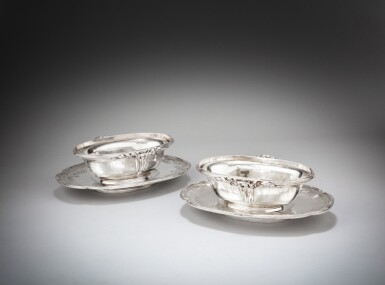
From the Livingston Service
Two silver sauceboats and their stands, Jacques-Nicolas Roëttiers, Paris, 1775-1776 | Deux saucières et leurs présentoirs formant paire en argent par Jacques-Nicolas Roëttiers, Paris, 1775-1776
Auction Closed
June 28, 03:24 PM GMT
Estimate
30,000 - 40,000 EUR
Lot Details
Description
Two silver sauceboats and their stands, Jacques-Nicolas Roëttiers, Paris, 1775-1776
each arched gantière-shape stand, the border molded with crossed thread and ribbons , the border engraved with a frieze of foliage on matted ground, resting on a small spreading foot, the sauceboat edge moulded with a frieze of nets ribbons crossed topping a frieze of grecques and fleurons on matted ground, the laurel branch handles attached to the body with an acanthus leaf, one of the sauce boats engraved with a coat-of-arms topped by a ship crest and the motto SPERO MELLORA underneath one of the ends, the center of the stand engraved with the same coat of arms and motto, the other sauce boat engraved only with the same crest and motto under one of the ends and on the border of the stand
------------------------------------------------------------
Deux saucières et leurs présentoirs formant paire en argent par Jacques-Nicolas Roëttiers, Paris, 1775-1776
chaque présentoir en forme de gantière cintrée, le bord mouluré de filets et rubans croisés, le marli gravé d’une frise de feuillages sur fond amati, reposant sur une bâte unie, la saucière à bord mouluré d’une frise de filets rubans croisés sommant une frise de grecques et fleurons à fond amati, les anses en rameau de laurier attachées au corps par une feuille d’acanthe, reposant sur une bâte unie, l’une des saucières gravée d’armoiries sommées d’un cimier en bateau
et de la devise SPERO MELLORA sous une des extrémités, le centre du présentoir gravé des mêmes armoiries et devise, l’autre saucière gravée uniquement des mêmes cimier et devise sous une des extrémités et sur le marli du présentoir
10 1/8in. long. ; 8 1/16in. long ; 877⁄16 oz.
Long. des présentoirs 25,7 cm ; Long des saucières 20,5 cm ; 2 479 g
The arms and crest are those of the American lawyer Robert R. Livingston. Born on 27 November 1746 in New York, Robert R. Livingston, was one of the founding fathers of the United States.
Born into a wealthy and influential New York family, Livingston became a lawyer in 1770. He advocated independence from Great Britain and sat on numerous committees of the Continental Congress in Philadelphia (1775-1776, 1779-1781, 1784-1785). A delegate to the Continental Congress, he became First Secretary of the Department of State (1781-83), helped to draft the Declaration of Independence, and contributed to the drafting of the first Constitution of the State of New York (1777). He was appointed first State Chancellor (1777-1801). On 30 April 1789, in New York, the Chancellor administered the presidential oath of office to the nation's first President, George Washington at his first inauguration.
In 1801, he was appointed by President Thomas Jefferson to represent the United States in France. It was in this capacity that he earned his greatest merits, helping to implement the Louisiana Purchase (1803), one of the country's most important diplomatic coups. He died on 26 February 1813 in Clermont, United States.
There are several pieces bearing his arms in New York's Metropolitan Museum and one in the New York Historical Society Museum & Library, which may have been part of a service purchased by Robert R. Livingston.
Like the 1775-1776 Roettiers coffee-pot also with Livingston's arms now in the New York Historical Society Museum & Library, the sauce-boats could have been bought by Gouverneur Morris (1752-1816). United States Ambassador to France, Morris lived in Paris during the French Revolution between 1792 and 1794. Morris may have bought the sauce-boat pair from somebody influential who needed money to flee the country. The service was then sold to Robert R. Livingston (1746-1813), who held the same position as Morris in 1801. As US Minister to France, Morris explained Livingston would need a dinner service suitable for official events. Morris is said to have written: "You cannot handsomely do without one". However, their first owner may have been a member of the European high-rank aristocracy. Livingston was surely not the commissioner, the date of manufacture does not correspond to a period of relationship with France. Furthermore, the laurel motif (which also adorns the tureens of the second Sachsen-Teschen service) alludes to the success and fame of the Prince.
Jacques-Nicolas Roëttiers (1736-1788) designed this model. Born into a wealthy family, he was predestined for a career as a silversmith, enjoying the already well-established reputation of his father, Jacques Roëttiers (1707-1784). Jacques himself had taken over the workshop of his father-in-law, Nicolas Besnier, another great silversmith of the period. Born into a dynasty of medal engravers from Flanders, Jacques Roëttiers built his reputation for excellence partly on his genius as a draughtsman and sculptor, particularly evident in the commission he received on 6 December 1734 to create a hunting centerpiece for the Duke of Bourbon, now in the Louvre.
It was against this backdrop that Jacques Nicolas Roëttiers became his father's apprentice at the age of 16 at the Galeries du Louvre. The company "Roëttiers père et fils" was founded in 1762. In 1765, Jacques-Nicolas Roëttiers was awarded the title of master goldsmith in Paris and had his hallmark inscribed: "J N R, a wheat sheaf". Roëttiers father and son fulfilled numerous court orders, including the so-called "Orloff" service for Catherine II of Russia in 1770-1772, probably one of the last orders fulfilled by the silversmiths. Jacques-Nicolas used several of the motifs previously used in this "Orloff" service to design the pieces brought together by Livingston. Our pair of sauce-boats was designed in 1775-1776, just after this famous imperial service.
The largest collection of pieces engraved with the Livingston arms are now on display at the Metropolitan Museum in New York. This comprises a pair of covered tureens (dated 1775-1776), three covered vegetable-dishes (two dated 1775-1776 and the third 1774-1776) and two plates (dated 1775-1776).
------------------------------------------------------------
Les armes et le cimier sont ceux de l'avocat américain Robert R. Livingston. Né le 27 novembre 1746 à New York, Robert R. Livingston, est l’un des pères fondateurs des États-Unis.
Issu d'une famille new-yorkaise aisée et influente, Livingston devient avocat en 1770. Il prône l'indépendance vis-à-vis de la Grande-Bretagne et siège dans de nombreuses commissions du Congrès continental de Philadelphie (1775-1776, 1779-1781, 1784-1785). Délégué au Congrès continental, il devint premier secrétaire du Département d'État (1781-83), et participe à la rédaction de la Déclaration d'indépendance, contribuant aussi à la rédaction de la première Constitution de l'État de New York (1777).
Il est nommé premier chancelier de l'État (1777-1801). Dans ce cadre, le 30 avril 1789, à New York, le chancelier fait prêter serment au premier président de la nation, George Washington.
En 1801, il est désigné par le président Thomas Jefferson pour représenter les États-Unis en France. C'est à ce titre qu'il acquiert ses plus grands mérites en contribuant à la mise en œuvre de l'achat de la Louisiane (1803), l'un des coups diplomatiques les plus importants du pays. Il meurt le 26 février 1813 à Clermont, Etats-Unis.
On trouve plusieurs pièces à ses armes au Metropolitan Museum de New York et une à la New York Historical Society Museum & Library, qui auraient pu faire partie d'un même service acheté par Robert R. Livingston.
A l’instar de la cafetière de 1775-1776 par Roettiers également aux armes de Livingston aujourd’hui dans la New York Historical Society Museum & Library, les saucières auraient pu être achetées par Gouverneur Morris (1752-1816).
Ambassadeur des États-Unis en France, Morris résidait à Paris pendant la révolution française, entre 1792 et 1794. Morris a peut-être acheté cette paire à quelqu’un important qui avait besoin d'argent liquide pour fuir le pays. Le service aurait ensuite été vendu à Robert R. Livingston (1746-1813), qui a occupé le même poste que Morris en 1801. En tant que ministre des États-Unis en France, expliqua Morris, Livingston aurait besoin d'un service de table approprié pour les événements officiels. Morris aurait écrit : "Vous ne pouvez pas vous passer d'un tel". Toutefois, leur premier propriétaire était peut-être un membre de l'aristocratie européenne, Livingston n’était surement pas le commanditaire, la date de fabrication ne correspondant pas à une période de relation avec la France.
Michèle Bimbenet-Privat dans son catalogue de la collection du musée du Louvre volume II, p. 292, écrit : "Entre 1770 et 1775, les Roëttiers signèrent un service similaire qui fut acquis en France pendant la Terreur par le diplomate américain Gouverneur Morris (1752-1816), puis revendu par celui-ci à Robert R. Livingston (1746-1813), ancien secrétaire d'État américain aux Affaires étrangères et chancelier de l'État de New York. Ce « service Livingston » pourrait bien être le service d'argent du comte d'Angiviller (1730-1809), dernier directeur général des Bâtiments du roi, que la comtesse d'Angiviller confia à Morris après le départ en émigration de son mari. C'était en effet « une argenterie immense et des plus superbes » selon le graveur Jean-Georges Wille qui participa à un diner chez les d'Angiviller en septembre 1787". Les terrines du service Livingston sont conservées au Metroplitan Museum of Art. Elles ont les mêmes proportions que le service Orloff, mais s'en distinguent par leurs branches de chêne (et non d'olivier), par leurs anses constituées d'un branchage de chêne enrubanné (et non d'une couronne de feuilles de laurier), et par leurs prises en forme d'urne garnies de guirlandes de feuilles de chêne."
C’est Jacques-Nicolas Roëttiers (1736-1788) qui conçoit ce modèle. Né au sein d’une famille aisée qui le prédestine à une carrière d’orfèvre, jouissant de la réputation déjà largement établie de son père, Jacques Roëttiers (1707-1784). Jacques avait lui-même repris l’atelier de son beau-père, Nicolas Besnier, un autre grand orfèvre de cette période. Issu d'une dynastie de graveurs de médailles des Flandres, Jacques Roëttiers a bâti sa réputation d'excellence en partie sur son génie de dessinateur et de sculpteur, particulièrement visibles sur la commande, du 6 décembre 1734, qui l'a rendu célèbre : celle de réaliser un centre de table pour le duc de Bourbon, aujourd'hui conservé au musée du Louvre.
C'est dans ce contexte que Jacques Nicolas Roëttiers, devient l'apprenti de son père à l'âge de seize ans, aux Galeries du Louvre. La société "Roëttiers père et fils" est créee en 1762. En 1765, Jacques Nicolas Roëttiers est reçu maître orfèvre à Paris et fait inscrire son poinçon : "J N R, une gerbe de blé". Les Roëttiers père et fils honorent de nombreuses commandes des cours, notamment le service dit "Orloff" pour Catherine II de Russie, en 1770-1772, probablement l'une des dernières commandes honorées par les orfèvres. Jacques Nicolas va reprendre plusieurs motifs utilisés précédemment dans ce service "Orloff" pour concevoir les pièces réunies par Livingston. Notre paire de saucières à été conçue en 1775-1776 donc juste après ce célébre service impérial.
La plus grand nombre de pièces gravées au armes de Livinston sont aujourd’hui exposé au Metropolitan Museum de New York. On y compte deux terrines couvertes (datées 1775-1776), trois légumiers couverts (deux datés 1775-1776 et la troisième 1774-1776) et deux assiettes (datées 1775-1776).