Property of a European Collector
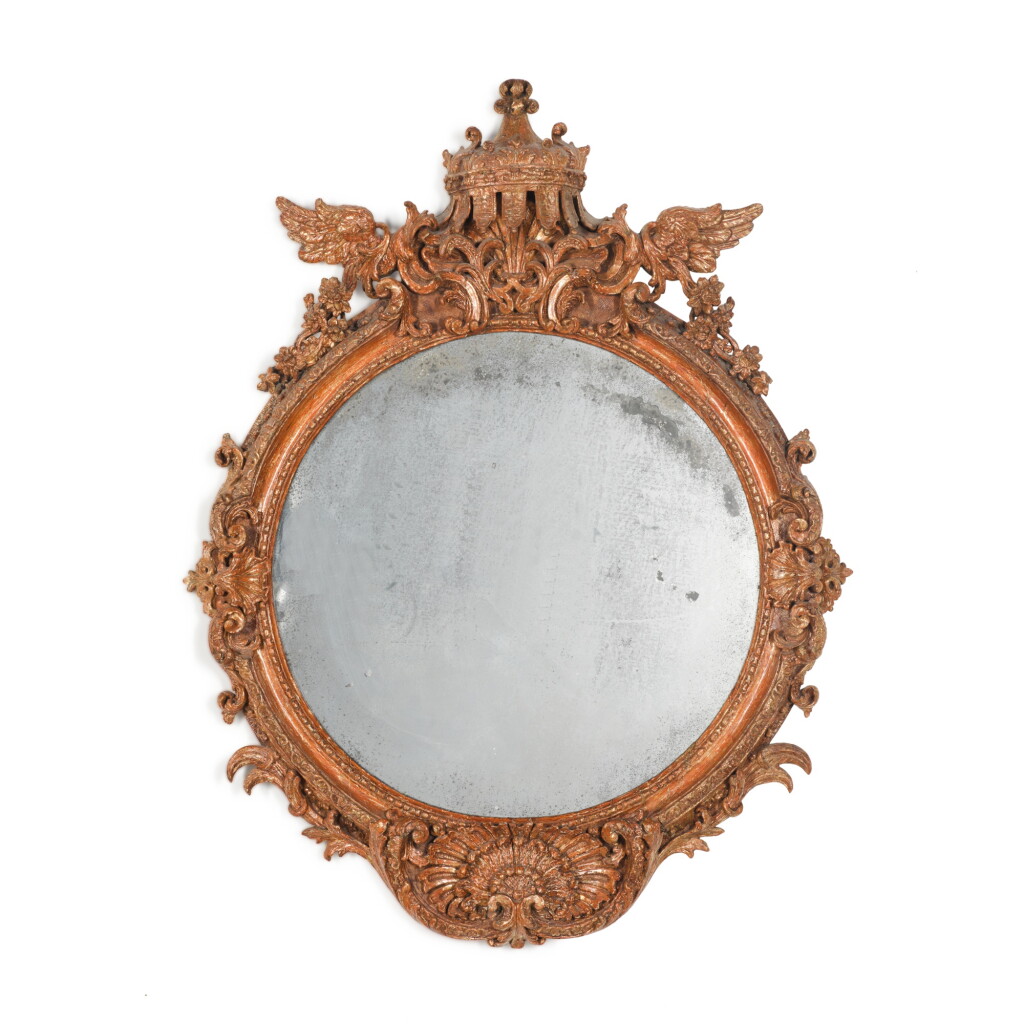
A Régence carved wood mirror, circa 1720
Lot Closed
May 23, 01:04 PM GMT
Estimate
8,000 - 12,000 GBP
Lot Details
Description
Property of a European Collector
A Régence carved wood mirror, circa 1720
the mirror plate of round shape, surrounded by a frame extensively carved with stylized foliage, the crest with a pair of wings on either side of a shell-shaped motif and surmounted by a crown
118cm. high, 93cm. wide
The circular shape of the present mirror is unusual but sophisticated ornamental solution for this period, used for overdoors, overmantels, and narrow panels between two windows (known as 'trumeau'), and was also adopted in armorial bearings and heraldic crests. The crown and wings at the top of the present lot, very finely carved, could well suggest a heraldic connection, and were adopted by the French royalty on numerous occasions.
The French Royal Arms flanked by wings often referred to the ‘Ailes de la Renommée’ or Wings of Fame, an extremely popular motif found in drawings, overmantels and Savonnerie rugs. The motif is reputedly derived from an Antique Roman decorative element used by Borromini in his decoration of the gallery of the Palazzo Pamphili in Rome around 1650. In France, the ‘Ailes de la Renommée’ appeared during Louis XIV’s reign on carpets designed by Charles Le Brun, some for the Grande Galerie in the Louvre and then by Robert de Cotte and Blain de Fontenay used it in for the rugs in the chapel of the Château de Versailles (see inv. no. V6273).
The ‘Ailes de la Renommée’ clearly have a strong connection to the French Royal arms, and further examples from the apartments of Queen Marie Leszczynska certify this fact. See for example a drawing by Ange-Jacques Gabriel, Louis XV’s principal architect, for a trumeau in the Queen’s bedroom sculpted by Jules Degoullons, Mathieu Legoupil and Jacques Verberckt (ill. Bruno Pons, De Paris à Versailles, 1986, figs. 300 and 301). Another example with wings, after a design by Gabriel and sculpted by Verberckt, is present in the Salon de la pendule at Versailles (Pons, op.cit., figs 312 and 313).
Another related example worth mentioning is a pair of gilt-bronze looking-glass frames with wings to the crest and made in 1742 by Jacques Caffieri. Made as a diplomatic gift from the King to Mahmud I, Sultan of the Ottoman empire, these mirrors have now vanished but a design for them by Ange-Jacques Gabriel (1698-1782) still exists ( illustrated in Alfred de Champeaux, ed., Portefeuille des arts décoratifs, 1888-98).
You May Also Like