
Property from the Collection of Robin Bradley Martin
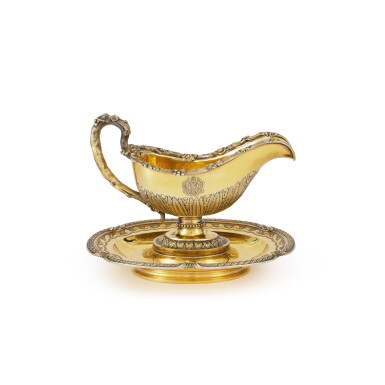
A Large Imperial Russian Silver-Gilt Sauce Boat And Stand, Nicholls and Plinke, St. Petersburg, Circa 1858
Lot Closed
October 17, 04:54 PM GMT
Estimate
7,000 - 10,000 USD
Lot Details
Description
A Large Imperial Russian Silver-Gilt Sauce Boat and Stand, Nicholls and Plinke, St. Petersburg, Circa 1858
sauce boat with screw-on stand, the rim applied with running laurel with acanthus at intervals and chased with Vitruvian scroll border, the boat rim applied with fruiting vine and body chased with rising stiff leaves and flowers, engraved on both sides with the Russian Imperial arms, fully marked on side and base of stand and with Imperial warrant, inventory numbers both engraved and stamped: No. 291
50 oz 4 dwt
1555 g
length 10 ⅝ in.
27 cm
This large sauce boat and stand is an extension of the Orloff Service, a 3000-piece dinner set for 60 people that was made for Empress Catherine the Great of Russia (1729-1796) and gifted to her lover, Count Gregory Orloff. Catherine originally sought the design from her friend Etienne-Maurice Falconet in Paris, who later moved to St. Petersburg to create a monumental bronze equestrian sculpture of Peter the Great. Using Falconet’s drawings, silversmiths Jacques Roettiers (1707-1789) and his son Jacques-Nicholas (1736-1788) produced the majority of the service, with additional pieces created by other silversmiths throughout the following century. Though the Orloff Service became one of the first complete silver sets executed in the neoclassical style, this later addition includes naturalistic ornamentation, as it was designed in St. Petersburg in 1858 by Nicholls and Plinke, English silversmiths who received Russian citizenship and a number of imperial commissions throughout the first half of the nineteenth century. After Orloff’s death in 1783, which occurred two decades after he led the coup that overthrew Catherine’s husband Peter and subsequently brought her to the throne, Catherine reacquired the set. Though the set was used at various Russian state dinners throughout the eighteenth and nineteenth centuries, the Soviet Government sold much of the collection in the 1930s.