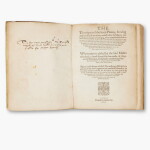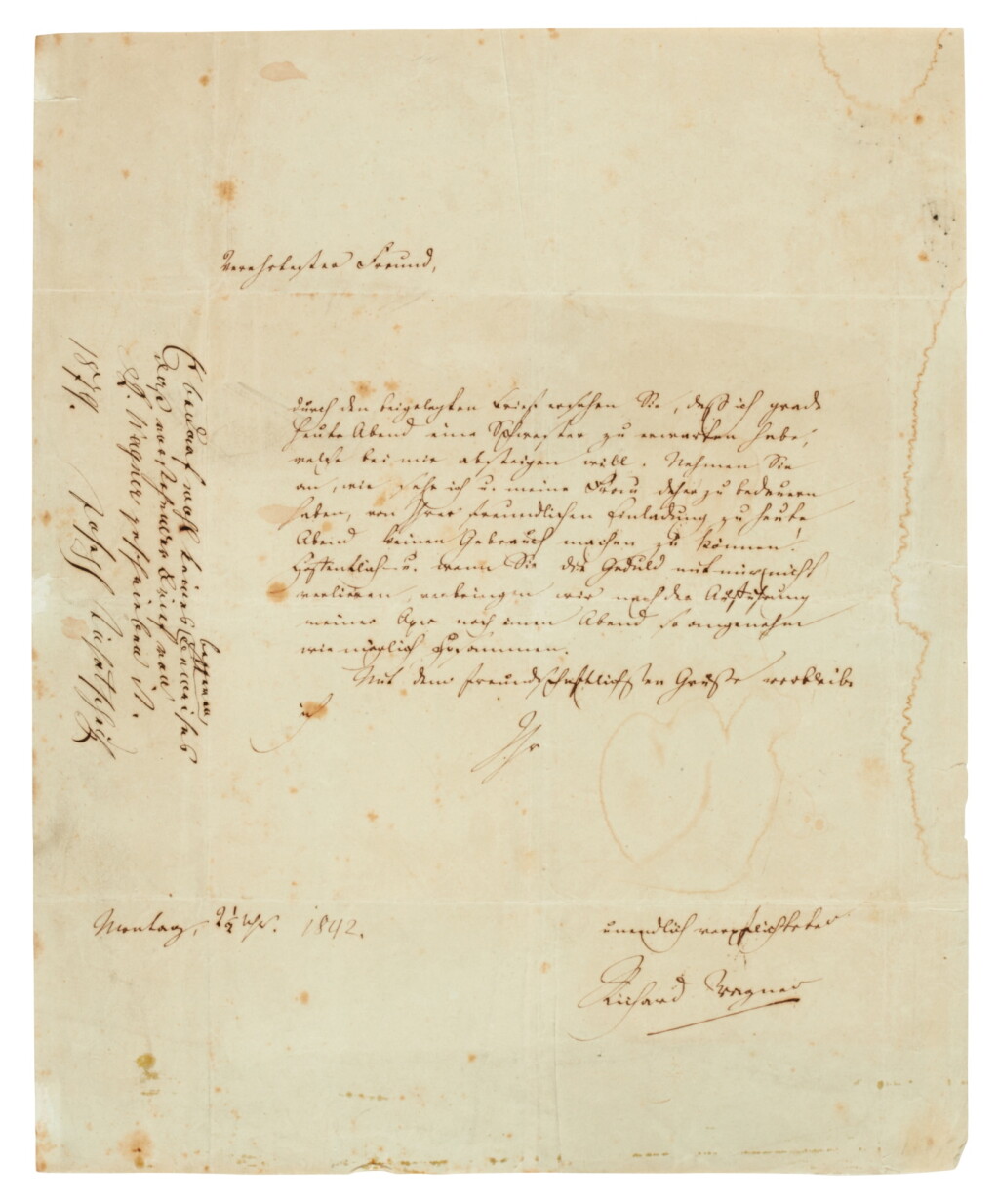
R. Wagner, Autograph letter signed, apparently unpublished, to Joseph Tichatschek, about "Rienzi", Dresden, 1842
Lot Closed
July 18, 01:55 PM GMT
Estimate
2,000 - 3,000 GBP
Lot Details
Description
Richard Wagner
Early autograph letter about Rienzi, signed ("Richard Wagner"), to Joseph Tichatschek, October 1842
regretting that he and his wife will not be able to take up his friendly invitation for that evening on account of the arrival of a sister of his [Klara Wagner], and expressing the hope that, if he doesn't lose patience with him, they can spend an evening together after the performance of his opera [Rienzi] ("...Hoffentlich - u. wenn Sie die Geduld mit mir nicht verlieren, verbringen wir nach der Aufführung meiner Oper noch einen Abend so angenehm wie möglich zusammen...")
1 page, 4to (27.7 x 22.5cm), integral autograph address-panel, with attestation of authenticity by Tichatschek to the left of the letter-text ("Es bedarf wohl keines besseren Beweises, daß vorstehender Brief von R. Wagner geschrieben ist. 1879 Joseph Tichatschek"), [Dresden,] Monday, half-past two, [17 October?] 1842, some staining and browning, half of the address-panel, presumably blank, cut away, old repair to outer edge of integral, a few tiny tears
UNPUBLISHED: Not in Sämtliche Briefe. A remarkable early letter by Wagner, written in the days preceding the triumphant première of his Dresden opera Rienzi to the Czech tenor Joseph Tichatschek (1807-1886), who created the title-role of the opera.
The famous premiere was described thus by Ernest Newman, based on Wagner's own account of the evening in his autobiography Mein Leben:
"...Wagner sat in a pit-box with Minna, the Heine family, and his sister Klara, who, with all her stage illusions shattered and all her hopes from that quarter vanished, was now dragging out a bourgeois existence in Dresden...Wagner sat for most of the time in one of those semi-cataleptic states that were frequent with him in moments of crisis. At the large audience he did not dare to look; its torrential applause affected him, he says, like some stupendous natural phenomenon, such as a storm of rain. From his own work he stood completely aloof; it neither gave him pleasure nor created any anxiety in him; he was in a somnambulistic state in which he appeared to be watching an event with which he had no personal connection; and at the end of each act he had to be roused by Heine and driven on to the stage to acknowledge the applause..." (Ernest Newman, The Life of Richard Wagner, i (R/1976), p.341.)
You May Also Like

![Cantor, Georg | Fernere Bemerkung über trigonometrische; [And:] Uber ein neues und allgemeines Condensationsprincip der Singularitaeten von Functionen, Halle, 1879 and 1882](https://sothebys-md.brightspotcdn.com/dims4/default/36a9bde/2147483647/strip/true/crop/2000x2000+0+0/resize/150x150!/quality/90/?url=http%3A%2F%2Fsothebys-brightspot.s3.amazonaws.com%2Fmedia-desk%2Fwebnative%2Fimages%2F66%2F39%2Fc61ed7f24bf0ac2557f0693e4122%2Fn12451-bkgzc-t3-02.jpg)