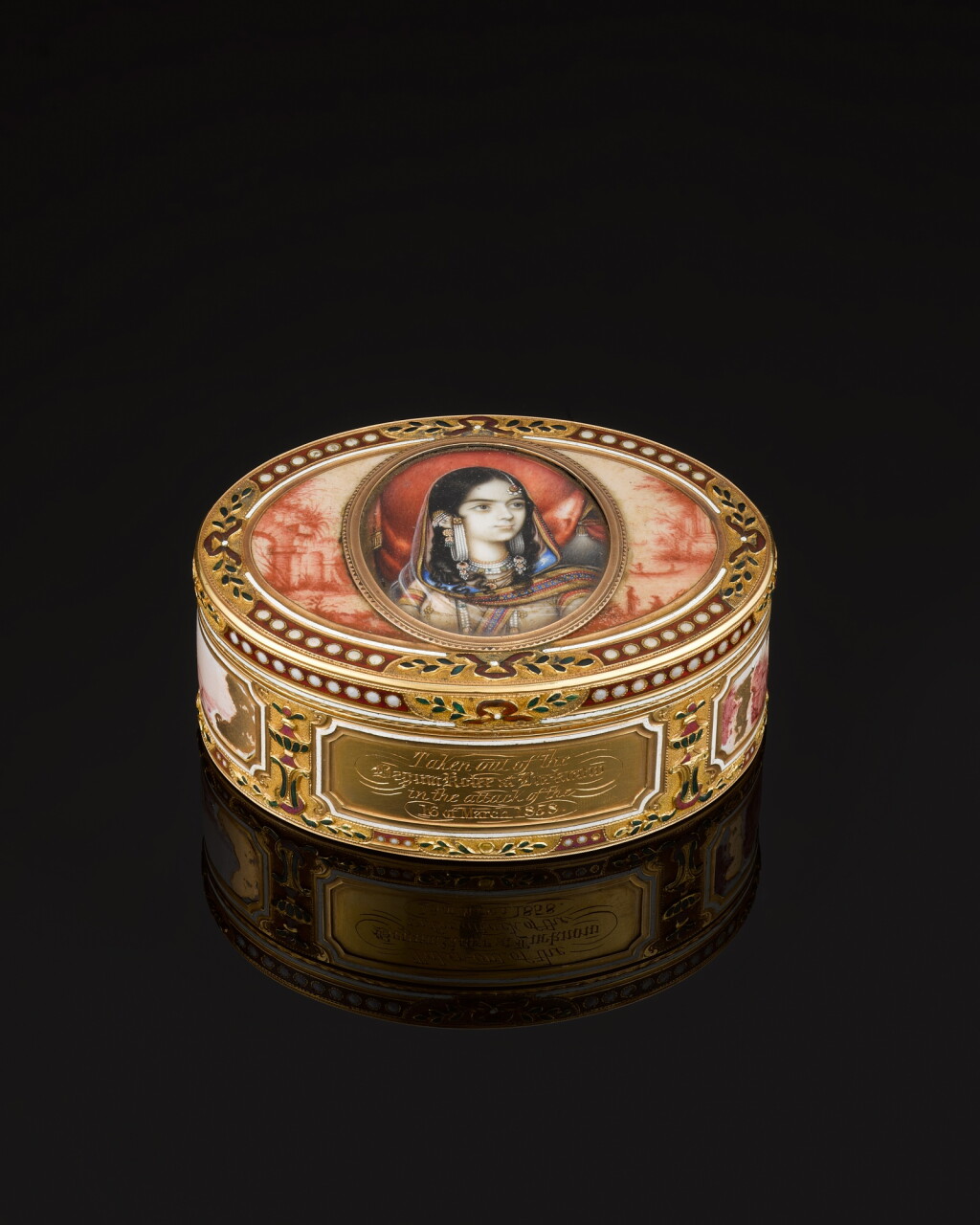
An enamelled gold presentation box by Esaias Obicker, Germany, Hanau, circa 1785, set with a portrait of a Mughal noblewoman, India, early 19th century; with a Mughal gem-set and inscribed jade bazuband, India, 18th/19th century
Auction Closed
October 25, 04:59 PM GMT
Estimate
7,000 - 10,000 GBP
Lot Details
Description
the German box of oval form, the exterior sides and base decorated with enamelled en camaieu scenes, the lid set with a later, 19th century Indian portrait of a Mughal lady painted with gouache on ivory, the interior of the box bearing French prestige marks including crowned Hanau maker's mark EO and charge mark of Eloy Brichard, the outside rim of the base with Hanau bird's head control mark for 19 ct. gold, the front of the box with an engraved inscription; with an associated 18th/19th century Mughal jade bazuband set with rubies and emeralds, a carnelian in the centre inscribed in Arabic with invocations to God by His attributes, the reverse with a carved flowerhead to centre and leaf motifs to sides
(2)
box: 3.3 cm. (height) by 8.3cm. (width) by 6.3cm. (depth);
bazuband: 7.8cm. (width)
inscriptions:'Taken out of the / Begum Kotee at Lucknow / in the attack of the / 16 of March 1858.'
The front of the box bears an important inscription. It states that the box was taken from the famous Begum Kothi in Lucknow on 16 March 1858. The box was possibly looted in the chaos that ensued after the Kothi was attacked by British forces on 11 March, during the reconquest of Lucknow. The Begum Kotee (or Begum Kothi) was a palace complex which belonged to Begum Hazrat Mahal, the second wife of Nawab Wajid Ali Shah of Awadh. She was an important leader during the Indian Rebellion, or the First War of Indian Independence, against the British East India Company in 1857. She also acted as Regent of Awadh from 1857-58. Her palace complex was one of the key centres for the revolutionary forces in Lucknow. The British attack on Lucknow began in March 1858 under the leadership of Sir Colin Campbell and Sir James Outram. The Begum Kothi was the scene of fierce fighting on 11 March, with over 600-700 Indian rebels being killed, and was severely damaged. Campbell's gunners blasted through the buildings between the Begum Kothi and Kaisar Bagh, the Nawab's palace, over the next few days, finally gaining control over the palace on 14 March. By 21 March, Lucknow had been been captured.
This beautifully enamelled gold box was produced as a presentation box in Hanau, Germany around 1785. Hanau boxes bearing the maker's mark 'EO' are quite rare and have only recently been attributed to the goldsmith Esaias Obicker. The enamelled en camaieu scenes on the sides, lid and base of the box are quite typical for that day. The early nineteenth century portrait of a Mughal lady would have been added to the lid of the box in India. It is worth noting that the colours of the portrait complement the tints employed for the en camaieu subject surrounding it. It is possible that the box initially belonged to a European living in India in the late eighteenth or early nineteenth century. It may have been gifted to the Nawab of Awadh or to a member of his family.
You May Also Like