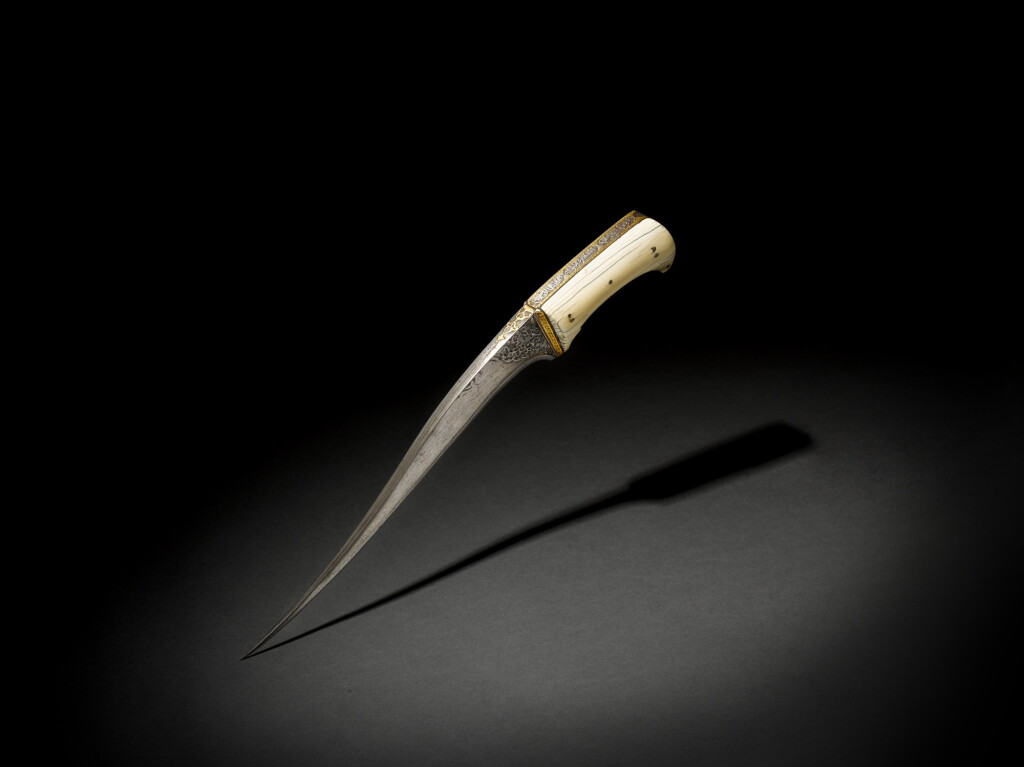
A watered-steel dagger (peshkabz) with marine-ivory hilt dedicated to Shah Isma'il I (r.1501-24), Persia, Safavid, dated 925 AH/1519-20 AD
Auction Closed
October 25, 04:59 PM GMT
Estimate
30,000 - 50,000 GBP
Lot Details
Description
the curved watered-steel blade chiselled around the forte on both sides with split palmettes and arabesques, with broad flatted back overlaid with a gold trefoil motif, the marine-ivory hilt in two sections divided by a steel band with inscriptions and overlaid in gold
44.1cm. length
inscriptions:
In nasta'liq:
hasb al-irshad shah isma'il safavi waliyeh (sic) iran khanjar behbud tayyar shodeh sanah 925
'The dagger has been prepared by the order of Shah Isma'il Safavi, the governor (sic) of Iran, the year 925 (1519-20 AD)'
In Arabic:
li khamsah atfa biha hurr al-waba al-hatimah
al-mustafa wa al-murtada wa [a]bnahuma [wa] al-fatimah
'I have five (persons) by whom I extinguish crushing plague (cholera):
al-Mustafa (i.e Prophet Muhammad), al-Murtada (i.e. ‘Ali) and their sons (i.e. Hasan and Husayn) and Fatimah'
The treatment of the split-palmette decoration around the forte of the blade relates to the gold arabesque found on the black jade jug inscribed with the name of Shah Isma'il in the Topkapi Saray (see S. Canby, The Golden Age of Persian Art, London, 1999, fig.14, p.27). This distinctive spiraling arabesque is also found in contemporaneous manuscript illumination and in the tilework of the Harun-i Vilayat in Isfahan which was completed in 1512.
You May Also Like