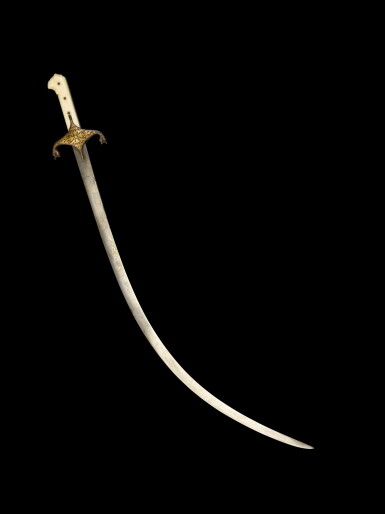
A marine-ivory hilted sword dedicated to Süleyman the Magnificent (r.1520-66), the blade, Persia, Safavid, early 16th century; the hilt, 18th century
Auction Closed
October 25, 04:59 PM GMT
Estimate
100,000 - 150,000 GBP
Lot Details
Description
A marine-ivory hilted sword dedicated to Süleyman the Magnificent (r.1520-66), the blade, Persia, Safavid, early 16th century; the hilt, 18th century
with curved single-edged finely watered-steel blade, each side inlaid in gold with an inscription in naskh, the marine-ivory hilt with dragon head quillons, with gold overlaid floral motifs
0
90.4cm. length
inscriptions:
‘ala allah fi kull al-umur tawakkuli wa bi-khams [as]hab al-‘aba tawassuli hadha husam mu‘tabar harz li-sultan al-bashar sultan sulayman ibn salim allah ya‘tihi al-zafar,
‘My trust is in God in all affairs and I have recourse to the Five Companions of the Cloak. This is a venerated sword, an amulet for the sultan of mankind, Sultan Sulayman ibn Salim, may God grant him victory.’
Qur’an, surah al-Talaq (LXV) middle of verse 2 to end of verse 3.
The elegant, slender curved blade of this sword produced from finely watered steel illustrates the high standard of Safavid sword manufacture. The term 'watered' or 'Damascus' steel can be used to describe a blade where the surface of the steel resembles water ripples and requires crystallisation in a crucible. Artifacts displaying the beauty of high-quality watered steel such as this are highly coveted because the technique was lost to metalsmiths across the region in the eighteenth century (Burton 1884, p.111). The process is described at length by the famous ninth century philosopher Ya‘qub ibn Ishaq al-Kindi in his treatise ‘On swords and their kinds’ (Hoyland and Gilmour 2004, pp.59, 69, 105 and 146). Watered steel blades were not simply visually compelling, but enhanced the martial potential of the weapon by combining hardness with elasticity and could be sharpened to a very fine, tough edge (Coe 1989, p.144).
Blades such as the present example were prized during the Safavid period, as shown by a sword of Shah ‘Abbas I in the Topkapi Palace Museum (inv. no.1/2529, see Ayhan 2010, p.101). It is likely that the present blade came into possession of the Ottomans after the Battle of Chaldiran in 1514 when Sultan Selim conquered Tabriz. Contemporaneous accounts attest to the vast array of objects that were looted from the battlefield and the Hasht Bihisht Palace following the Ottoman victory, ranging from textiles to jewellery to arms and armour (Genç 2015). It is possible that the blade was captured at this time and retained by the Ottomans who would have recognised its fine quality, deeming it worthy of Sultan Suleyman's armoury. Another possibility is that the blade was produced in Turkey by Persian craftsmen who were captured and brought back to the Ottoman capital.
Several swords dedicated to the Sultan are held in the Topkapi Palace Collection (inv. nos.1/95, 1/459, 1/478 and 1/467, Ayhan 2010, pp.67-69). A further example is in the Louvre (inv. no.OA 7088) and another is in the Askari Museum, Istanbul (inv. no.20). The inscriptions tend to follow a similar formula, with three of the above examples including surah al-Talaq, v.3 (Topkapi inv. no.1/467, Louvre inv. no.OA 7088 and Askari inv. no.20). Our blade also contains verses from surah al-Talaq v.3 but presents an extended inscription comprising parts of the preceding verse. The general formular of the dedication to the Sultan is also comparable among the group, the same phrasing used on the Louvre example and the Topkapi sword (inv. no.1/459).
The style of the inscriptions, however, varies between the group. One published example comprises dense naskh inscriptions on a thickly applied gold ground (Topkapi, inv. no.1/478), while the other above examples in the Topkapi and the Louvre bear similar inscriptions inscribed in a relatively neat thuluth. Stylistically, the present sword relates most closely to the Askari sword in which the craftsman has employed a similarly flowing thuluth applied on a fine Persian blade.
You May Also Like