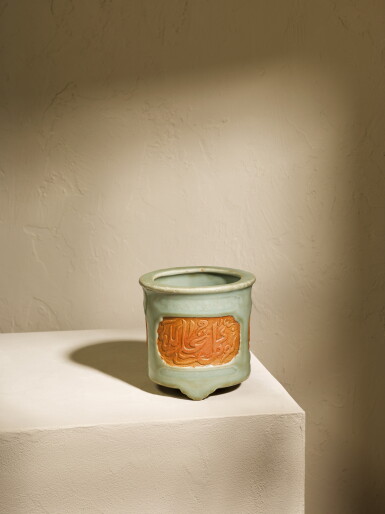
A ‘Longquan’ celadon censer with Islamic inscriptions, China, probably Ming Dynasty, 15th century
Auction Closed
April 26, 01:36 PM GMT
Estimate
20,000 - 30,000 GBP
Lot Details
Description
the low cylindrical body with three wide central cartouches with Arabic inscriptions, each between two narrow bands of detached floral spray cartouches, the vessel covered with a thick glaze of olive-green except for the cartouches of inscriptions and a carved circular area on the underside, both revealing the fine grey body burnt orange, upon three sturdy triangular legs
12.6 cm. diam.; 12.4 cm. height
inscriptions
tawakkul ‘ala allah / ‘izzat al-akhirah bi’l-a‘mal / allah mufattih al-abwab
‘Reliance on God. The glory of the afterlife is [the reward for] actions. God, The Opener of (all) Doors’
Longquan celadons were among the finest of a range of celadon wares produced in China and were widely imported in the Middle East between the thirteenth and fifteenth centuries. Various accounts from European officials demonstrate the popularity of these vessels in Islamic lands: Mamluk Sultan Qaytbay would have gifted some to Lorenzo di Medici in 1487 (M. Milwright, 'Pottery in the Written Sources of the Ayyubid-Mamluk Period (c.567-923/1171-1517)', Bulletin of the School of Oriental and African Studies, University of London, Vol.62, p.116), while Jean Baptiste Chardin recounts that Chinese celadon was thought to detect and neutralise poison in Safavid Persia (A. Lane, Later Islamic Pottery, London, 1957, p.72). Various types of Longquan wares can be found in the collections of the Ardebil Shrine, Tabriz and the Topkapi Saray, Istanbul, in addition of substantial archaeological finds in Syrian and Egyptian sites (M. Milwright, p.517). While it is known that Longquan vessels were expressly made for the Islamic market, examples with Arabic inscriptions such as the present lot are far rarer.
This was more commonly encountered in bronze vessels, including a censer with Arabic cartouches sharing similar features with our celadon example, sold in Sotheby’s Hong Kong, 3 April 2012, lot 143.
You May Also Like