
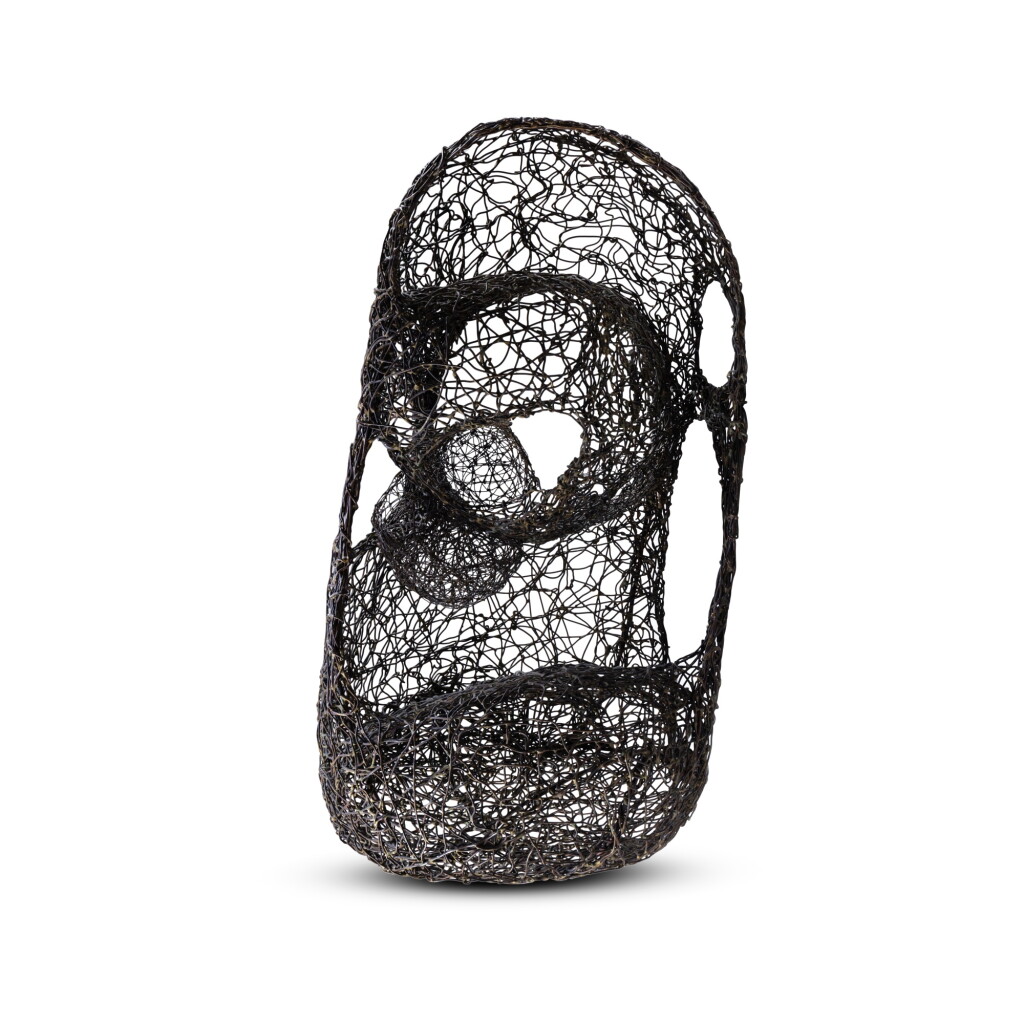
Property from the Historic Collection of Michel Tapié I Provenant de la Collection Historique de Michel Tapié
Claire Falkenstein
Involuting Zero
Lot Closed
December 7, 02:35 PM GMT
Estimate
15,000 - 20,000 EUR
Lot Details
Description
Property from the Historic Collection of Michel Tapié
Claire Falkenstein
1908 - 1997
Involuting Zero
brass and silver
76 x 42 x 44 cm; 29 ⅞ x 16 ½ x 17 ⅜ in.
Executed in 1956.
__________________________________________________________________________
Provenant de la Collection Historique de Michel Tapié
Claire Falkenstein
1908 - 1997
Involuting Zero
laiton et argent
76 x 42 x 44 cm; 29 ⅞ x 16 ½ x 17 ⅜ in.
Exécuté en 1956.
Michel Tapié, Paris
Thence by descent to the present owner
__________________________________________________________________________
Michel Tapié, Paris
Puis par descendance au propriétaire actuel
Michel Tapié, Claire Falkenstein, Rome, 1958, p. 22, illustrated
Luigi Moretti, Michel Tapié and Friedrich Bayl, Eds., Musée-Manifeste Structures et styles autres, Turin, 1961, n.p., illustrated
__________________________________________________________________________
Michel Tapié, Claire Falkenstein, Rome, 1958, p. 22, illustré
Luigi Moretti, Michel Tapié et Friedrich Bayl, Eds., Musée-Manifeste Structures et styles autres, Turin, 1961, n.p., illustré
American artist Claire Falkenstein met Michel Tapié in the early 1950s, when she moved to Paris, like other compatriots, such as Paul Jenkins and Sam Francis, after studying under Alexander Archipenko in California and working as a sculptor in San Francisco. The French critic took a great interest in her sculptures, in which he detected an expression “of another kind”, to the point of including her in his "stable" of artists and devoting several exhibitions to her, notably at Rive Droite gallery and Stadler.
In one of the many texts Tapié wrote about Falkenstein, in 1956 he wrote: "Since 1951, she has worked almost exclusively with metal networks, which lend themselves to very complex structures, where the inside plays an equally important role as the outside" (Catalogue text for the Falkenstein exhibition at the Galerie Rive Droite, Paris, 1956). Two years later, he went so far as to declare that "Claire Falkenstein is probably the artist who has most brought Sculpture to the heart of what the artistic epopee of today must be" (Catalogue text for the Falkenstein exhibition at Il Segno Gallery, Rome, February 1958).
This almost ancestral way of manipulating wires of iron, brass or silver to achieve abstract organic forms, like a modern Hephaestus, is exceptionally evidenced by the two mysterious sculptures presented in the auction, Personnage, and Involuting Zero, dated 1956. Moving mysteriously between emptiness and matter, these two sculptures trace Falkenstein's magical exploration of the third dimension.
____________________________________________________________________________
L'artiste américaine Claire Falkenstein rencontre Michel Tapié au début des années 1950, lorsqu'elle s'installe à Paris, comme d'autres compatriotes, tels Paul Jenkins et Sal Francis, après avoir étudié auprès d'Archipenko en Californie et travaillé comme sculpteur à San Francisco. Le critique français s'intéresse beaucoup à ses sculptures, dans lesquelles il décèle une expression "autre", au point de l'inclure dans son "écurie" d'artistes et de lui consacrer plusieurs expositions, notamment à la galerie Rive Droite et chez Stadler.
Dans l'un des nombreux textes que Tapié consacre à Falkenstein, il écrit en 1956 : « Depuis 1951, elle travaille presque exclusivement avec des réseaux métalliques qui se prêtent à des structures très complexes, où l'intérieur joue un rôle aussi important que l'extérieur » (Texte pour l'exposition Falkenstein à la Galerie Rive Droite, Paris, 1956). Deux ans plus tard, il ira jusqu'à déclarer que « Claire Falkenstein est probablement l'artiste qui a le plus amené la Sculpture au coeur de ce que doit être l'épopée artistique d'aujourd'hui » (Texte pour l'exposition Falkenstein à la Galerie Il Segno, Rome, février 1958).
Cette façon quasi ancestrale de manipuler des fils de fer, de laiton ou d'argent pour obtenir des formes organiques abstraites, tel un Héphaïstos moderne, est exceptionnellement mise en évidence par les deux mystérieuses sculptures présentées dans la vente, Personnage et Involuting Zero, de 1956, qui ont fasciné Tapié lui-même, qui les a incluses dans sa collection. Évoluant mystérieusement entre le vide et la matière, ces deux sculptures retracent l'exploration magique de la troisième dimension par Falkenstein.