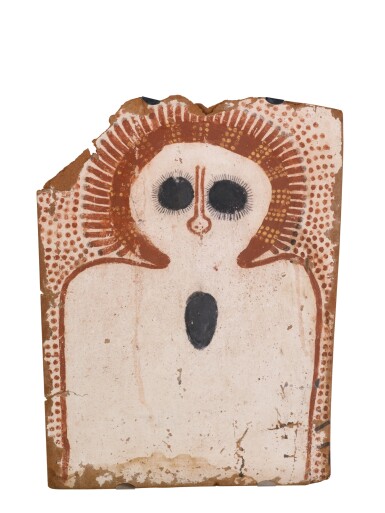
Charlie Numbulmore
The Wanjiina at Mamadayi
Auction Closed
May 23, 09:01 PM GMT
Estimate
30,000 - 50,000 USD
Lot Details
Description
Charlie Numbulmore
circa 1907-1971
The Wanjiina at Mamadayi, circa 1970
Natural earth pigments on masonite
18 ⅛ in x 14 ⅛ in (46 cm x 36 cm)
Found at Mowanjum, Kimberley, 1973 (after the artist had died)
Kim Akerman Collection
Mary Macha, Perth
The Thomas Vroom Collection, The Netherlands
Sotheby's, London, Aboriginal Art - Thomas Vroom Collection, June 10, 2015, lot 54
Private Collection
Kim Akerman, "Wanjina - Notes on some Iconic Ancestral Beings of the Northern Kimberley", http://www.kimberleyfoundation.org.au/akerman-2014/p.61 illus
Painted in about 1970, possibly at the time Helen Groger-Wurm was commissioning paintings from Numbulmore, this painting had been lost behind a cupboard in the small room that served as a craft centre at the 'old' Mowanjum community. It was found in 1973 when the centre was moved to a new location in the community. Numbulmore was known to have re-painted Wanjina figures at the rock shelter at Mamadayi and David Mowaljarli believed this figure to represent the same Wanjina. Numbulmore's Wanjina paintings are generally readily identifiable. Those that represent the head and shoulders only are usually solid white figures (invariably derived from the mineral huntite) with details added in red, black and yellow. In the centre of the chest a solid (usually black, but occasionally red) oval form is said to depict the sternum, heart or a pearl shell pendant. The almost circular heads are surrounded by a very regular halo that represents a headdress (and hair, clouds and/or lightning). The large, round, black eyes fringed with short, delicate lashes usually occupy a greater proportion of the head in Numbulmore's Wanjinas than in those painted by other artists. Similarly, his Wanjinas have well defined, long narrow parallel-sided noses, flared at the very tip, with the nostrils invariably depicted. In the final creative burst before his death, Numbulmore began to give his Wanjina figures mouths and sometimes bodies, rather than portray only the head and shoulders. Since his death in 1971, just eleven paintings of Wanjina on bark and board by Numbulmore have appeared on the secondary market at auction, and it is significant to note that in only two of these paintings, Wanjina have been depicted without mouths.
Kim Akerman, 2015
You May Also Like