Laurence MacDonald
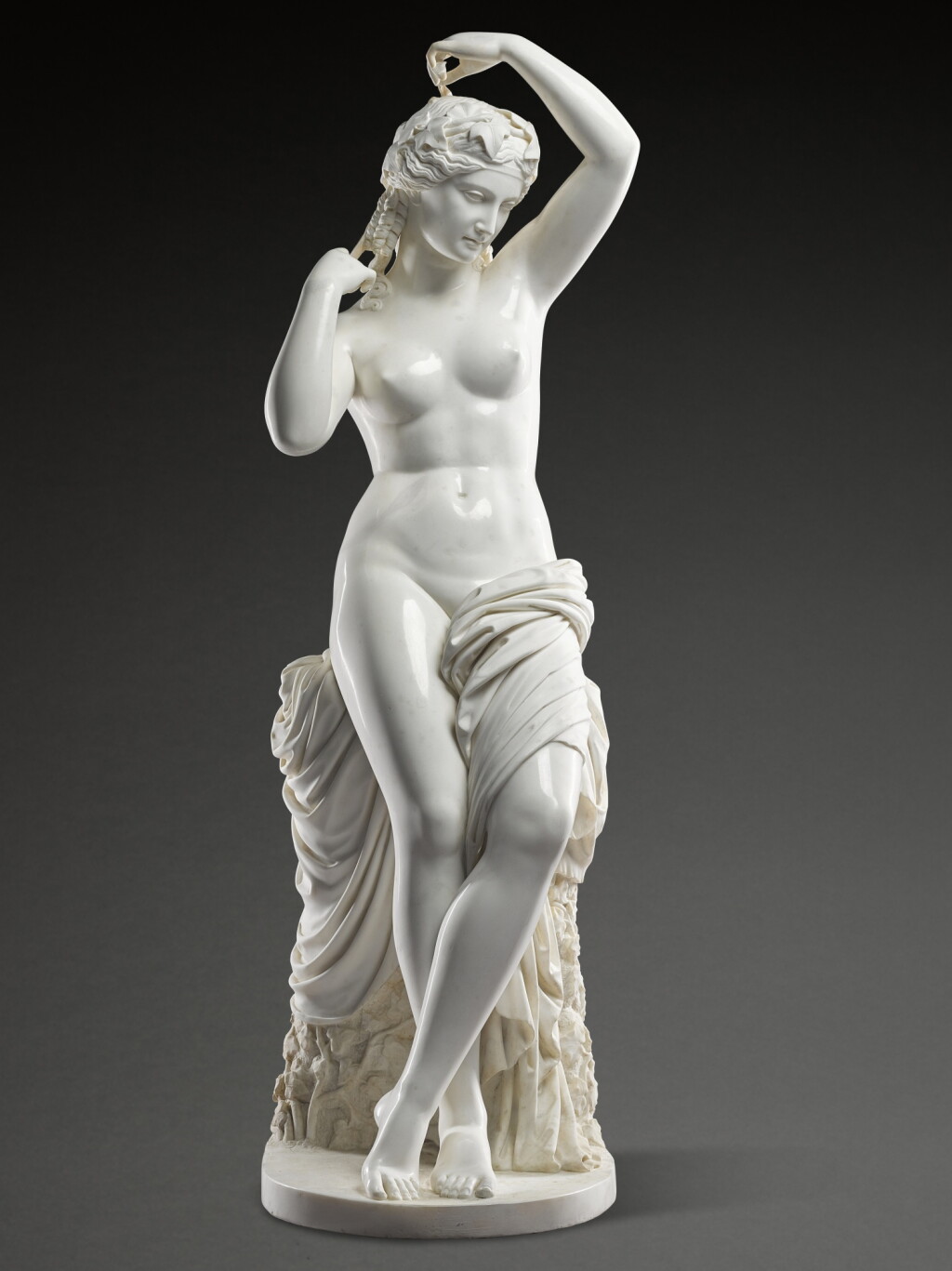
Bacchante tying her hair
Lot Closed
July 12, 11:46 AM GMT
Estimate
30,000 - 50,000 GBP
Lot Details
Description
Laurence MacDonald
British
1799 - 1878
Bacchante tying her hair
signed and dated: L. MACDONALD / FECIT ROMAE / 1862
white marble
155cm., 61in.
Lawrence Macdonald, born at Bonnyview, Findo-Gask, Perthshire, was a Scottish Neoclassical sculptor who spent most of his life working in Rome. He first moved there in late 1822 and stayed for three years, setting up a sculpture studio and became a founding member of the British Academy of Arts in Rome, focusing on portrait busts. His contemporaries and colleagues included John Gibson and Richard James Wyatt, and together they formed a group of leading British sculptors working in the Neoclassical style. Macdonald immediately attracted the patronage of important Scottish tourists, and commissioning a Macdonald portrait bust was soon thought of as ‘indispensible’ to a visit to the city (Roscoe op. cit. p. 776). Returning to Edinburgh in 1826, he exhibited a number of his busts, together with a statue of a Boy Slinging (1823). In 1829 and 1830, he organised further exhibitions of his work, focussing on ideal statuary and more portrait busts. Although he was thus soon renowned in Scotland and the rest of Britain as one of its preeminent sculptors (in 1830 the Edinburgh Literary Journal described him as 'our Canova'), Macdonald returned to Rome in 1832 and remained there for the rest of his career. Lawrence Macdonald was closely acquainted with Bertel Thorvaldsen, who was active in Rome until his death in 1844 - Macdonald inherited Thorvaldsen's studio in the Palazzo Barberini. Stories from contemporaries suggest he was a man with an extremely active life - often already out and about by 5.30 in the morning, he is said to have produced nearly 100 portrait busts in the year before his death. In 1852, a visitor to his studio remarked, ‘This artist’s studio is a real British Walhalla. It contains upwards of 300 busts of the British nobility and the most celebrated men of the day’ (Morning Chronicle, 19 February 1852). Lawrence’s son Alexander Macdonald, born in Rome in 1847, joined his studio at some point in the 1860s as an assistant. He also carved Lawrence’s tombstone after his father's death in 1878, and continued working in the Barberini studio, successfully establishing himself as a sculptor in his own right.
The Bacchante was one of Macdonald's most successful models. First recorded in 1841 by his biographer Count Hawks Le Grice, a version of the model was exhibited at the Royal Academy of Arts in London in 1842 (no. 1293). Macdonald carved a number of versions of the Bacchante for British aristocrats in the 1850s. These include the example for Lord Londonderry, which is today at Mount Stewart, County Down (inv. no. NT 1221034.1). In his entry on the Londonderry marble, Jeremy Warren notes that the sculptor executed versions for Lord Kilmorey (1852), Lord Ward (1857), and the Fitzwilliam family (a marble was formerly at Wentworth Woodhouse). Another version was owned by Charles Jenner, who loaned it to exhibitions at the Royal Scottish Academy in 1865 and 1880. Warren suggests that the Londonderry marble was probably acquired by the 4th Lord Londonderry in the late 1850s. He points out that, whilst Macdonald's Bacchante finds no close precedent in ancient Greek and Roman sculpture, it shares some similarities with small bronzes by the French sculptor Barthélémy Prieur (circa 1536-1611). See, for example, the bronze of a woman bathing at Anglesey Abbey (NT 515010) (for all of the above, see Warren, op. cit.).
RELATED LITERATURE
H. Le Grice, Walks through the Studii of the Sculptors at Rome, I, p. 82; I. Roscoe, E. Hardy and M.G. Sullivan, A Biographical Dictionary of Sculptors in Britain, 1660-1851, pp. 775-781; M. Greenwood, 'Macdonald, Lawrence (1799-1878)', in Oxford Dictionary of National Biography, 2004, online edition available at https://doi.org/10.1093/ref:odnb/17445 [page accessed 25/10/2018]; J. Warren, Laurence Macdonald: A Bacchante tying her hair, September 2022 [https://www.nationaltrustcollections.org.uk/object/1221034.1] accessed 21 June 2023
You May Also Like