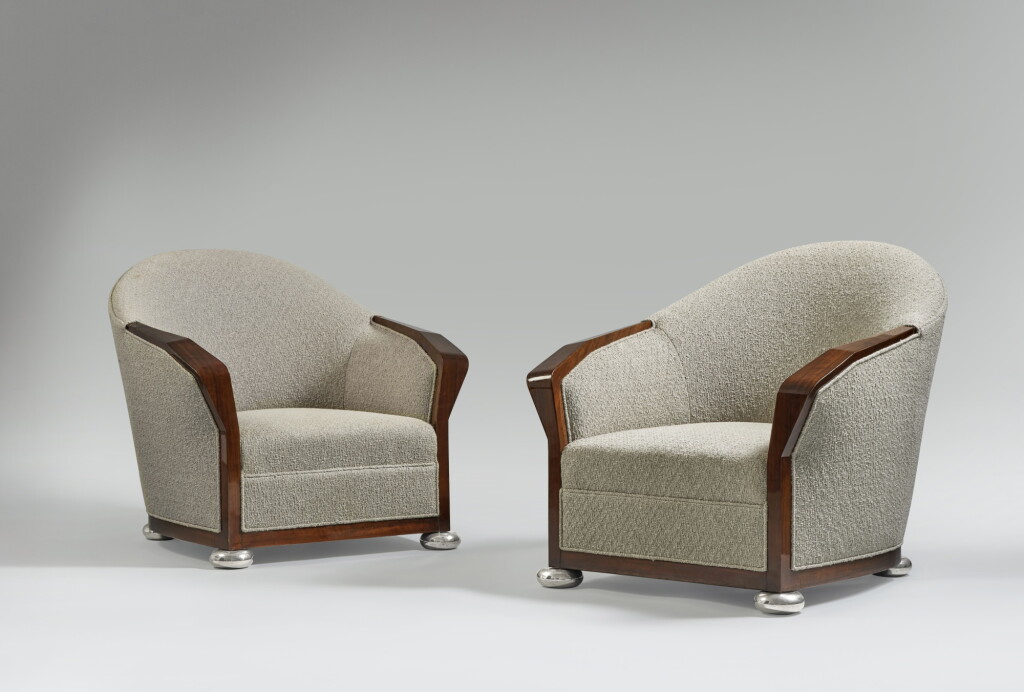
Pierre Chareau
Pair of Armchairs from the Grand Hôtel de Tours
Auction Closed
December 6, 07:17 PM GMT
Estimate
150,000 - 250,000 USD
Lot Details
Description
Pierre Chareau
Pair of Armchairs from the Grand Hôtel de Tours
circa 1928
model no. MF158
walnut, nickel-plated bronze, fabric upholstery
28¼ x 28½ x 33¼ inches (71.8 x 72.4 x 84.5 cm) each
DeLorenzo Gallery, New York
Mr. and Mrs. Robert Krikorian
DeLorenzo Gallery, New York
Acquired from the above by the present owner, 2006
Yves Rambosson, "Le Salon des Décorateurs," L'Amour de l'Art, June 1924, p. 193
Tisserand, "Une œuvre nouvelle de Pierre Chareau ensemblier," L'Art et les Artistes, January 1928, pp. 131-132
Gaston Varenne, "Un ensemble de Chareau," L'Amour de l'Art, February 1928, pp. 60 and 62
Yves Rambosson, "Un Grand Hôtel à Tours," Art et Décoration, February 1928, p. 35 (for a period photograph of the model at the Grand Hôtel de Tours, 1928)
René Chavance, "Quelques exemples d'installations modernes, rue Mallet-Stevens," Mobilier et Décoration, April 1928, pp. 161-162
Marc Vellay and Kenneth Frampton, Pierre Chareau: Architecte-Meublier 1883-1950, Paris, 1984, pp. 70 and 72-73 (for period photographs of the model at the Grand Hôtel de Tours, 1928), 99, 194 and 315
Pierre Chareau: Modern Architecture and Design, exh. cat., Jewish Museum, New York, 2016, p. 60 (for a period photograph of the model at the Grand Hôtel de Tours, 1928)
In 1928, Pierre Chareau designed the interior of the Grand Hôtel of Tours for Paul Bernheim at the recommendation of his uncles Emile and Edmond Bernheim, who had commissioned Chareau two years earlier to design the interior of the clubhouse at Beauvallon Golf Club near Saint-Tropez. For this project, Chareau collaborated with the Dutch architect Bernard Bijvoet, who would prove instrumental in the development of his pioneering design ideology where furniture, interior design and architecture were thought of as a whole and conceived of through the lens of functionalism. Chareau was unique in rejecting mass production while embracing modern technology and materials, and finding success in integrating modern materials with fine craftsmanship in line with the traditions of the French decorative arts.
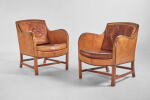
The present pair of armchairs were original to the hotel and exemplify Chareau’s balanced juxtaposition of elegance and modern materials and form. The chairs are upholstered and outlined at the bottom and front edges in rich walnut shaped with soft yet dramatic angular form. Each chair rests on four flattened spherical feet of nickel-plated bronze. Much like the grand scheme of the hotel interior, the chairs emulate a sense of luxury while embodying a modernity of lines and form. As a modernist, Chareau designed the hotel around the function and utility of each room. He employed avant-garde techniques to divide and connect rooms such as the adjustable panels installed between the bar and smoking room. In addition to refined materials such as alabaster, walnut and fine textiles, Chareau integrated wrought iron, opaque glass and rubber flooring.
The present pair of armchairs mark a unique opportunity to acquire objects from one of Chareau’s earliest commissions, which was fundamental in his development of a radical and innovative design ideology that distinguished him from other modernists of the interwar period.
You May Also Like