Gio Ponti
A Rare Sofa for Palazzo Liviano, University of Padua
Live auction begins on:
October 22, 02:00 PM GMT
Estimate
30,000 - 50,000 USD
Bid
20,000 USD
Lot Details
Description
Gio Ponti
1891-1979
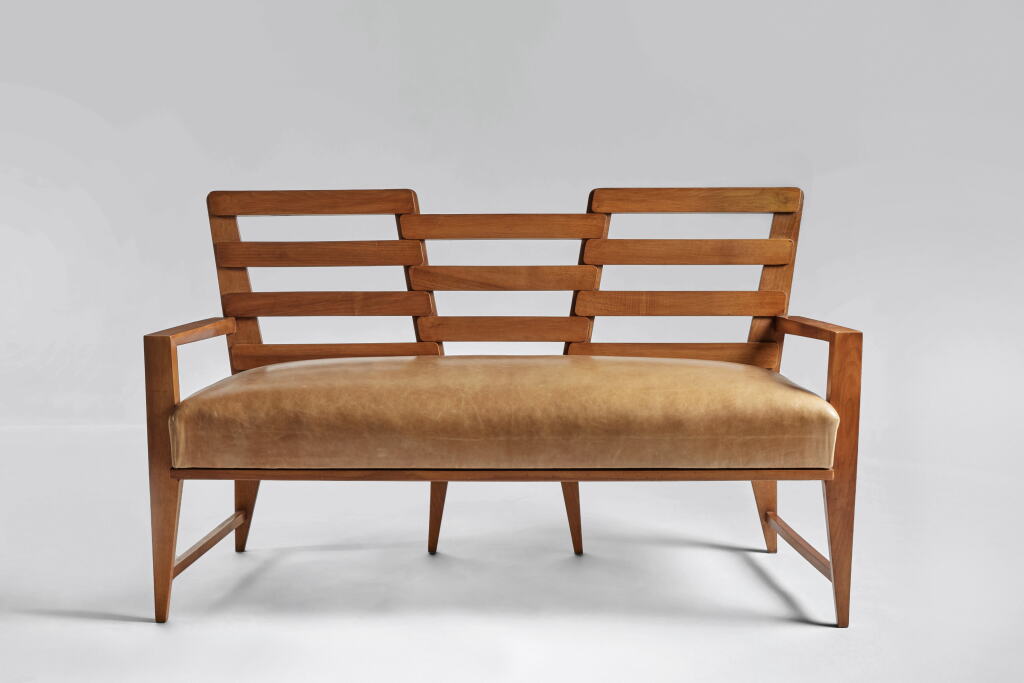
A Rare Sofa for Palazzo Liviano, University of Padua
circa 1939
produced by Fratelli Scremin, Belluno, Italy
with manufacturer's plaque MOBILI D'ARTE/SCREMIN/BELLUNO
French walnut, leather upholstery
height 35 in.; width 59 ¼ in.; depth 25 ¾ in.
89 cm; 150.5 cm; 65.5 cm
Palazzo Liviano, University of Padua, Padua, Italy;
Private Collection, New York;
Wright Chicago, November 19, 2015, lot 3;
Where acquired by the present collector.
Modern Living: Gio Ponti and the Twentieth-Century Aesthetics of Design, Georgia Museum of Art, Athens, June 10-September 17, 2017
Mario Universo, Gio Ponti Designer: Padova 1936-1941, Rome, 1989, p. 50
Irene De Gutty and Maria Paola Maino, Scremin: Mobili d'arte, Padua, 1997, p. 67
Laura Falconi, Gio Ponti: Interiors, Objects, Drawings, 1920-1976, 2004, pp. 121-123 (for a discussion on the commission)
Modern Living: Gio Ponti and the Twentieth-Century Aesthetics of Design, exh. cat., Georgia Museum of Art, Athens, 2017, p. 50
This lot is accompanied by a letter of expertise from the Gio Ponti Archives.
Gio Ponti, an icon of 20th century Italian design, tested how traditional craftsmanship could coexist with the methods of modern manufacturing. He began his architectural training at the Politecnico di Milano in 1914 only to have World War I soon interrupt his education. After several years as a captain in the Pontonier Corps, he returned to complete his degree in 1921. Over the following decade, his work reflected Italy's neoclassical Novecento movement, though the founding of Domus magazine in 1928 signaled his growing interest in new directions for design. By the 1930s, while teaching at his alma mater, he had begun to translate these interests into practice, developing a design portfolio that integrated artistic expression with industrial production.
In 1934, Ponti received the commission to design the Palazzo Liviano for the University of Padova’s School of Philosophy and Letters. The project allowed him to work on the building’s interiors, furnishings, decoration, and art, from modern and ancient artworks to its frescoes, enabling Ponti to unite architecture, design, and art under a single vision.
The furniture produced for this commission was diverse, encompassing sofas, tables, chairs, and armchairs in a variety of forms. Working within the university’s limited budget, Ponti used materials such as beech, walnut, cherry, oak, and chestnut. Production was divided between factories equipped for large-scale manufacture, including Melchiorre Bega’s company in Bologna, Meroni & Fossati in Brianza, and independent craftsmen throughout Lombardy, Veneto, and Liguria. To ensure both elegance and durability, Ponti required components to be cut from matched boards so that their grain aligned seamlessly, veneers and woods to be sufficiently thick for structural integrity, and all joinery and hardware to remain concealed.
The present sofa was produced for this commission by the craftsmen of Fratelli Scremin in Belluno around 1939. Its tapered, double-flared silhouette gives the piece a lighter appearance than its actual scale, characteristic of the furniture Ponti was designing at the time. Although the university’s archives indicate that eleven examples were ordered, manufacturer records reflect that only six were completed, highlighting the sofa’s rarity within Ponti’s body of work. Like the Palazzo Liviano as a whole, the sofa reflects Ponti’s effort to unite skilled craftsmanship and modern production, bringing art, industry, and design together in a modern expression.
You May Also Like