
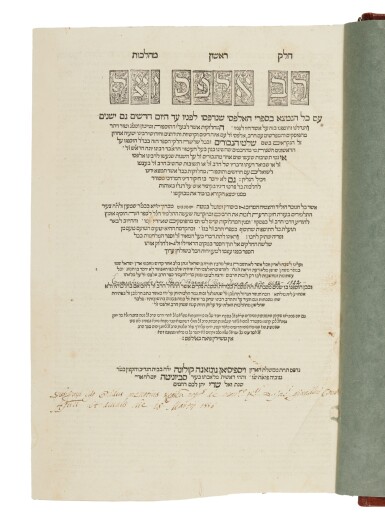
Hilkhot Rav Alfas (Halakhic Code), Rabbi Isaac ben Jacob Alfasi, Sabbioneta: Tobias Foa, 1554-1555
Lot Closed
December 20, 06:16 PM GMT
Estimate
3,000 - 5,000 USD
Lot Details
Description
Hilkhot Rav Alfas (Halakhic Code), Rabbi Isaac ben Jacob Alfasi, Sabbioneta: Tobias Foa, 1554-1555
Rabbi Isaac ben Jacob Alfasi (Rif; 1013-1103) was a transitional figure who lived on the seam between the period of the ge’onim and that of the rishonim. A native of northern Algeria who received his education in Kairouan, Rif resided for much of his life in Fez (hence the surname Alfasi) until about the age of 75, when he was forced to flee to Spain, where he subsequently passed away. During his long career, he taught many eminent students and wrote numerous responsa. Perhaps his greatest literary legacy, however, is his Sefer ha-halakhot, also known as Hilkhot rav alfas, a comprehensive summary-cum-commentary of/on the halakhic and aggadic portions of the Talmud that remain practically relevant nowadays, in the absence of the Temple in Jerusalem. Many rabbinic authorities in the centuries that followed studied, praised, criticized, and expanded Rif’s work, making it one of the essential halakhic codes of the Middle Ages.
Sefer ha-halakhot was first printed in Constantinople in 1509 in two volumes, including the commentaries of Rabbis Nissim Gerondi, Joseph Habiba, Jonathan ha-Kohen of Lunel, and others, together with Rabbi Mordechai ben Hillel’s voluminous halakhic compendium, Sefer mordekhai. A new edition appeared at Daniel Bomberg’s press in Venice in 1521-1522, this time in three volumes and including an edited version of Rashi’s commentary on the Talmud, as well as the text of the Tosefta. Thirty years later, another Venetian publisher, Alvise Bragadini, issued a reprint of the Bomberg edition, adding to it the commentaries of Rabbis Zerahiah ha-Levi and Moses Nahmanides, plus several important indexing tools and a commentary by Rabbi Joshua Boaz Baruch, a sixteenth-century Italian scholar of Catalonian extraction. Importantly, however, Baruch’s name was not associated with these innovations in Bragadini’s edition.
Meanwhile, Tobias ben Eliezer Foa had established a Hebrew press in his home in Sabbioneta in 1551. Following the infamous papal decree condemning the Talmud to the flames in several Italian cities and the subsequent cessation of Hebrew printing in Venice, Foa’s publishing house rose to prominence as one of the only Hebrew printshops still functioning in Italy. Joined by the veteran Venice-based printer Cornelio Adelkind, Foa would issue as many as seven Hebrew titles in 1554 alone, including the present edition of Hilkhot rav alfas. Here, Baruch is credited with authorship of the aforementioned indexing tools (bearing the titles Ein mishpat and Ner mitsvah) and commentary (known as Shiltei ha-gibborim), the latter of which appears now in a more complete form than it had in 1552. Baruch also appended a long introduction to the edition at the beginning of volume 1. According to the title page, the publisher had planned to include several other texts in this imprint, but, as noted in the colophon at the end of volume 3, Baruch passed away before the printing was completed.
The Sabbioneta edition includes two subject indexes keyed according to the system of organization used in Rabbi Moses Maimonides’ Mishneh torah, one for the halakhic discussions of Rif and the other for those of the Sefer mordekhai. In the present copy, the latter was bound at the rear of volume 1, whereas the former was bound at the rear of volume 2. It is also interesting to note that this set of Hilkhot rav alfas traveled from Italy, where it was censored several times in the late sixteenth and early seventeenth centuries, to the Maghreb, where it was owned by at least two members of the prominent Benmergui family.
Provenance
Bound by David Barugel Bar Isaac año 5682–1922 (1:[1r], 2:[1r], sheet preceding 2:[1], 2:554r, 3:[1r])
E.S. (stamped on 1:3r, 1:21r at rear, 2:[1r], 2:[1r] at rear, 3:[1r])
Yeshivat/Beit Midrash Or Zarua (sheet inserted between 1:267-265, as well as 2:[1r], 3:[1v])
Rabbi Isaac Benmerg[ui] bar Samuel Benmerg[ui], Tetouan, 1888 (1:410v)
Elijah Benmergui, Tetouan, 1895 (3:398r)
Heirs of Mordechai Manotrio[?] (2:[1r] at rear)
Censorship
Jacob Geraldino, 18 March 1556 (1:[1r], 2:[1r], 3:[1r])
Laurentius Franguellus, December 1574 (1:410r, 2:778r, 3:398r)
Hippolitus Ferris, 1601 (1:410r, 2:778r, 3:398r)
Giovanni Domenico Vistorini, 1609 (1:410r, 2:778r, 3:398r)
Physical Description
Vol. 1: 456 folios (15 1/8 x 10 1/2 in.; 384 x 267 mm) (collation: i-xi8, xii10, xiii-xx8, xxi10, xxii-xxiii8, xxiv3 [xxiv4 (blank) removed], xxv-xxviii8, xxix6, xxix6, xxx-xxxii8, xxxiii6, xxxiii6, xxxiv5 [xxxiv6 (blank) removed], xxxv-li8, lii10, iii-v8, vi10) on paper; frequent marginalia and corrections in pen and pencil; manicules and underlining added in manuscript; manuscript diagrams on ff. 100r, 339r. Foliate woodcut title letters on ff. [1r], 3r, 70v, 97r, 189r, 227r, 265r, 278v, 305r, 321r, 331r, 358r, 381r. Slight scattered staining; minor dog-earing; intermittent strengthening of gutters; periodic expurgation; worming almost throughout, mostly marginal but at times not and at other times repaired with tape; small holes in text of ff. 18-19; lower edges of ff. 29, 31 strengthened; tape repairs over text of f. 150v, in upper edge of f. 228, in lower edges of ff. 229, 346, and in outer edge of f. 311; ff. 152-153 loose at foot; ff. 190-195 entirely loose; small tears in upper edges of ff. 305, 322; extensive restorations of f. 21 at rear.
Vol. 2: 398 folios (14 1/8 x 10 1/4 in.; 358 x 260 mm) (collation: liii-xcviii8, xcix10, i-ii10) on paper; marginalia and corrections in pen and pencil; manicules and underlining added in manuscript. Foliate woodcut title letters on ff. [1r], 402r, 468r, 554r, 620r, 673v. Slight scattered staining and dampstaining; worming, mostly marginal but sometimes serious; small puncture on f. 403; small hole in text of f. 622; ff. 769, 778 strengthened along gutter; extensive restorations of f. 1 at rear.
Vol. 3: 404 folios (14 x 10 1/4 in.; 355 x 260 mm) (collation: i-vi8, vi-vii6, viii4, ix-xlix8, l-li6) on paper; marginalia and corrections in pen and pencil; manicules and underlining added in manuscript; manuscript diagrams on ff. 131r, 167r, 194r. Foliate woodcut title letters on ff. [1r], 2r, 65r, 160r, 270r, 297r, 302v, 349r; Foa family printer’s mark on f. 398r. Slight scattered staining; worming, mostly marginal but sometimes serious and at other times repaired with tape; intermittent strengthening of gutters; pages closely cropped, sometimes slightly affecting text; tape repair over text of f. 2r; small holes in text of ff. 87, 108, 247, 274.
All volumes bound in modern half-leather over thick tan boards, slightly worn and stained; spine in five compartments with raised bands; title, place, date, and volume number lettered in gilt on spine; modern paper flyleaves and pastedowns; ticket of bookbinder Reuven Campagnano, Jerusalem, stuck to inside of upper board.
Literature
A. M. Habermann, Ha-madpis cornelio adelkind u-beno daniyyel u-reshimat ha-sefarim she-nidpesu al yedeihem (Jerusalem: Rubin Mass, 1980), 77-78 (no. 119).
Marvin J. Heller, The Sixteenth Century Hebrew Book: An Abridged Thesaurus, vol. 1 (Leiden; Boston: Brill, 2004), 394-395.
Vinograd, Sabbioneta 16
Abraham Yaari, “Ha-madpisim benei foa,” in Mehkerei sefer: perakim be-toledot ha-sefer ha-ivri (Jerusalem: Mossad Harav Kook, 1958), 323-419, at pp. 358-359 (no. 10).
Isaac Yudlov and G. J. Ormann, Sefer ginzei yisraʼel: sefarim, hoverot, va-alonim me-osef dr. yisraʼel mehlman, asher be-beit ha-sefarim ha-leʼummi ve-ha-universitaʼi (Jerusalem: JNUL, 1984), 123 (no. 737).