Italian, probably Milan, 16th century
Cameo with a Sacrifice
Lot Closed
December 15, 11:12 AM GMT
Estimate
18,000 - 25,000 GBP
Lot Details
Description
Italian, probably Milan, 16th century
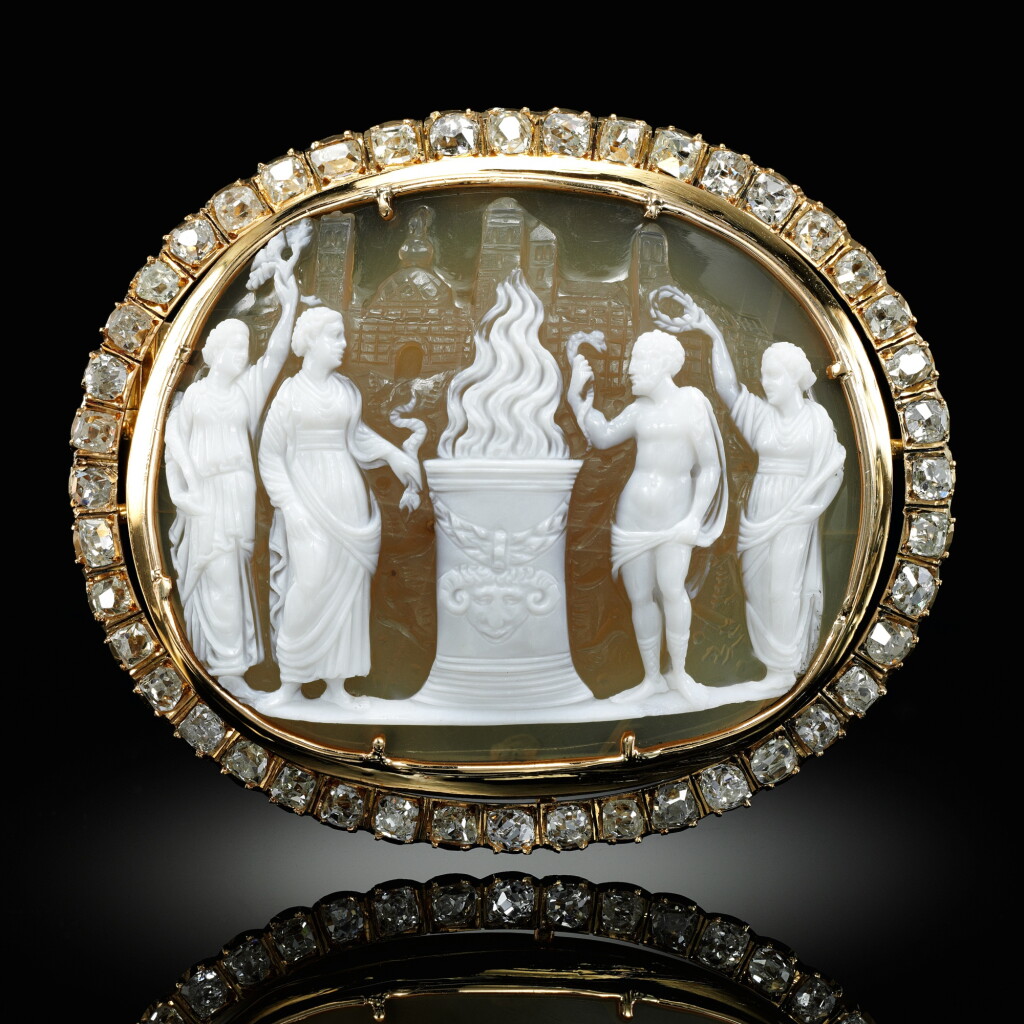
Cameo with a Sacrifice
sardonyx, within a later diamond set brooch mount
32 by 40mm., 1 1/4 by 2 9/16 in.
45 by 50mm., 1 3/4 by 2in. overall
The composition on this finely engraved cameo relates to that on a rock crystal intaglio attributed to Valerio Belli (circa 1468-1546) which was sold in these rooms on 5 December 2017, lot 74.
The composition on the rock crystal is known from a number of Renaissance medals. It appears on the reverse of a silver medal of Isabella of Portugal in the Kunsthistorisches Museum, Vienna, and on the reverse of a medal of Jacopo Sannazaro in the Musei Civici, Brescia. It is also known from medals formerly in the Sylvia Adams Collection and the Max Falk Collection. The model has been published as attributed to Valerio Belli (Donati and Casadio, op. cit., nos. 3 and 224; H. Burns, M. Collareta and D. Gasparotto, op. cit., nos. n 106.3 and 106.1).
Significantly, Valerio Belli was commissioned to make a dagger for the writer and commentator Pietro Aretino, as a gift for Federico II Gonzaga, Duke of Mantua. This dagger may be the one which is today in the Museo Bardini, Florence, and is set with a bronze roundel depicting the same model with traces of gilding inset into its pommel (inv. no. 341; Vannel, op. cit., p.150, no.182). The commission is documented in several letters between Pietro Aretino and the Federico II on September 10, October 2 and 23, 1529 (Luzio, op. cit., D'Arco, op. cit.). Valerio Belli also obtained Parmigiano's famous Self-Portrait in a Convex Mirror from Pietro Aretino. Although both the dagger commission and exchange of Parmigiano's painting likely occurred during the same period, it is not certain if these events are related. Aretino arrived in Venice as an exile from the Roman court circa March 25, 1527 and Valerio Belli moved away from Venice to Vincenza in March 10, 1530 to work on several important commissions from Rome. The attribution of the model to Belli is given added credence with a comparison to the Medallion with a Roman Sacrifice in the British Museum (Waddesdon Bequest, inv. no. WB. 86), which likewise shows a frieze of all'antica figures before a devotional altar, with a temple structure in the background.
The present cameo is one of several derived from models by Belli, whose identified surviving output is purely in the medium of intaglio. It is interesting to note that the composition appears on medals with Isabella of Portugal (wife of Charles V) and Jacopo Sannazaro (which was commissioned by Isabella d'Este, mother of Ferrante Gonzaga Duke of Mantua). The use of the model combined with medals with Habsburg and Este provenance, indicates knowledge of the rock crystal prime version and might suggest that the maker of the aforementioned medals worked in the Habsburg and Este courts. The present cameo has stylistic affinities to the cameo of Antoine Perrenot de Granvelle in the Hermitage (inv. no. К-1012), and the cameo of the same sitter attributed to Antonio Abondio from the Marlborough collection of gems (no. 85). Both portraits of Perrenot de Granvelle derive from models by the celebrated Italian Renaissance sculptor and medallist Leone Leoni, who worked for Charles V, Ferrante Gonzaga Duke of Mantua, and Antoine Perrenot de Granvelle. Significantly Pietro Aretino, from whom Belli acquired the Parmigiano, was Leoni's principal supporter in his early career, saving him from the punishment of enslavement for violent crimes. Leoni is known to have been responsible for cameo carving. His masterpiece is the double portrait of Charles V and his son Philip, with Isabella of Portugal to the reverse, which is today in the Metropolitan Museum of Art, New York (inv. no. 38.150.9), which is recorded by Leoni himself in 1550 in a letter to Granvelle in which he describes having found 'a fantastic stone' which has lead him to carve a cameo of the Emperor 'the way a sculptor used to do for Caesar and Augustus. On the reverse I represented the Empress so beloved of the Emperor.' Returning to the present cameo, it is interesting to note that the horned mask on the altar is similar to another carved on the frame of Leoni's relief of Charles V in the Prado, Madrid (inv. no. E000291). A cameo with Philip II of Spain in the V&A (inv. no. 2628-1855), London, has alternately been attributed to Jacopo da Trezzo, or Pompeo or Leone Leoni. Another in the Royal Collection has been attributed to Jacopo da Trezzo, who similarly worked in the same circles as a medallist and is principally associated with Philip of Spain. Several of Trezzo's medals have similarly been translated into cameo form, including in examples in the Cabinet des medailles, BnF, Paris and the Hermitage, St Petersburg.
The manner in which the present cameo is cut from two layers with cityscape in the translucent background layer is typical of North Italian engraving from the second half of the 16th century. Compare with the 16th-century cameo with Moses, probably Milanese, sold in these rooms on 3 December 2019, lot 48. The link with Valerio Belli is intriguing, as as the further associations with medallists and engravers working in the leading Renaissance courts notably Leone Leoni and Jacopo da Trezzo.
RELATED LITERATURE
H. Burns, M. Collareta and D. Gasparotto, Valerio Belli Vicentino (1468c-1546), Vicenza, 2000, p.318, no. 15; V.Donati and R. Casadio, Bronzi e pietre dure nelle incisioni di Valerio Belli vicentino, Ferrara, 2004, p. 180, no. 3 & no. 224; L.Alessandro, Pietro Aretino nei primi suoi anni a Venezia e la corte dei Gonzaga, 1888, p.83-84, Letters XXI & XXII; C.D'Arco, Delle arti e degli artefici di Mantova, Vol II, 1857, p.106, Letter 136; G.Toderi and F.Vannel, Medaglie e placchette del Museo Bardini di Firenze, 1998, p 150 n.182
You May Also Like


