
John La Farge
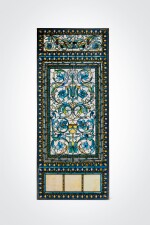
Window from the Thomas Emerson Proctor House, Boston, Massachusetts
Auction Closed
December 8, 07:38 PM GMT
Estimate
40,000 - 60,000 USD
Lot Details
Description
John La Farge
Window from the Thomas Emerson Proctor House, Boston, Massachusetts
circa 1889
leaded opalescent glass
79 x 33 x½ in. (200.7 x 83.8 x 1.3 cm)
Thomas Emerson Proctor, Boston, Massachusetts
Christie's New York, June 10, 1989, lot 234
Private Collection
Sotheby's New York, June 14, 1991, lot 393
Private Collection
Acquired from the above by the present owner
Christie's New York, June 10, 1989, lot 234
Private Collection
Sotheby's New York, June 14, 1991, lot 393
Private Collection
Acquired from the above by the present owner
This lovely blue-and-white window from the Thomas Emerson Proctor house is one of a pair of door lights. Originally designed for the house at 273 Commonwealth Avenue in Boston, the pair opened from the reception hall into the drawing room. The house was designed by Hartwell & Richardson and still stands. La Farge designed the windows shortly before he departed for a months-long journey to the South Seas. La Farge divided the composition into three vertical parts. The central, largest design is a Pompeiian arabesque with an egg-and-dart border topped by a Renaissance swag. At the bottom is a plain field of white glass divided into three by vertical jeweled bands. Separate egg-and-dart borders surround all three parts. The artist’s earlier 1882 windows for the Frederick Lothrop Ames house, a few blocks away and now in the collection of the Saint Louis Art Museum, were composed similarly, although they have realistic scenes of flowers in the center.
Thomas Proctor (1834-1894) was a prominent leather manufacturer in Boston, as well as a bank director, a trustee of Massachusetts General Hospital, president of the General Electric Security Company, and a commissioner of the 1893 World’s Fair. He spent at least $60,000 building his Commonwealth Avenue house, “one of the most desirable in the city.”
–Julie L. Sloan
Thomas Proctor (1834-1894) was a prominent leather manufacturer in Boston, as well as a bank director, a trustee of Massachusetts General Hospital, president of the General Electric Security Company, and a commissioner of the 1893 World’s Fair. He spent at least $60,000 building his Commonwealth Avenue house, “one of the most desirable in the city.”
–Julie L. Sloan
You May Also Like