
Property from a Private Northeast Collection
John La Farge
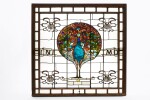
"Peacock" Transom Window from the Charles Carroll Lee House, New York, New York
Auction Closed
December 8, 07:38 PM GMT
Estimate
30,000 - 50,000 USD
Lot Details
Description
Property from a Private Northeast Collection
John La Farge
"Peacock" Transom Window from the Charles Carroll Lee House, New York, New York
1880
together with one side flanking window panel
leaded opalescent and clear glass, fused glass, oak frame
signed J. La Farge and dated Pat'd 1880
"Peacock" window: 39¾ x 41¾ in. (101 x 106 cm) excluding frame; 48½ x 50 in. (123.2 x 127 cm) including frame
side panel: 39½ x 35¾ in. (100.3 x 90.8 cm) excluding frame; 48½ x 44 in. (123.2 x 111.8 cm) including frame
Helen Parrish Lee, New York, 1893
James Parrish Lee, New York, 1925
Acquired from the above by the present owner
This set of transom windows is a rare example of John La Farge’s earliest stained glass work. It was made for the Madison Avenue home of Dr. Charles Carroll Lee (1839-1893), a physician in New York City who practiced at St. Vincent’s Hospital. He was the great-grandson of a signer of the Declaration of Independence. Lee and La Farge were friends, having attended Mount St. Mary’s College in Emmitsburg, Maryland, at the same time (La Farge was a senior when Lee was a freshman). Lee collected many of La Farge’s works. Little is known about the transoms for the Lee house, but others are thought to survive. These two works were part of a triptych, joined by a banderol spanning all three sashes that read, “ANNO DOMINI MDCCCLXXX.” (The whereabouts of the left panel, inscribed with “ANNO DOMI” in the scroll, are unknown.)
The window was commissioned and fabricated at a time when La Farge was in a legal dispute with Louis Comfort Tiffany over patent infringement (it was apparently settled out of court, since no court records of it survive). During this period, La Farge signed his windows by scratching into a piece of a glass the phrase, “J. La Farge Pat. 1880.” In this pair of windows, there are five such signatures. Other windows with similar signatures include several examples in the Newport Congregational Church, Newport, Rhode Island (1880); and a firescreen now in the collection of the Chrysler Museum of Art, Norfolk, Virginia (1880). The highly stylized peacock, a symbol widely associated with the Art Nouveau movement, is distinguished by its unusual head in which tiny glass jewels and shards were fused to a piece of white opalescent glass. La Farge would later manufacture whole windows or large parts of windows in this manner, notably the dress of the figure in Welcome (1908-1909) in the Metropolitan Museum of Art.
- Julie L. Sloan