A pair of monumental vases on columns, late 18th - early 19th century, in the manner of Jean-Louis Prieur and Jean-François Forty
Auction Closed
October 11, 05:25 PM GMT
Estimate
150,000 - 300,000 EUR
Lot Details
Description
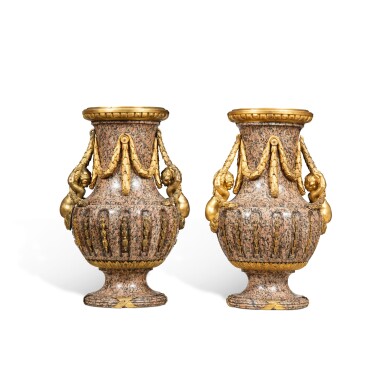
A pair of monumental vases on columns, late 18th - early 19th century, in the manner of Jean-Louis Prieur and Jean-François Forty
gilt-bronze mounted granite; each of baluster form, with gilt-bronze rim to top, putti hanging from laurel wreaths as handles, and the fluted body with gilt-bronze laurels to grooves, on circular waisted socles; on granite columnar pedestals
total height 77½in.; vases only height 37½in.; 197 cm.; 95 cm.
(4)
____________________________________________
Paire de vases monumentaux en granit et bronze doré montés sur colonnes de la fin du XVIIIe - début du XIXe siècle, à la manière de Jean-Louis Prieur et Jean-François Forty
total height 77½in.; vases only height 37½in.; 197 cm.; 95 cm.
(4)
J.-L. Gaillemin, Antiquaires. The Finest Antique Dealers in Paris, New York 2000, p.86-87.
COMPARATIVE LITERATURE
Baulez, 'Le marquis de Marigny, le comte d’Angiviller et le goût des amateurs de porphyre à Paris au XVIIIe siècle', Porphyre, la pierre pourpre des Ptolémées aux Bonaparte, exhibition catalogue, Musée du Louvre, Paris 2003, p. 152-162.
H. Ottomeyer and P. Pröschel, Vergoldete Bronzen: Die Bronzearbeiten des Spätbarock und Klassizimus, Munich 1986, Vol.I p. 173.
Verlet, P., Les bronzes dorés français du XVIIIe siècle, Paris 1987, p. 130-32.
VASE MANIA
The efflorescence of the Parisian school of gilt-bronze production in the 18th century contributed to the popularity of mounted objects and vases in precious marbles and hardstones, a trend that reached its peak during the Louis XVI period. Particularly sought after were marble specimens dating from antiquity such as Egyptian porphyry and granite, imported from Italy by prominent Parisian collectors and connoisseurs like the Marquis de Marigny, the Comte d'Angiviller and the Duc d'Aumont, who was also the head of the Menus Plaisirs du Roi, the official body responsible for Court ceremonies and festivities and an important employer of designers and architects who had a major influence on contemporary decorative arts in general.
The rarity, high cost and logistical challenges involved with procuring antique stone in Italy led the Menus Plaisirs to seek more local sources, and in 1768 suitable veins near Remiremont in the Vosges region of Eastern France were discovered. A manufacture priviligiée was established and soon opened an outlet in Paris serving as a 'magasin ou dépôt des ouvrages en roches, composées de granits, granitelles, jaspes, serpentins et porphyres'. In 1774 the architect François-Joseph Bélanger, who worked for the Menus Plaisirs and also designed mounts for vases in the Duc d'Aumont's personal collection, observed that domestically exploited porphyry and granite was of the same quality as that of Ancient Rome: '...nous avons dans nos provinces une partie des marbres que les Grecs et les Romains allaient chercher dans la Haute-Egypte et que les porphyres et les granits se trouvent chez nous dans l’Alsace […] cette matière est parfaitement de la même nature que celle dont nous avons des fragments d’antiquité' (Baulez, p.160).
Indigenous stone was actively promoted in Paris by art dealers including Jean-Baptiste Pierre Lebrun (d.1813) and the sculptor Jean-Baptiste Feuillet (d.1806). Feuillet was the buyer of several important lots in the sale of the great connoisseur-collector Randon de Boisset on 27 February 1777, including gilt-bronze mounted vases in porphyry, verde antico, and pink granite; these were likely acquired to re-sell but also may have provided models of bronze mounts for Feuillet to copy. Auction catalogues from the period indicate vases made of French-quarried marble appear to have been valued among eminent collectors by the 1780s. Lot 1 in the partial sale of the collection of the Duchesse de Mazarin, the niece of the Duc d'Aumont on 10 December 1781 following her premature death earlier that year, was a large vase 'de belle forme & d'un beau poli de Granit d'Alsace à fond rouge', and the 1797 auction collection of the financier Grimod de la Reynière (d.1793) included as lots 81 and 82 two pairs of vases in the 'belle matière' of 'Granit des Vosges imitant le granit rose oriental', the first pair with mounts in the form of children holding laurel swags.
On 23 March 1784 Lebrun and Feuillet organised an auction under the name of Du Pereux of une collection précieuse de marbres d’Alsace, tels que porphyre, granit, serpentin, etc., composée de vases de différentes formes [...] dont plusieurs montés en bronze d’or mat et d’autres prêts à être dorés, exécutés sur de beaux profils et modèles de M. Feuillet. Lots 2, 3, 4, 7, and 8 were all pairs of large gilt bronze mounted vases and pedestals in Granit Rose ranging in total height from 24 to 47 pouces - roughly 65-127 cm or 26-50 in., thus confirming vases of comparable scale to the offered lot were being produced in the 1780s. Interestingly the sale also included several lots of unmounted pink granite vases and un-gilded bronze mounts, suggesting unfinished works were in circulation in the years immediately preceding the Revolution and may have remained in workshop stocks going into the first decades of the 19th century.
AN ENDURING MODEL FOR MOUNTS
The motif of a half figure of a small boy or putto with an endearingly plump belly and raised arms holding garlands appears in a drawing for a two-branch wall light attributed to the sculptor and bronze chaser Jean-Louis Prieur (1732-1795) (private collection, sold Sotheby's Monaco, 26 November 1979, lot 598; ill. in Ottomeyer and Pröschel, op. cit., p.173). Wall lights based on this design were executed in both three- and two-light versions; examples of the latter include a pair formerly in the Goldschmidt-Rothschild collection, Berlin, and a set of four sold Sotheby's New York, 10 November 2006, lot 54.
Prieur employed similar figures of children in other designs for candelabra, wall lights and chandeliers, and this design element was taken up by other artists, such as the draughtsman and ornamental engraver Jean-François Forty (active c.1775-1790). Forty often terminated his putto figures with acanthus scrolls or bifurcated Triton tails, seen for example in a pencil drawing for a clock case now in the Metropolitan Museum (48.148(42)) or the design for a wall light appearing as plate 5 in his Cahier de Six Bras de Cheminées. Related putti mounts appear on numerous recorded examples of mounted objects, including a pair of blue Chinese porcelain vases illustrated in P. Kjellberg, Objets montés du Moyen-Âge à nos jours, Paris, 2000, p.113.
You May Also Like