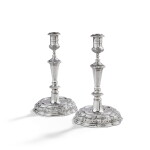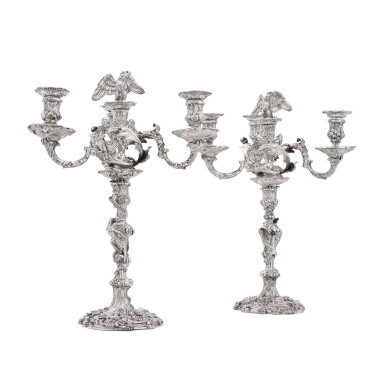
A pair of George III silver candelabra, Story & Elliott, London, 1813
Lot Closed
May 17, 11:36 AM GMT
Estimate
25,000 - 30,000 GBP
Lot Details
Description
A pair of George III silver candelabra, Story & Elliott, London, 1813
Each with four lights, the scrolling foliate branches leading to eagle sconces with removable nozzles and drip-trays, the centreal light with eagle wing and floral nozzle, the stems partly formed as an eagle with lions maskes and fluting, the bases with an ornate scroll outline and with images of crocodiles, lions and dolphins, with two eagle stoppers, William Pitts, London 1809.
53cm.; 21in. high
12,379gr.; 398oz.
The crest (a boar’s head erased) and earl’s coronet are those of Campbell for John Campbell, 4th Earl of Breadalbane and Holland, a Scottish landowner and soldier. He was born on 30 March 1762, the son of Colin Campbell of Carwhin and his wife, Elizabeth, daughter of Archibald Campbell of Stonefield. On 26 January 1782 he succeeded to the earldom of Breadalbane and Holland upon the death of his kinsman, John Campbell, 3rd Earl (1696-1782). He was married in 1793 to Mary Gavin (d. 1845), daughter of David Gavin of Langton House, Berwickshire. Lord Breadalbane was further elevated in 1831 as Earl of Ormelie and Marquess of Breadalbane. He died on 29 March 1834).
Story & Elliott
Joseph William Story (1781?-1864), a former apprentice of the smallworker Abstainando King (1764-1833), entered his first mark as a smallworker on 7 July 1803, giving his address as 4 Charterhouse Lane. His second mark was entered in partnership with William Elliott (1773-1855) on 6 October 1809 from their address, 25 Compton Street, Clerkenwell. Their partnership was dissolved in 1813.
While Story and his family eventually emigrated to Tasmania, Elliott remained at Compton Street for the remainder of his working life. During the 1820s and ‘30s he was principal manufacturing silversmith to the leading retail goldsmith and jeweller, Thomas Hamlet (1770?-1853).
You May Also Like