
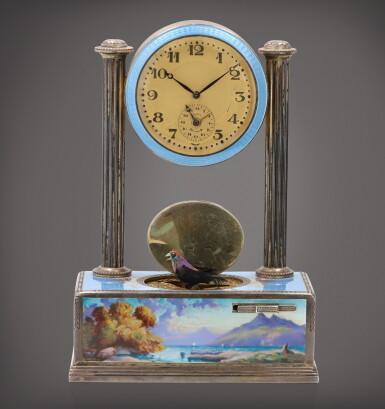
Boîte à oiseau chanteur en argent et émail, Suisse | Enamel and silver singing-bird box, Switzerland Vers 1910 | Circa 1910
Lot Closed
September 30, 10:05 AM GMT
Estimate
6,000 - 10,000 EUR
Lot Details
Description
Boîte à oiseau chanteur en argent et émail, Suisse |
Enamel and silver singing-bird box, Switzerland
Vers 1910 |
Circa 1910
Cadran doré avec chiffres Breguet et cadran subsidiaire pour le réveil à 6 heures. Glace bombée. Lunette en émail bleue guillochée. Boîtier rectangulaire en émail bleu guilloché avec motifs floraux peints et flanqués de deux colonnes cannelées en argent doré. Couvercle ovale décoré d'une vue du Temple de l'Amour de Versailles, avec des guirlandes de fleurs sur les côtés, se soulevant pour présenter l'automate à plumes trillant et battant des ailes. Les côtés offrent diverses vues du lac de Genève et des montagnes suisses.
Poiçon du fabricant CM, marque suisse et frappé : 935.
Accompagné d'une clé de remontoire
Gilt dial with Breguet numerals and subisdiary dial for the alarm at 6 o'clock. Domed glass. Bezel in blue guilloché enamel. Rectangular case in blue guilloché enamel with painted floral motifs, flanked by two silver-gilt fluted columns. Oval lid, decorated with view of the Temple de l'Amour of Versailles, with garlands of flowers to its sides, lifting to present the feathered automaton trilling and flapping its wings. The sides show various views of the Geneva lake and Swiss mountains
Maker's mark CM, Swiss mark, further struck: 935.
Comes with winding-key
Poids brut 843.80 g |
Gross weight 843.80 g
Singing birds have captured the imagination of generations of children and adults alike. The magical feeling, this little charming automaton provokes, knows no equivalent.
They are also a testimony of the Swiss mechanical genius for creating entertaining automata since the 18th century. Singing birds were a popular subject as miniaturised clockwork organs could be made to imitate birdsong whilst simutaneously providing lifelike movement through the addition of ever more complex cam mechanisms. The earliest examples incorporated painted singing birds and often brightly feathered birds gradually became the norm.
Some of the most famous names of the watchmaking history are associated with singning birds, such as Pierre Jaquet-Droz, Frères Rochat, Isaac Piguet or Philippe Meylan to name but a few.
During the 19th and beginning of the 20th century, these automata saw a larger production to meet the ever-growing demand. It was at that time that Charles-Armand Marguerat was active and created attractive pieces such as the present lot.
Charles-Armand Marguerat (1887-1931) was born at Lutry near Lausanne but set up business in Geneva around 1914. From 1915-19 he styled himself as ‘fabricant de montres’ (watchmaker), working from 9 rue de Savoie. From about 1920 until his death in 1931 he moved to Avenue de la Gare des Eux Vives 18, where he advertised the ‘Manufacture d'Oiseaux Chantant’. He is noted for rectangular boxes with a small round timepiece mounted on two pillars above the box, such as the present example.