
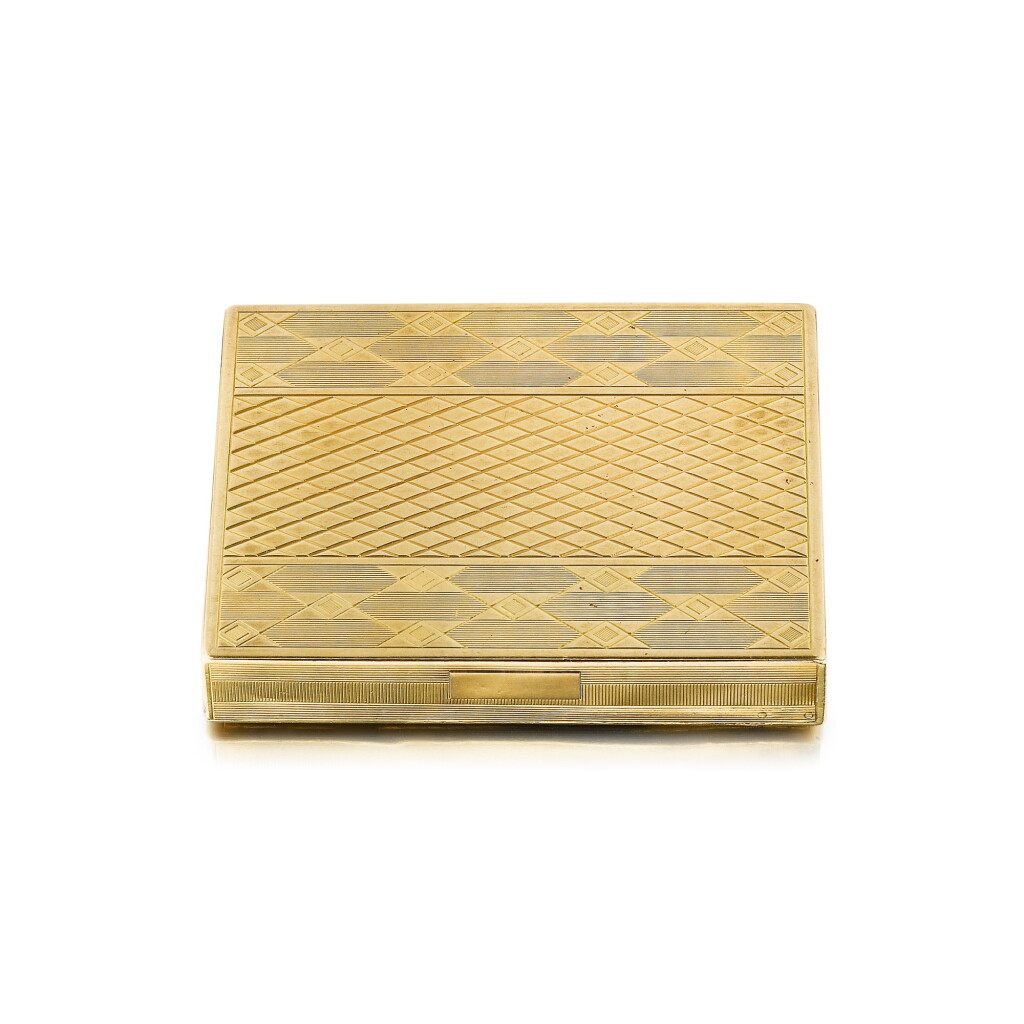
Van Cleef & Arpels | Poudrier or | Gold powder compact
Lot Closed
March 4, 02:43 PM GMT
Estimate
3,200 - 4,500 EUR
Lot Details
Description
From a Private Collection
Van Cleef & Arpels | Poudrier or
Van Cleef & Arpels | Gold powder compact
De forme rectangulaire, orné de formes géométriques, dimensions 63 x 77 x 11 mm environ, signé Van Cleef & Arpels, numéroté, poinçons français pour l'or 18K (750°/00), poinçon de maître pour Alfred Langlois, poids brut 96.43 g, vers 1930.
Of rectangular shape and geometrical design, measuring approximately 63 x 77 x 11mm, signed Van Cleef & Arpels, numbered, French assay marks for 18 carat gold, maker's mark for Alfred Langlois, grosss weight 96.43 grams; 1930s.
Van Cleef & Arpels was born at the dawning of the 20th century, through the association of Alfred Van Cleef and his brothers-in-law Charles and Julien Arpels. From their offices at 22 place Vendôme, inaugurated in 1906, they attract the attention of the wealthiest and quickly must hire to sustain their growth.
Van Cleef & Arpels build its renown through jewels of course, but also thanks to accessories such as minaudières, vanity and cigarette cases. They are the new must-have of every sophisticated lady and are ornated in magnificent details with precious stones, carvings and applied with enamel. In 1932, due to its ever-growing expansion, the jewelry house enters into an exclusive contract with a renowned jewelry-maker : Alfred Langlois. With his workshop, strong of a dozen artisans, all masters of their own crafts, he realized accessories and jewels alike with a meticulousness that attract the attention of Van Cleef & Arpels, but also Cartier, Boucheron and Lacloche Frères, for whom he produces marvels of craftsmanship, stamped with his mark (A spear L).
In 1929, Langlois invented a new setting, erasing any visible traces of metal between the stones : the serti mystérieux (mystery setting). Van Cleef & Arpels patented it in 1933 and from now on, this revolutionary jewelry-making technique became a trademark of the jewelry house.
Alfred Langlois is still recognized as one of the greatest jewelry-maker of the 20th century, sought after by connoisseurs for his sense of detail and know-how.