
Property of a Gentleman
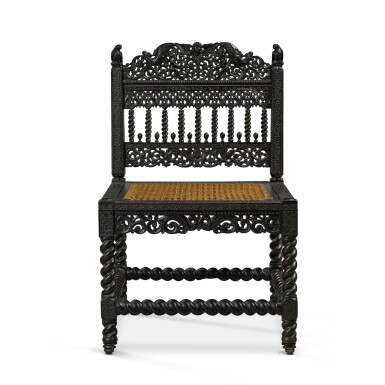
An Indo-Dutch ivory-inlaid carved ebony side chair, probably Coromandel Coast, circa 1660-80
Lot Closed
November 8, 02:13 PM GMT
Estimate
2,000 - 3,000 GBP
Lot Details
Description
An Indo-Dutch ivory-inlaid carved ebony side chair, probably Coromandel Coast, circa 1660-80
the pierced top-rail carved with nude female figures (apsara) and mythic sea beasts (makara) centred by a winged female head, the uprights with birds, their eyes inset with ivory, the backs of twisted spindles spaced by turned finials, the panelled fields of the frame carved with low relief foliate decoration, with a cane drop-in seat, on a spirally turned legs with later leather castors
The collecting of Indo-Dutch ebony furniture in England was based for a while on a misunderstanding of its historical origin. In the mid-18th century, influential collector Horace Walpole (1717-97) encountered a set of ebony chairs at Esher Place. Believing them to have once been the property of Cardinal Wolsey, who resided there after 1519, Walpole determined that the chairs must be examples of fine English Tudor furniture.1 Walpole procured several similar pieces for the decoration of his Gothic Revival House, Strawberry Hill. One of the earliest English collectors of carved ebony furniture was Thomas, 1st Viscount Weymouth (1640-1714), who acquired a magnificent suite for the ‘Best Gallery’ at Longleat house, Wiltshire. The presence of the Longleat House suite was first recorded in 1740.
The myth that this style of furniture originated in early England was perpetuated throughout the 19th century. Furniture Historian Henry Shaw would record a chair belonging to Walpole as ‘early 17th century English’ in his 1836 text Specimens of Ancient Furniture.2 In reality, carved ebony furniture of this type was produced across South Asia in the second half of the 17th century, with particular concentration along the Coromandel Coast, India. The distinct twist-turning is presumed to have originated along this coast; a synthesis of 17th century Dutch design and a form of spiral column found on Indian temples since the 1500s.3 A chair very similar to that presented here is discussed by Jan Veenendaal in his book Furniture from Indonesia, Sri Lanka and India During the Dutch Period. Veenendaal asserts that the combination of low relief scrolling designs and a pierced back containing both Hindu and Christian motifs indicate a dating of 1660-1680.4 Later pieces tended to feature bold floral designs carved in higher relief.
For other related examples see two Coromandel chairs in the collection of the V&A (ref. 413-1882 and IS.6-2000), and another pair at the Ashmolean Museum, Oxford (WA.OA180 and WA.OA181). The latter are believed to have come to England from Portugal in 1662, as part of Catherine of Braganza’s dowry.5 A similar chair from the aforementioned Longleat suite was sold by Sotheby’s London, 9 November 2021, lot 4, for 25,200 GDP.
1 Jaffer, Amin, Luxury Goods From India: the art if the Indian Cabinet-Maker, V&A publications, 2002, pp.46-47
2 Shaw, Henry, Specimens of Ancient Furniture, Pickering Publisher, 1836
3 Veenendaal, Jan, Furniture From Indonesia, Sri Lanka and India During the Dutch Period, Volkenkundig Museum Nusantara, 1985, pp.31
4 Ibid., pp.47-69
5 Penny, Nicholas, Catalogue of European Sculpture in the Ashmolean Museum, 1992, VoI. II, p.225
You May Also Like


