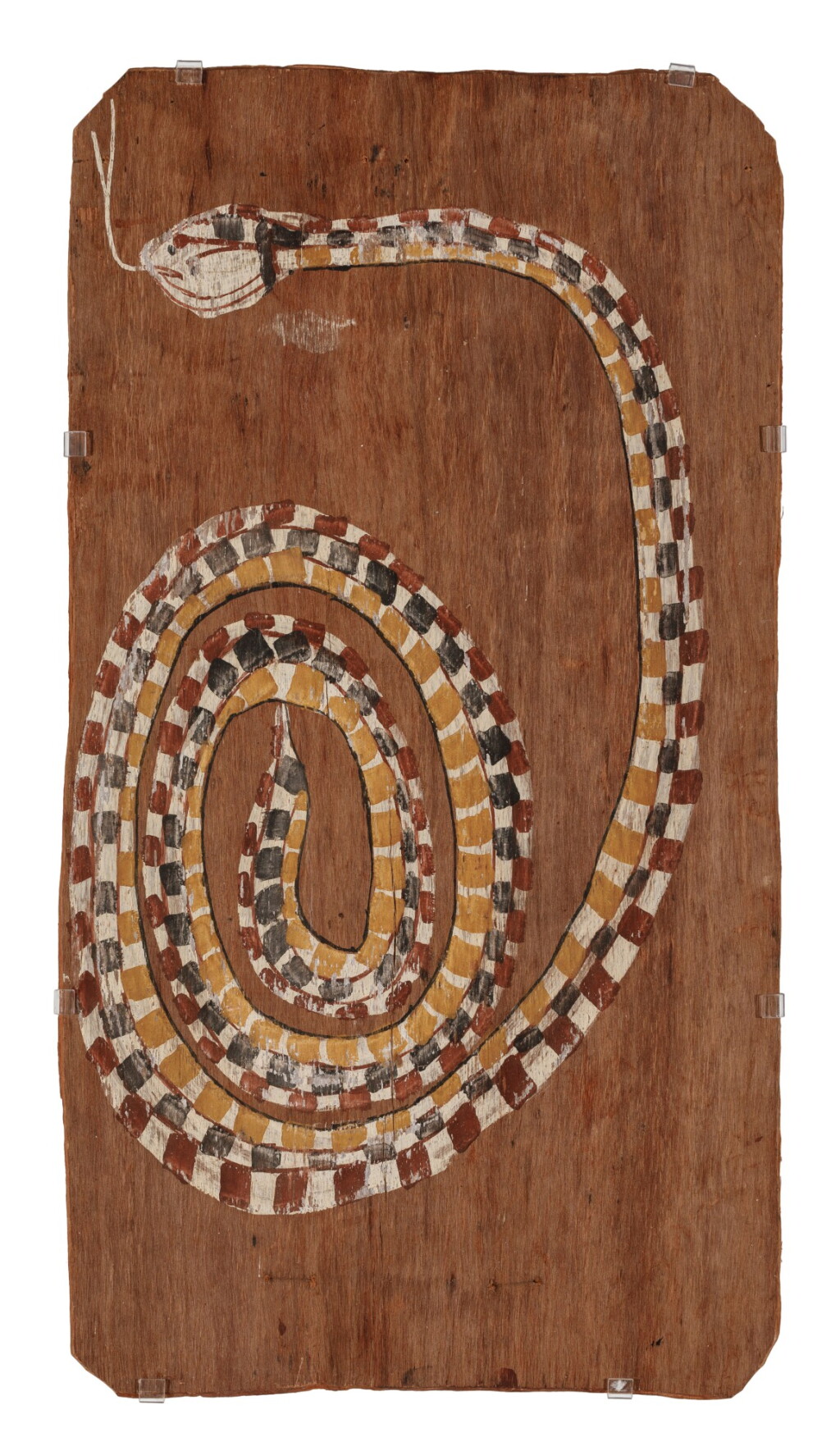
Jimmy Mijau Mijau
Nawarran, (The Rock Python), circa 1959
Auction Closed
May 25, 09:41 PM GMT
Estimate
10,000 - 15,000 USD
Lot Details
Description
Jimmy Mijau Mijau
Circa 1897-1985
Nawarran, (The Rock Python), circa 1959
Natural earth pigments on eucalyptus bark
Bears inscription 'Sugarbag' in chalk together with Spence Museum catalogue number 22 on the reverse
30 ¾ in by 16 ¼ in (78 cm by 41.5 cm)
Geoffrey W. Spence, Botanical Gardens Museum and Gallery, Darwin
George W. Gill, Lawrence, Kansas
The Spence-Gill Collection, Laramie, Wyoming
Sotheby’s, Melbourne, Important Aboriginal Art, 28 June 1999, lot 109
Fiona Brockhoff, Melbourne, acquired at the above auction
Sotheby's, London, Aboriginal Art, 21 September 2016, lot 20, consigned by the above
Private Collection, acquired at the above auction
For a closely related painting of the same subject matter in the collection of the National Gallery of Australia see, Franchesca Cubillo and Wally Caruana, eds, Aboriginal & Torres Strait Islander Art: Collection Highlights, National Gallery of Australia, Canberra, 2010, p. 116.
With regard to the National Gallery of Australia’s closely related example, Dr Luke Taylor writes: "Mijau Mijau's country comprising the Coburg Peninsula near Nimbuwa Rock abounds with rock art. He is first known as an artist who assisted the anthropologist Ronald Berndt's research about art and ceremony at 0enpelli (Gunbalanya) in 1949 to 1950. Later Mijau Mijau's paintings became famous through Karel Kupka, who worked on Croker Island in 1963. Nawarran, rock python c 1963 formed part of Kupka's personal collection [...]
The artist was a senior ceremonial leader and could paint the subjects of important ceremonies such as Wubarr, Mardayin and Kunabibi, as well as subjects that refer to the more esoteric realms of sorcery and love magic. In the early works collected by Kupka, Mijau Mijau's paintings have a rough texture akin to rock painting techniques. In this painting, Nawarran the rock python is infilled with daubs of ochre and charcoal ' which is quite unlike the very neat crosshatching of some of Mijau Mijau's later work. The painting possesses a strong graphic quality that relies less on neatness and more on contrasts in colour between infilled sections. The spiral form of the snake is a classic western Arnhem Land image, suggesting the moment of creation as the Rainbow Serpent creates a waterhole that becomes a sacred place. Similar images often show the snake coiled around its prey. Kunwinjku often say that this snake lies coiled inside the water at sacred places they call 'djang’." (ibid.)
You May Also Like