Property of a Private Collector, Bryn Mawr, Pennsylvania
Elihu Vedder
The Fable of the Miller, His Son and the Donkey: a Set of Nine Paintings
Lot Closed
May 26, 06:19 PM GMT
Estimate
80,000 - 120,000 USD
Lot Details
Description
Property of a Private Collector, Bryn Mawr, Pennsylvania
Elihu Vedder
American
1836 - 1923
The Fable of the Miller, His Son and the Donkey: a Set of Nine Paintings
the first: signed with the initial V. (center left); the second: signed with the initial V. (lower right); the third: signed with the initial V. and dated 1869 (lower right); the fourth: signed with the initial V. (center right) and signed with the initial V. and numbered 4 (upper left); the fifth: signed with the initial V. and numbered 5 (lower right); the sixth: signed with the initial V. and numbered 6 (lower left); the seventh: signed with the initial V. (lower right) and numbered 7 (lower center); the eighth and ninth: signed with the initial V. (lower right); each also inscribed Copyright 1899 by E. Vedder (lower left)
oil on panel
each panel: 7⅛ by 12 in.; 18 by 30.5 cm
framed: 14¼ by 19⅛ in.; 36.1 by 48.5 cm
Private collection, 1984
Sale: Sotheby's, New York, 3 December 1998, lot 165
Regina Soria, Elihu Vedder, American Visionary, Artist in Rome, 1836-1923, 1970, p. 235, ill.
1: The Miller and his son and the donkey, or the Man who tried to please everybody.
2: He starts to the market driving the donkey before him. Girls make fun of him for having an animal and not riding.
3: The son rides; the Miller overhears men finding fault with this disrespect for age
4: The Miller rides; mothers abuse him for making the youth walk
5: They both ride; workmen pity the donkey and advise them to carry rather than ride it
6: The complying Miller amid the jeering approval of the crowd tries to follow the advice
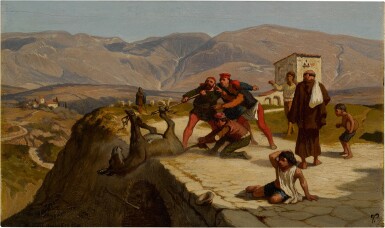
7: The donkey, struggling against the unusual treatment, breaks the pole, falls from a bridge and is killed
8: Without his donkey and with wallet still empty, the Miller returns home a poorer but wiser man
9: Moral -- in seeking to please all we please none and have our labor for our pains
You May Also Like


