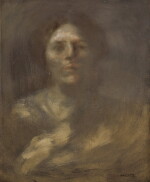
George Hendrik Breitner
Drie koffiepiksters (Three coffee pickers)
Lot Closed
July 12, 12:02 PM GMT
Estimate
12,000 - 18,000 EUR
Lot Details
Description
George Hendrik Breitner
1857 - 1923
Drie koffiepiksters (Three coffee pickers)
signed with initials GHB. (lower left)
black chalk and pastel on paper
31,4 x 44 cm; 12⅜ x 17⅜ in.
_________________________________________________________
George Hendrik Breitner
1857 - 1923
Drie koffiepiksters (Trois cueilleuses de café)
signé des initiales GHB. (en bas à gauche)
crayon noir et pastel sur papier
31,4 x 44 cm; 12⅜ x 17⅜ in.
Kunsthandel Nicolaas Beets, Amsterdam, 1931;
W.J.R. Dreesmann, Amsterdam, 1949;
Collection Professor Dr Drs Anton C.R. Dreesmann, Laren, inv. no C164, by descent from the above;
His deceased sale, Amsterdam, Christie's, The Dr Anton C.R. Dreesmann Collection, part V, 16 April 2002 (BARBARA-2542), lot 1366, when acquired by Marianne Dreesmann;
Collection Mrs Marianne L. Dreesmann-van der Spek, Laren, inv. no C007;
Thence by inheritance to the present owners.
__________________________________________________________________________
Kunsthandel Nicolaas Beets, Amsterdam, 1931 ;
W.J.R. Dreesmann, Amsterdam, 1949 ;
Collection Professeur Dr Drs Anton C.R. Dreesmann, Laren, inv. n° C164, par descendance du précédent ;
Sa vente, Amsterdam, Christie's, The Dr Anton C.R. Dreesmann Collection, part V, 16 avril 2002 (BARBARA-2542), lot 1366, acquis par Marianne Dreesmann;
Collection Mrs Marianne L. Dreesmann-van der Spek, Laren, inv. n° C007 ;
Par descendance jusqu'aux propriétaires actuels.
Adriaan Venema, G.H. Breitner, 1857-1923, Bussum, 1981, illustrated p. 160 (titled Drie dienstboden)
__________________________________________________________________________
Adriaan Venema, G.H. Breitner, 1857-1923, Bussum, 1981, reproduit p. 160 (sous le titre Drie dienstboden)
George Hendrik Breitner trained as a painter and draughtsman at the academy in The Hague. Though the Dutch painter Charles Rochussen taught the students history and landscape painting, Breitner's interests did not lie in these areas. It was not the picturesqueness of the landscape or the Dutch skies that appealed to him. With Van Gogh he roamed the working-class districts of The Hague and through the dockyards of Rotterdam. Both artists recorded the vitality of city life in their sketchbooks. Breitner consciously chose these themes and motifs: he wanted to paint people going about their daily lives, such as these coffee pickers, and on his trips through the towns and docks he was constantly in search of motifs and impressions that he could use in his paintings.
In 1886 he moved to Amsterdam where he was associated with the Dutch literary group known as the Tachtigers and he entered the Rijks-ackademies. With Isaac Israels and Willem Witsen he would become one of the most important Amsterdam Impressionists, who chose Amsterdam city life as their main subject matter. He would become 'le peintre du peuple'.
__________________________________________________________________________
George Hendrik Breitner se forme à la peinture et au dessin à l'académie de La Haye. Si le peintre néerlandais Charles Rochussen y enseigne aux étudiants la peinture d'histoire et de paysage, Breitner ne s'intéresse pas à ces domaines. Ce ne sont pas le pittoresque du paysage ou les ciels hollandais qui l'attirent. Avec van Gogh, il parcourt les quartiers ouvriers de La Haye et les chantiers navals de Rotterdam. Les deux artistes retranscrivent la vitalité de la vie urbaine dans leurs carnets de croquis. Breitner choisit consciemment ces thèmes et ces motifs : il souhaite peindre des gens qui vaquent à leurs occupations quotidiennes, comme ces cueilleuses de café, et lors de ses voyages dans les villes et sur les quais, il est constamment à la recherche de motifs et d'impressions qu'il pourrait utiliser dans ses tableaux.
En 1886, il s'installe à Amsterdam où il s'associe au groupe littéraire hollandais connu sous le nom de Tachtigers et entre à l'académie Rijks. Il devient l'un des plus importants peintres impressionnistes d'Amsterdam avec Isaac Israels et Willem Witsen et se considère comme "le peintre du peuple".
You May Also Like