Jan Brueghel the Elder and Hendrick van Balen
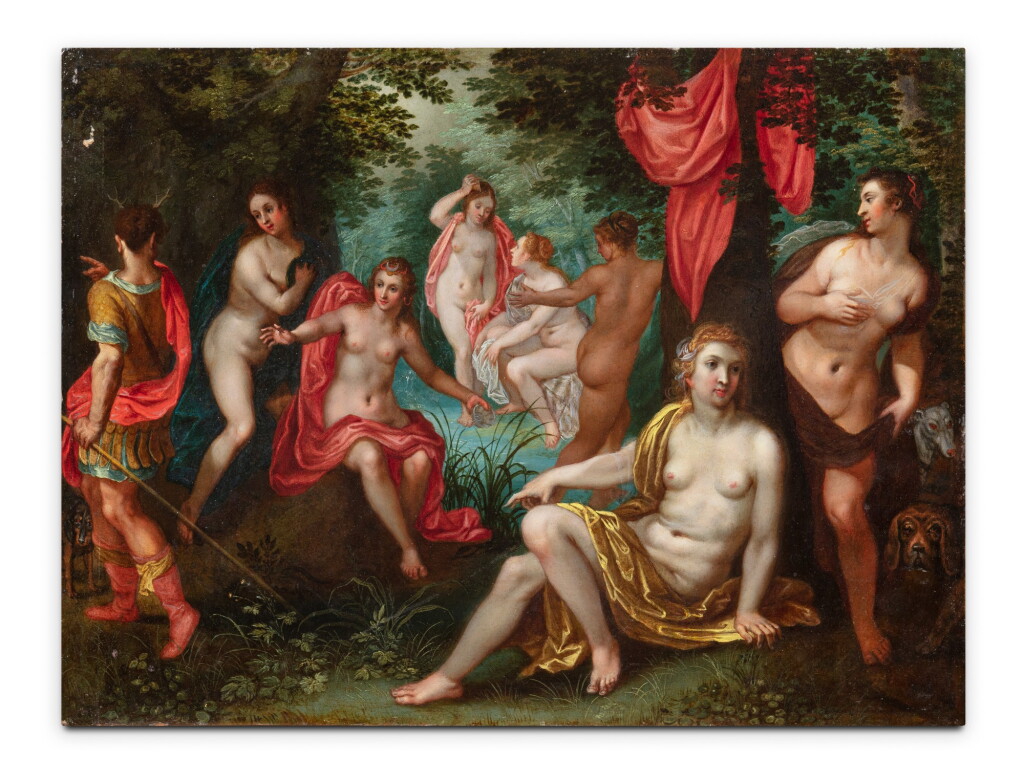
Diana and Actaeon | Diane et Actéon
Lot Closed
November 10, 02:42 PM GMT
Estimate
30,000 - 50,000 EUR
Lot Details
Description
Jan Brueghel the Elder and Hendrick van Balen
Brussels 1568 - 1625 Antwerp and Antwerp 1573 - 1632
Diana and Actaeon
Oil on copper
35,6 x 47,3 cm ; 14 by 18 ⅝ in.
____________________________________________
Jan Brueghel l'Ancien et Hendrick van Balen
Bruxelles 1568 - 1625 Anvers et Anvers 1573 - 1632
Diane et Actéon
Huile sur cuivre
35,6 x 47,3 cm ; 14 by 18 ⅝ in.
Hendrick van Balen excelled in the depiction of nudes, paying particular attention to flesh tones. Although Flemish by birth, he completed his training with a trip to Italy in about 1595-1600. When he returned to Antwerp, his home town, he opened a workshop, where his pupils included Anthony van Dyck (1599-1641) and Frans Snyders (1579-1657).
Van Balen also collaborated frequently with various Antwerp artists, such as Joos de Momper (1564-1635) and of course Jan Brueghel the Elder, as in the case of the present painting.
The hands of the two artists can easily be distinguished: Van Balen was responsible for the figures, gracefully modelling the ample forms, enhanced by the subtle play of skin tones, while the illustration of the setting was left to Brueghel the Elder. The artist often evoked idyllic landscapes, as he has done here, in shades of green, expressing the harmony between nature and the figures.
The goddess Diana, whose story is recounted by Ovid, represented a recurring theme for both artists. Here, Van Balen and Brueghel the Elder describe the scene in which Diana – in the centre surrounded by her attendants – has just been surprised at her bath by Actaeon. She still holds the cup used to exact her revenge: by throwing water onto him she has changed him into a stag. Actaeon, on the left of the composition, is already sprouting antlers on the top of his head…
There is another version of the present composition in the Staatliche Museen in Kassel (signed and dated H v. Balen / 1608, inv. GK 64; see B. Werche, Hendrick van Balen (1575-1632): ein Antwerpener Kabinettbildmaler der Rubenszeit, Turhnout, 2004, pp. 162-163 and 369, cat no. A 75, repr.). The figures and the landscape elements were widely used as models in Van Balen’s workshop, and are sometimes found in other similar compositions.
We are grateful to Dr Klaus Ertz for confirming the authenticity of the present painting: a certificate dated 22 June 2017 will be supplied to the buyer.
____________________________________________
Hendrick van Balen excelle dans la représentation des nus, dont il travaille tout particulièrement les carnations. Quoique d’origine flamande, il complète son apprentissage par un voyage en Italie vers 1595-1600. A son retour à Anvers, sa ville d’origine, il ouvre un atelier qui compte parmi ses élèves Anthony van Dyck (1599-1641) ou encore Frans Snyders (1579-1657).
Van Balen collabore également fréquemment avec différents artistes anversois, tels que Joos de Momper (1564-1635), ou bien sûr Jan Brueghel l’Ancien, comme dans le présent tableau.
Les deux mains sont parfaitement identifiables : tandis que Van Balen exécute les figures, modelant gracieusement les formes généreuses, et jouant avec de subtils effets de carnations, il laisse à Brueghel l’Ancien le soin de la représentation du paysage. Tout en nuances de verts, celui-ci évoque comme souvent un paysage idyllique, traduisant l’harmonie entre la nature et les figures.
La déesse Diane, dont l’histoire nous est relatée par Ovide, est un sujet récurrent chez les deux maîtres. Van Balen et Brueghel l’Ancien décrivent ici la scène où Diane, figurant au centre entourée de ses suivantes, vient d’être surprise par Actéon alors qu’elle prenait son bain. Elle tient encore à la main la coupelle qui a servi à lui jeter de l’eau pour se venger, et transformer Actéon en cerf. Celui-ci, à gauche de la composition, commence à voir apparaître au sommet de son crâne des bois de cerf…
Une autre version de notre composition est conservée au Staatliche Museum à Cassel (signé et daté H v. Balen / 1608, inv. GK 64 ; voir B. Werche, Hendrick van Balen (1575-1632): ein Antwerpener Kabinettbildmaler der Rubenszeit, Turhnout, 2004, pp. 162-163 et 369, cat n° A 75, repr.). Les figures et les éléments du paysage faisaient en effet l’objet de modèles diffusés dans l’atelier de Van Balen, et que l’on retrouve parfois dans des compositions similaires.
Nous remercions le Dr. Klaus Ertz d’avoir confirmé l’authenticité de notre tableau ; un certificat daté du 22 juin 2017 sera remis à l’acquéreur.
You May Also Like