
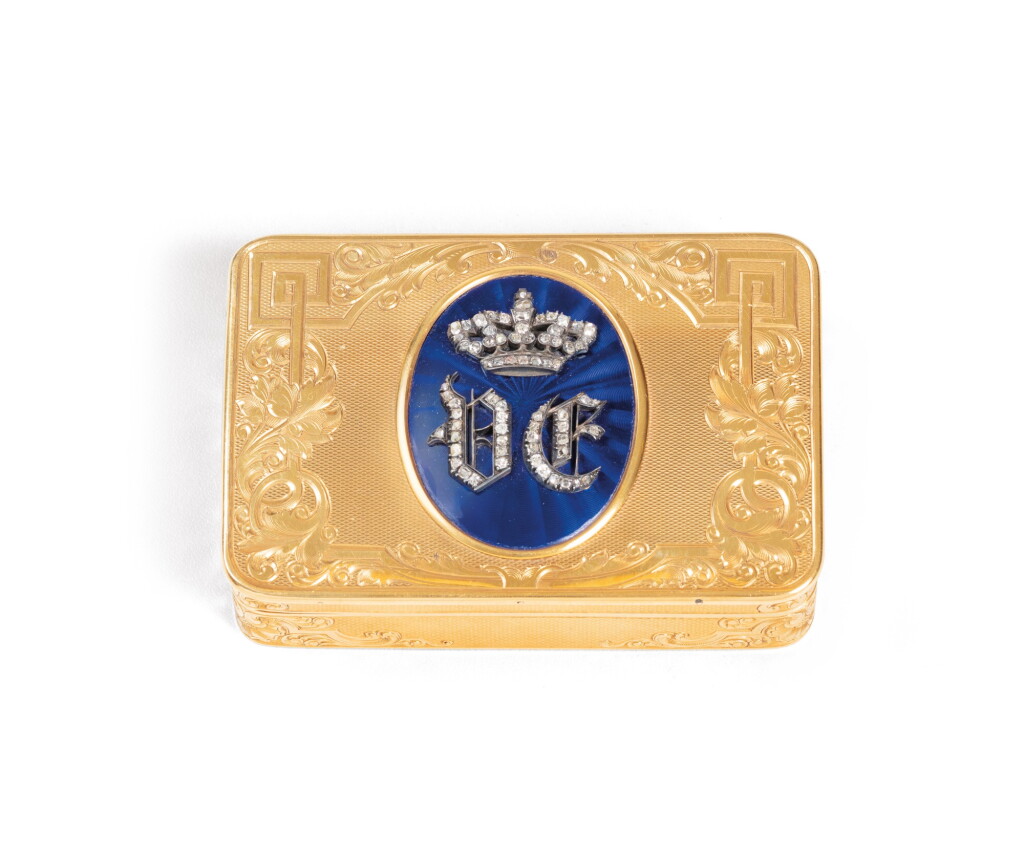
Applied with the Cipher of Vittorio-Emanuele II, King of Piedmont-Sardinia
A jewelled gold and enamel Royal presentation snuff box, apparently unmarked but probably Turin, circa 1850 | Tabatière royale de présentation en or, émail, sertie de diamants, apparemment non poinçonnée, probablement Turin, vers 1850
Lot Closed
June 1, 03:56 PM GMT
Estimate
18,000 - 22,000 EUR
Lot Details
Description
Applied with the Cipher of Vittorio-Emanuele II, King of Piedmont-Sardinia
A jewelled gold and enamel Royal presentation snuff box, apparently unmarked but probably Turin, circa 1850
rectangular, the lid inset with the crowned cipher of Vittorio-Emanuele II, King of Piedmont and Sardinia (1820-1878), in rose diamonds on an oval translucent blue enamel medallion, the ground and sides diaper engine-turned within acanthus-hung strapwork, the base engraved with the Royal coat of arms
---------------------------------------------------------------------------
Tabatière royale de présentation en or, émail, sertie de diamants, apparemment non poinçonnée, probablement Turin, vers 1850
rectangulaire, le couvercle serti du chiffre de Victor-Emmanuel II, Roi de Piémont-Sardaigne (1820-1878) en diamants de taille rose, sur un médaillon ovale émaillé bleu translucide, le fond et les côtés guillochés de motifs losangés, le bord ciselé de rinceaux et grecques, la base gravée des armoiries royales
Long. 8,4 cm, 156 g. ; 3 1/3in., 3oz 18dwt
Sotheby's London, 1 June 2006, lot 48
---------------------------------------------------------------------------
Sotheby's Londres, 1er juin 2006, lot 48
Victor-Emmanuel II was the first King of united Italy, following the unification of the country leaded by his minister, Count Cavour. Already King of Piedmont and Sardinia since 1849, he assumed the title King of Italy in 1861. He kept the ordinal number II to maintain dynastic continuity, a decision which rankled with people in the south, who felt it had been a Piedmontese takeover.
---------------------------------------------------------------------------
Born in Turin in 1820, he became King of Sardinia-Piedmont upon the abdication of his father, Charles-Albert, who had failed in his campaigns against the Austrian Empire. Following the Unification, he set out to industrialise Italy, improve foreign relations, and reduce the influence of the Church. He married in 1842 his cousin, Marie-Adelaide of Habsburg, who gave him seven children.
You May Also Like


