A Meissen group of a Sultan riding an elephant after the model by J.J. Kaendler and Peter Reinicke, 19th century | Groupe en porcelaine de Meissen représentant un sultan montant un éléphant d'après le modèle de J.J. Kaendler et Peter Reinicke, XIXeme siècle
Lot Closed
November 19, 02:45 PM GMT
Estimate
10,000 - 15,000 EUR
Lot Details
Description
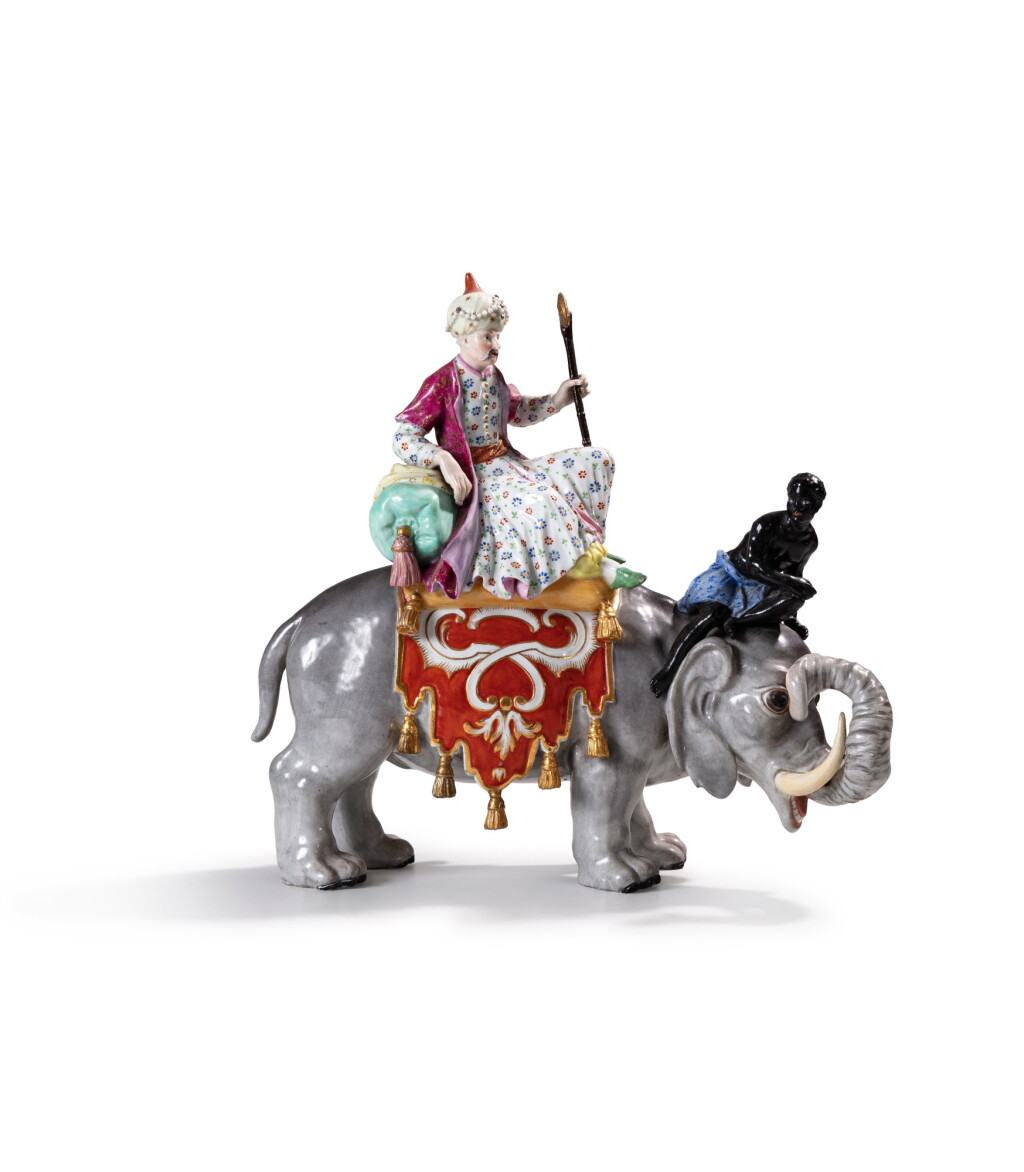
A Meissen group of a Sultan riding an elephant after the model by J.J. Kaendler and Peter Reinicke, 19th century
Groupe en porcelaine de Meissen représentant un sultan montant un éléphant d'après le modèle de J.J. Kaendler et Peter Reinicke, XIXeme siècle
composed of a grey elephant mounted by a figure of a Sultan wearing a long pink coat over a white robe, above a Moor seated on the elephant's neck
figurant un sultan vêtu d'un manteau rose et d'une robe blanche, assis sur un éléphant gris et conduit par un Maure
Height 10 1/2 in; width 4 in; prof 11 in; Haut. 26,5 cm, larg. 10 cm, prof. 28 cm
__________________________________________________________________________
The sultan and elephant group is probably a work by the sculptor Peter Reinicke (1715-1768), one of Johann Joachim Kändler's main assistants (1706-1775) at the Meissen factory. The model was designed around 1743. It was sometimes paired with a matching sultana on an elephant or another sultan on a rhinoceros.
In the subsequent years generally among Parisian production, certain artifacts were mounted onto gilt-bronze Rococo pedestals like one from the Detroit Institute of the Arts (inv. 2004.11) or one illustrated in Pierre Kjellberg, Objets Montés du Moyen Âge à nos Jours, Paris, 2000, p. 91. In January 1752 the Livre-Journal of the marchand mercier Lazare Duvaux mentions un éléphant de porcelaine de Saxe portant une figure, 261 l. (Livre Journal no. 1007 - Den Blaauwan, 1961, p. 23). Reinicke's solo elephant, adorned with the same lambrequins saddle, is often found as a clock dial support, like the pendulum clock kept at Waddesdon Manor (inv. 3154, ill. in Geoffrey de Bellaigue, The James A. de Rothschild Collection at Waddesdon Manor, 1974, p. 101), or as a potpourri holder (consult Musée Cognacq-Jay, inv. J879). Another clock with a different gilt-bronze mount is also kept at the Rijksmuseum of Amsterdam.
__________________________________________________________________________
Le groupe du sultan et de l'éléphant est probablement l’œuvre du modeleur Peter Reinicke (1715-1768), l’un des principaux assistants de Johann Joachim Kändler (1706-1775) à la manufacture de Meissen. Le modèle fut conçu vers 1743 ; il lui fut parfois adjoint en pendant une sultane sur un éléphant ou un autre sultan sur un rhinocéros.
Dans les années qui suivirent, certains exemplaires furent montés sur des socles rocaille en bronze doré, généralement de fabrication parisienne, comme celui du musée de Détroit (inv. 2004.11) ou celui illustré dans Pierre Kjellberg, Objets Montés du Moyen Âge à nos Jours, Paris, 2000, p. 91. En janvier 1752, le journal du marchand mercier Lazare Duvaux mentionne un éléphant de porcelaine de Saxe portant une figure, 261 l. (Livre Journal no. 1007 - Den Blaauwan, 1961, p. 23).
L’éléphant seul de Reinicke, orné de la même selle à lambrequins, se retrouve souvent en support de cadran, à l’instar de la pendule conservée à Waddesdon Manor (inv. 3154, ill. in Geoffrey de Bellaigue, The James A. de Rothschild Collection at Waddesdon Manor, 1974, p. 101), ou de pot-pourri (voir celui du musée Cognacq-Jay, inv. J879).
You May Also Like