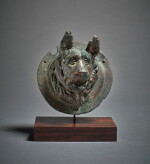
Probably German or Southern Netherlandish, 12th/ 13th century | Lion candleholder
Lot Closed
December 7, 03:12 PM GMT
Estimate
4,000 - 6,000 GBP
Lot Details
Description
Probably German or Southern Netherlandish, 12th/ 13th century
Lion candleholder
copper alloy
7 by 8cm., 2¾ by 3⅛in.
Found in Wenhaston, Suffolk, 22 January 2019 (Portable Antiquities Scheme ref. NMS-11D931);
TimeLine Auctions, London, 3 September 2019, lot 604;
private collection, Europe
TimeLine Auctions, London, 3 September 2019, lot 604;
private collection, Europe
A recent discovery, this diminutive Lion once served as the base for a candleholder, which would have been inserted into the cavity in its back. A slightly larger brass Lion candleholder which is near-identical in form, with a similar stylised tail, is housed in the Victoria and Albert Museum (inv. no. M.16-1953). While the V&A example is dated to the 15th century, the more abstract engraved pattern of the mane seen on the present Lion, as well as its finely modelled head, indicate an earlier dating, probably in the 13th century. Similar stylistic features are seen, for example, in an Italian, 12th-century Winged Tiger candlestick in the Walters Art Museum, Baltimore (inv. no. 54.231) and a German, 13th-century Dragon candleholder in the Rijksmuseum, Amsterdam (inv. no. R.B.K. 1961-68). Although it was found in England, the Lion is more likely to have been made in continental Europe, perhaps Germany or the Southern Netherlands, where the production of such metalwork flourished in the Gothic period.
RELATED LITERATURE
O. Ter Kuile, Koper & Brons, cat. Rijksmuseum, Amsterdam, 1986, p. 71, no. 93
RELATED LITERATURE
O. Ter Kuile, Koper & Brons, cat. Rijksmuseum, Amsterdam, 1986, p. 71, no. 93
You May Also Like