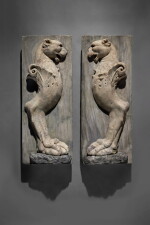
Northern French, late 13th century | Pair of Gargoyles
Lot Closed
December 7, 03:13 PM GMT
Estimate
30,000 - 50,000 GBP
Lot Details
Description
Northern French, late 13th century
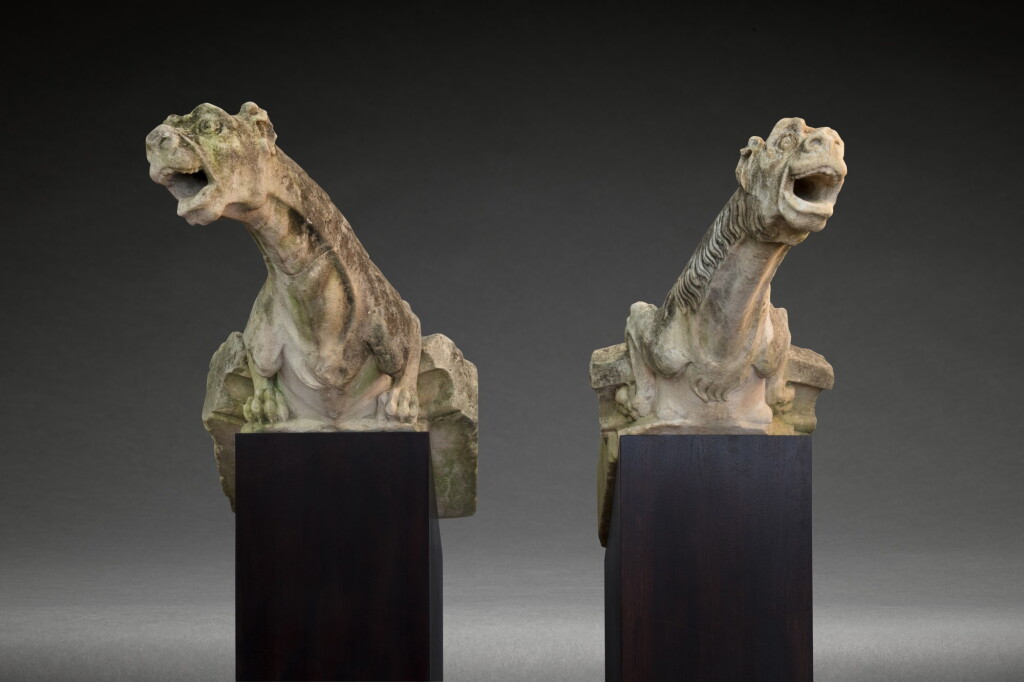
Pair of Gargoyles
stone, on wood bases
each 148cm., 58in. long
With Pierre-Richard Royer, Paris, 2003;
private collection, USA
A testament to the medieval fascination with fantastical beasts and grotesques, gargoyles are among the most intriguing and accomplished carvings of the Gothic age. Designed to divert water away from cathedral walls to prevent decay, gargoyles sometimes extended over a metre from the edge of a building, demonstrating the technical bravura of medieval stone masons. The corrosion suffered by gargoyles as a result of their function gave rise to extensive restoration campaigns among French churches in the 19th century during which medieval gargoyles and other architectural elements were removed and replaced with new carvings. The most famous of these was the restoration of Notre-Dame, Paris in the 1840s, led by Eugène Viollet-le-Duc, whose drawings of gargoyles witness the 19th-century obsession with Gothic imagery.
Representing monstrous, dragon-like animals, this magnificent pair of gargoyles is likely to have been removed from its original setting during a similar restoration campaign. The gargoyles are notable not only for their considerable size and remarkable state of preservation, but for their stylistic inventiveness and naturalism, which indicates their origin in northern France at the height of the Gothic age, in the late 13th century. Both beasts are clawing onto their architecture with feline feet, extending their long, rippled necks menacingly with wide-eyed, teeth-baring grimaces. The gargoyles' heads may be compared with a 13th-century animal head fragment of a crocket or gargoyle from Notre Dame in the Musée Carnavalet, Paris (inv. no. A.P. 180).
RELATED LITERATURE
L. Burbank Bridaham, Gargoyles, Chimères, and the Grotesque in French Gothic Sculpture, New York, 1969; J.-P. Willesme, Sculptures médiévales (XIIe siècle - début du XVIe siècle), cat. Musée Carnavalet, Paris, 1979, p. 119, no. 100