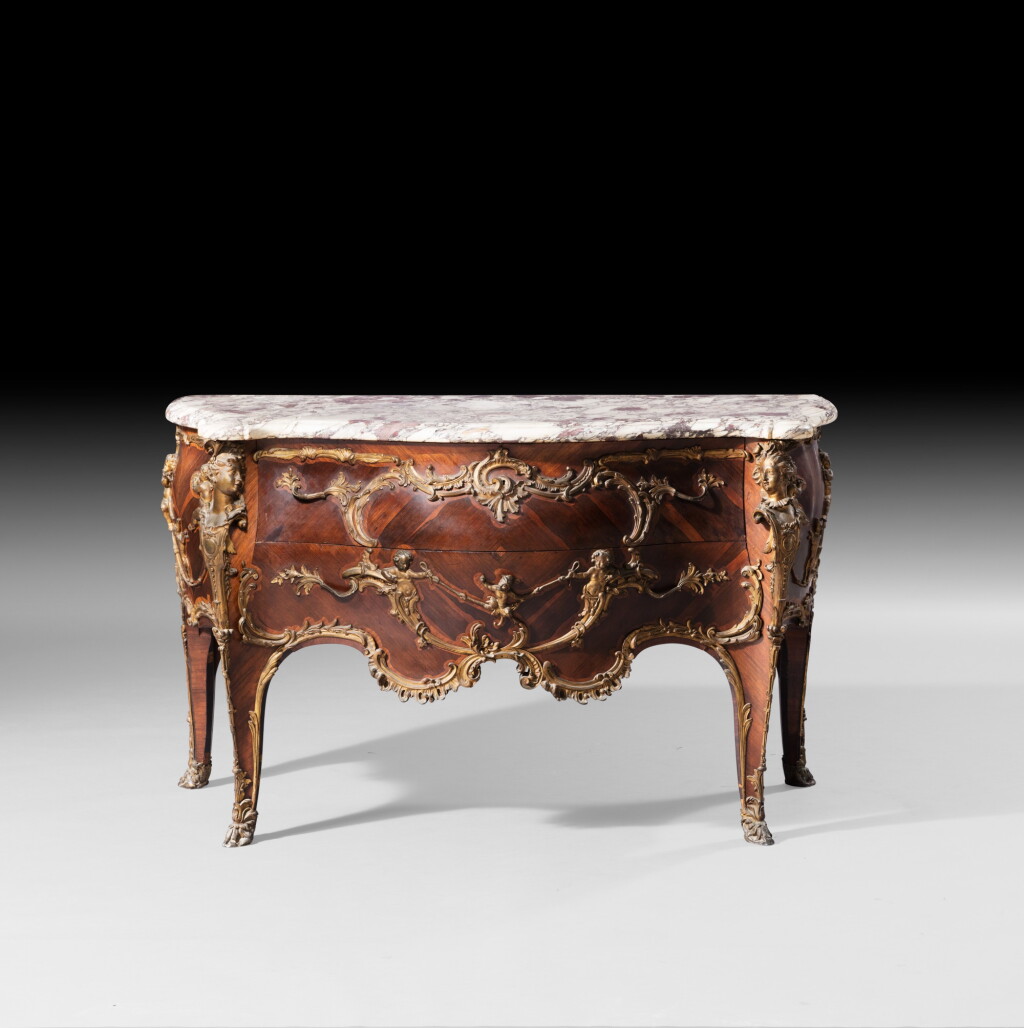
A Louis XV style giltbronze mounted tulipwood and palissander commode, late 19th century, attributed to François Linke, after a model by Charles Cressent | Commode en placage de bois de rose, palissandre et monture de bronze doré de style Louis XV, fin du XIXème siècle, attribuée à François Linke, d'après un modèle de Chales Cressent
Auction Closed
June 23, 03:45 PM GMT
Estimate
30,000 - 50,000 EUR
Lot Details
Description
A Louis XV style giltbronze mounted tulipwood and palissander commode, late 19th century, Attributed to françois linke, a louis xv style gilt-bronze, tulipwood and rosewood commode, circa 1885, after a model by charles cressent
opening with two drawers, with a brèche violette marble top (restored)
Height 38 in. width 71 in. depth 34½in. ; Haut. 97cm, larg. 160cm, prof. 88cm
____________________________________________
Commode en placage de bois de rose, palissandre et monture de bronze doré de style Louis XV, fin du XIXème siècle, Attribuée à françois linke, commode en placage de bois de rose et de palissandre et bronze doré de style louis xv, d’après un modèle de charles cressent
ouvrant à deux tiroirs sans traverse, ornementation de bronze doré : enfants et singes musiciens, crosses, chutes à buste de femme , sabots ; plateau de marbre brèche violette (restauré)
Payne, François Linke: The Belle Epoque of French Furniture, Woodbridge, 2003, p. 201, pl. 217.
P. Kjellberg, Le Meuble Français et européen du Moyen Age à nos jours, p. 490, fig. 562.
A similar commode was sold at Christie’s London, 15 April 2011, lot 158 (£ 116.500 BP included).
Kjellberg, p. 490, illustrates a commode of identical form by Krieger, but with seemingly different veneers to the present lot. In the collection of black and white photographic prints in the Linke archives, there is an identical version of this commode but no glass cliché. However, the veining of the marble top and the veneers on the present lot appear identical to the photograph in the Linke archive. In his book on Linke, Christopher Payne points out some of the numerous instances of Linke making furniture for the well established and thriving Maison Krieger, and it might be assumed that this commode was made by Linke in his early years before he signed his own work in the years post-circa 1896. This is consistent with the fact that there is no glass negative, a practice that , seemingly, Linke only started in the latter years of the 1890s. Prior to this date, his work was mainly concerned with supplying the larger concerns and there was little requirement to take photographs of his work to show private clients, the time and expense being too much for a small but growing firm. It might be assumed that Lonke later acquired the photographic print from Krieger for his records, as Linke’s business expanded after his success at the Paris Exposition Universelle of 1900.
You May Also Like