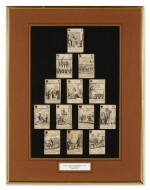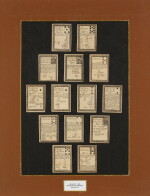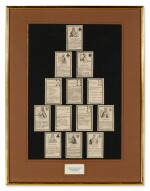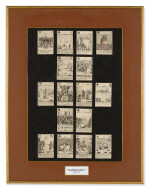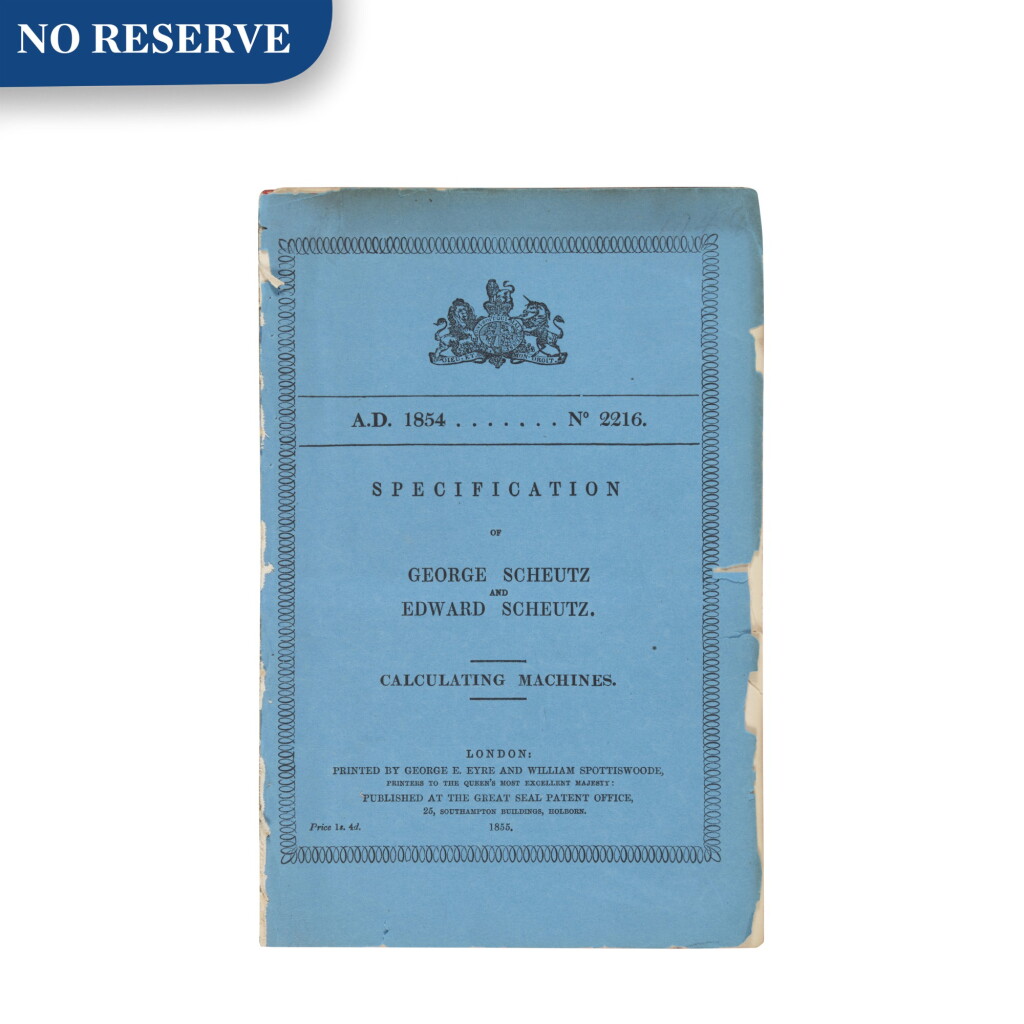
Scheutz, Per Georg & Edvard. Calculating Machines. Specifications. London: 1855
拍品已結束競投
April 28, 06:50 PM GMT
估價
20,000 - 30,000 USD
拍品資料
描述
Scheutz, Per Georg & Edvard
[Her Majesty's Patent Office]. "Specification of George Scheutz and Edward Scheutz.. Calculating Machines". Extract from: A.D. 1854. No. 2216. London: George E. Eyre and William Spottiswoode for the Great Seal Patent Office, 1855.
8vo (10 1/2 x 7 in.; 268 x 178 mm). 3 folding lithographic diagrams; tears in fore-edge margin of first two leaves, diagrams mounted on linen and slightly trimmed touching a few letters of imprint, marginal dust soiling. Original printed blue wrappers; lacking rear wrapper.
THE FIRST FULLY FUNCTIONING PRINTING CALCULATOR, A MONUMENT IN COMPUTING HISTORY.
Per Georg Scheutz (1785-1873), a Swedish publisher and inventor, having read about Babbage's Difference Engine, designed and constructed a machine to compute tabular differences and print the results. Built with a grant from the Swedish government and a group of supporters, the machine was completed in 1853 largely through the efforts of his son Edvard (1821-1888). It was patented in Great Britain in 1854, shown at the Paris Universal Exhibition in 1855 (where it won a gold medal), and was purchased by the Dudley Observatory in Albany, New York, in 1856. It is now in the National Museum for American History, Smithsonian Institution.
The present lot is the official publication of the British patent. This machine was far more complex than Babbage's design as it calculated to fifteen decimal places (instead of 5) and computed four differences (instead of 3).
Manchester Free Library (embossed armorial stamp in plates dated 1851)
LITERATURE
See U.C. Merzbach, "Georg Scheutz and the First Printing Calculator," Smithsonian Studies in History and Technology, no. 36 (1977)
相關推薦