
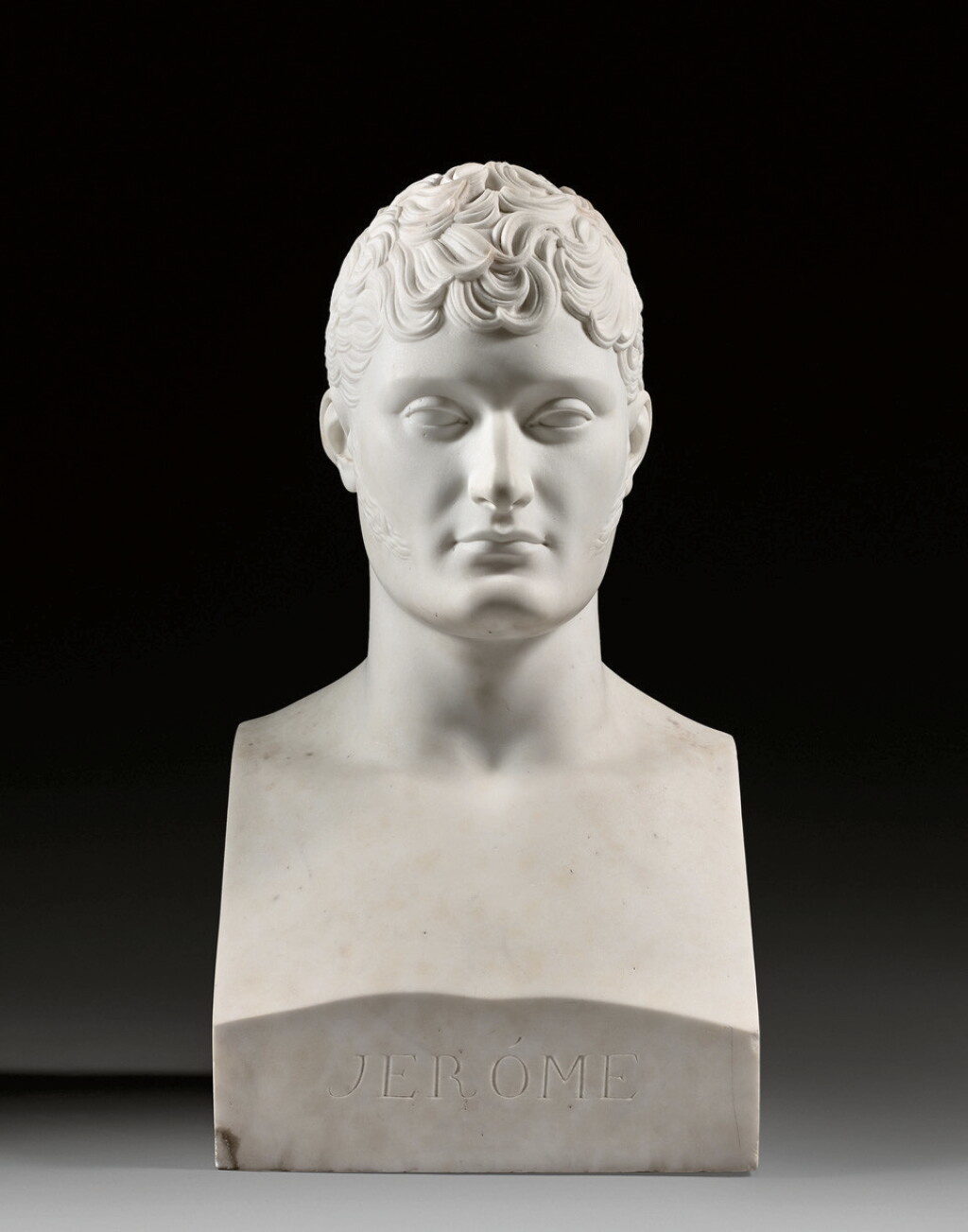
FRANÇOIS-JOSEPH BOSIO BARON | JÉRÔME BONAPARTE, KING OF WESTPHALIA (1784-1860)
Lot Closed
June 30, 04:25 PM GMT
Estimate
5,000 - 7,000 EUR
Lot Details
Description
FRANÇOIS-JOSEPH BOSIO BARON
1768 - 1845
JÉRÔME BONAPARTE, KING OF WESTPHALIA (1784-1860)
herm marble bust
entitled JERÓME
H. 54,6 cm, 21½ in.
__________________________________________________________________
FRANÇOIS-JOSEPH BOSIO BARON
1768 - 1845
JÉRÔME BONAPARTE, ROI DE WESTPHALIE DE 1807 À 1813 (1784-1860)
buste en marbre en forme d'hermès
intitulé JERÓME
H. 54,6 cm, 21½ in.
Due to the various measures taken to deal with the Covid-19 epidemic, property collection and shipment of this lot will be delayed until the offices where it is located are able to reopen. Please refer to the “auction details” tab. Thank you for your understanding
Please contact FRpostsaleservices@sothebys.com for any shipping inquiries.
[En raison des circonstances actuelles liées au COVID-19, la livraison de ce lot ne pourra intervenir qu’après la réouverture des locaux de Sotheby’s dans lesquels il se trouve. Nous vous remercions de votre compréhension et nous vous invitons à consulter l’onglet « auction details ».
Pour toute
demande concernant le transport, veuillez contacter FRpostsaleservices@sothebys.com.]
Related Literature
F. Masson, Napoléon et sa famille, Paris, 1911, vol. VI, pp. 18.
S. Lami, Dictionnaire des sculpteurs de l'Ecole française au dix-neuvième siècle, Paris, 1914, vol. 5, pp. 153 .
__________________________________________________________________
Références bibliographiques
F. Masson, Napoléon et sa famille, Paris, 1911, vol. VI, pp. 18.
S. Lami, Dictionnaire des sculpteurs de l'Ecole française au dix-neuvième siècle, Paris, 1914, vol. 5, pp. 153.
After the Treaty of Tilsit between Napoleon and Alexander I of Russia, signed in 1807, the kingdom of Westphalia was established right at the heart of the old Germanic Holy Roman Empire. Napoleon granted the rulership of this new state to his youngest brother Jérôme (1784-1860), who had just married Catherine, daughter of the king of Württemberg. While staying in Paris in 1810, the King of Westphalia commissioned portrait busts of himself and his wife from François-Joseph Bosio (1768-1845). The sculptor presented the two busts at the Salon of the same year (nos. 907 and 908).
The present herm bust in Carrara marble shows the King all’antica, his hair styled in the fashion of the time: curled and with sideburns. Jérôme Bonaparte was pleased with the bust, and had it distributed throughout his kingdom, placing an order with the bank set up by Elisa Bacciocchi, Grand Duchess of Tuscany, who was in charge of the Carrara marble quarries.
There are several marble examples of this model in prestigious collections, including the British Royal collections at Clarence House (inv. no. RCIN 2026, the Metropolitan Museum of Art, New York (inv. no. 1971.113), and the Château de Fontainebleau (inv. no. N41).
__________________________________________________________________
Suite aux traités de Tilsit signés en 1807 entre Napoléon et Alexandre Ier de Russie, le royaume de Westphalie est fondé en plein cœur de l’ancien Saint-Empire romain germanique. Napoléon place à la tête de ce nouvel état son plus jeune frère, Jérôme (1784-1860) qui vient d’épouser Catherine, fille du roi de Württemberg. Lors d’un séjour à Paris en 1810, le roi de Westphalie se fait portraiturer ainsi que son épouse par François-Joseph Bosio (1768-1845). Les deux bustes seront présentés par le sculpteur au Salon de la même année (n°907 et 908). Notre buste en hermès en marbre de Carrare présente le roi dans le style antique, portant la coiffure à la mode de l'époque : cheveux bouclés et favoris. Satisfait de ce buste, Jérôme Bonaparte le fit diffuser dans son royaume en passant commande auprès de la Banque d'Elisa Bacciocchi, Grande Duchesse de Toscane en charge des carrières de Carrare.
Plusieurs exemplaires en marbre de ce modèle sont présents dans des collections prestigieuses, dont les collections Royales britanniques à Clarence House (inv. n° RCIN 2026), ainsi qu’au Metropolitan Museum de New York (inv. n° 1971.113), ou encore au Château de Fontainebleau (inv. n° N41).